
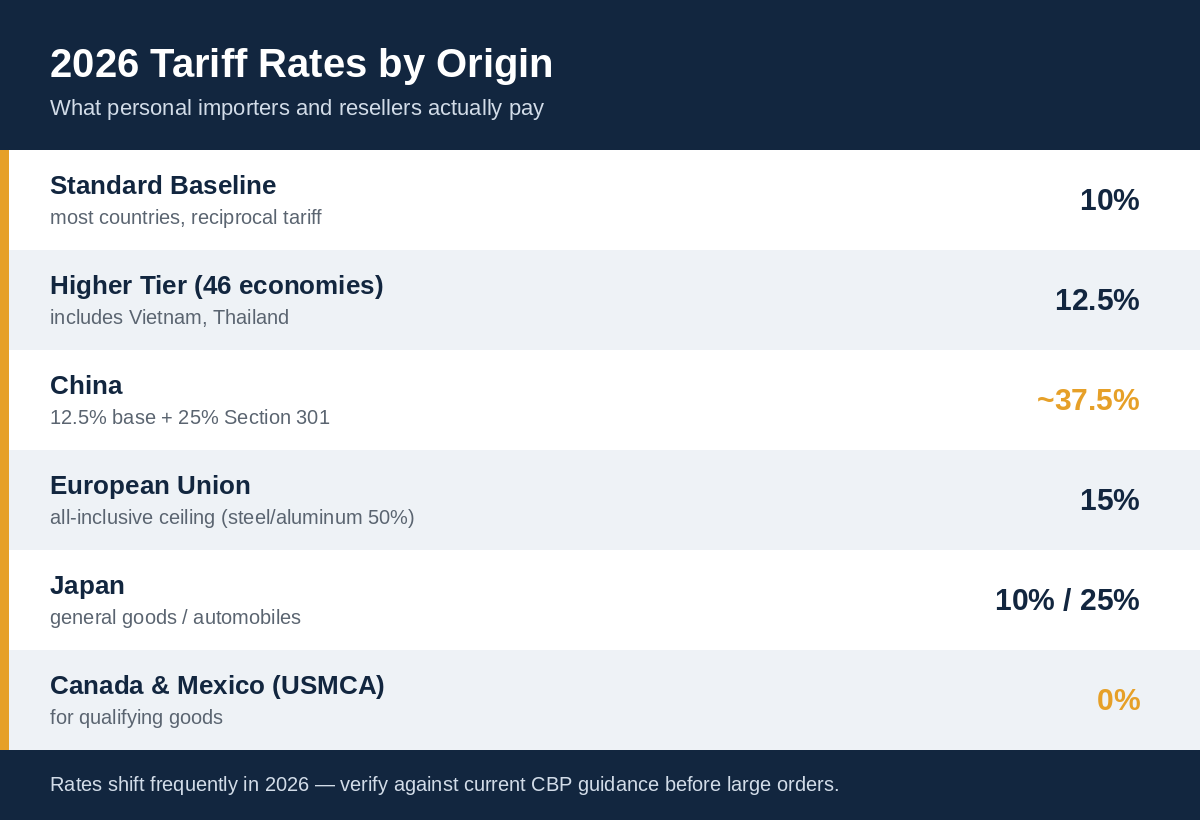
Short answer: 2026 tariff rates now apply to nearly every personal package, not just commercial freight — most countries sit on a 10% baseline reciprocal tariff, but China-origin goods carry a much higher effective rate of roughly 37.5%, and the European Union sits at a 15% all-inclusive ceiling under its current trade deal.
Combined with the suspension of the U.S. de minimis exemption, this means the “no charges under $800” rule most shoppers grew up with simply no longer applies.
This guide breaks down how current 2026 tariff rates actually work, what rate applies to your specific country of origin, and what it means in practice if you regularly buy from overseas sellers or resell imported goods.
The 2026 Baseline: A 10% Reciprocal Tariff
Most imports into the U.S. now carry a flat 10% base reciprocal tariff, regardless of the product category. A second tier at 12.5% applies to a group of roughly 46 economies, including Vietnam and Thailand, that were moved onto a higher schedule earlier in 2026. Unlike the old system where tariffs mostly applied to specific product categories that a business would need to classify, this baseline applies broadly, which is why individual buyers are feeling it on ordinary purchases for the first time.
Why China-Origin Goods Cost So Much More
China carries by far the highest effective rate among major trading partners: roughly 37.5% on most goods, combining the 12.5% base tier with an additional 25% Section 301 tariff layered on top. Certain categories go much higher still — electric vehicles face a 115% rate and solar panels 62.5% — though those are unlikely to affect typical personal import purchases. For anyone regularly ordering from Chinese marketplaces, this 37.5% baseline is the number to budget against, not the 10% rate that applies to most other countries.
The EU, Japan, and North America
The European Union operates under a separate trade arrangement that caps most tariffs at a 15% all-inclusive ceiling, though steel and aluminum remain at a much higher 50% under a standing Section 232 surcharge. Japan sits at a 10% baseline for general goods, with a 25% surcharge specifically on automobiles. Canada and Mexico are the exception that still works in shoppers’ favor: goods that qualify under USMCA rules of origin continue to enter at 0%, though anything that doesn’t qualify falls back to the 10% base reciprocal rate.
How Tariffs Interact With De Minimis Rules
2026 tariff rates and de minimis thresholds are two separate mechanisms that now compound each other for U.S.-bound personal imports. Because the U.S. suspended its $800 de minimis exemption in 2025, nearly every package owes duty on top of these tariff rates, whereas previously a package under $800 would have avoided both. If you’re importing into a country that still has a working de minimis threshold — Canada, the UK, the EU, Australia, or Japan — a low-value package can still avoid these charges entirely, which is one more reason the origin and destination combination matters more than ever.
Quick Reference: 2026 Tariff Rates by Origin
Standard baseline (most countries) — 10%. Higher tier (46 economies including Vietnam, Thailand) — 12.5%. China — roughly 37.5% effective on most goods. European Union — 15% all-inclusive ceiling (steel/aluminum at 50%). Japan — 10% general, 25% on automobiles. Canada/Mexico (USMCA-qualifying) — 0%.
What This Means for Personal Importers and Resellers
If you’re sourcing inventory to resell, the origin country now matters as much as the purchase price — a $20 item from a Chinese supplier effectively costs about $27.50 before shipping once the 37.5% tariff is applied, while the same item from a USMCA-qualifying Mexican supplier costs the sticker price. Building tariff math into your sourcing decisions, rather than treating it as an afterthought at checkout, is what separates accurate margin calculations from unpleasant surprises.
These rates are also genuinely unstable compared to the tariff schedules of a few years ago — several of the current tiers have shifted mid-year in 2026 already, so treat any specific percentage as a starting point to verify against current U.S. Customs and Border Protection tariff guidance rather than a fixed number.
Bottom Line
Current 2026 tariff rates add a 10% to 37.5% cost layer on top of whatever de minimis and duty rules already apply, and where your goods originate now has a bigger effect on landed cost than at almost any point in recent memory. China-origin goods carry by far the steepest rate, the EU and Japan sit in the middle, and USMCA-qualifying Canadian and Mexican goods remain the exception. Check the current rate for your specific origin country before placing a large order, since these numbers have already moved more than once this year.
Related Reading
- Duty-Free Limits by Country: The Essential 2026 Personal Import Guide
- Customs Duty on a Personal Package From China: What You’ll Actually Pay
- Landed Cost Calculator: A Step-by-Step Walkthrough for Export Pricing

About the Author: TradeMentorHQ Team
The TradeMentorHQ team researches and writes practical, plain-language guides on Incoterms, customs clearance, trade finance, and shipping logistics for small business owners, first-time importers/exporters, and side-hustle sellers. Our articles are grounded in publicly available regulations and guidance from bodies like U.S. Customs and Border Protection (CBP), the International Chamber of Commerce (Incoterms 2020), and established industry practice, and we link to primary sources wherever a number or rule could change. We are not customs brokers, freight forwarders, or licensed trade attorneys, and nothing here is a substitute for advice from one on your specific shipment.