Short answer: a sourcing agent is worth hiring once you’re placing repeat orders, need factory-side quality control you can’t do yourself, or keep running into suppliers who won’t respond to a first-time buyer — for a single small trial order, going direct through a platform like Alibaba is usually simpler and cheaper.
A sourcing agent is a person or small firm based near your suppliers — most commonly in China — who finds factories, negotiates price and terms on your behalf, inspects goods before they ship, and handles the local logistics of getting your order to a freight forwarder. The value isn’t just translation; it’s someone with local relationships and market knowledge catching problems before they become an expensive shipment of unsellable inventory.
This guide covers what a sourcing agent actually does, typical fees, how to vet one before paying anything, and the red flags that separate a legitimate agent from a scam.
What a Sourcing Agent Actually Does
A sourcing agent finds and vets factories that can make your product, negotiates unit price and minimum order quantity on your behalf, arranges and often attends a quality inspection before your goods ship, and coordinates the local logistics of getting your order from the factory to a port or a freight forwarder. Some agents also handle sample requests, translate technical specifications, and follow up on production timelines so a delay gets caught and communicated instead of discovered when your shipment doesn’t arrive on schedule.
How Much Does a Sourcing Agent Cost?
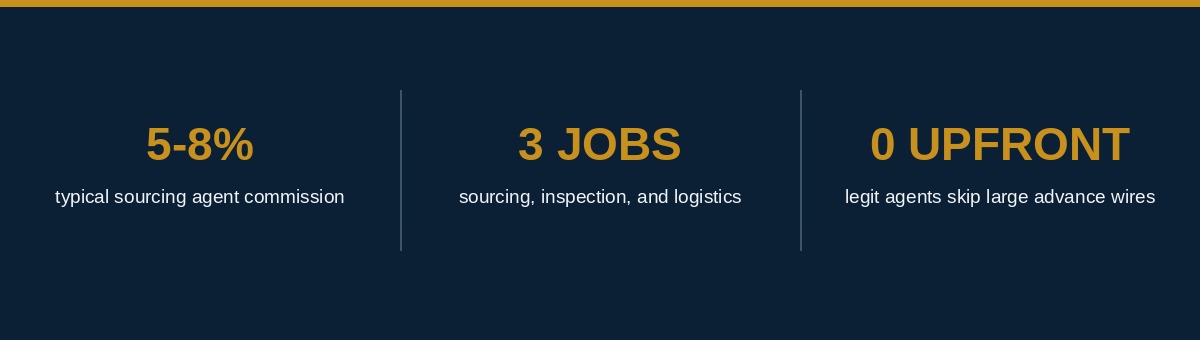
Most sourcing agents charge a commission of roughly 5% to 8% of your order value, though the exact rate varies by agent, order size, and how much hands-on work the order requires — larger orders often negotiate toward the lower end of that range. Some agents instead charge a flat fee per order or build their margin into a per-unit markup rather than a percentage commission, so it’s worth asking upfront exactly how an agent’s fee is structured before comparing quotes between agents.
A commission-based agent has an incentive aligned with getting you a fair unit price, since their fee scales with the order — a flat per-unit markup can sometimes create the opposite incentive, so understanding the fee model matters as much as the number itself.
When Hiring a Sourcing Agent Makes Sense
A sourcing agent earns their fee fastest on repeat or growing orders, where the relationships and quality control they maintain compound in value over time, and on products where quality control genuinely requires an in-person factory inspection you can’t reasonably do yourself.
They’re also useful if you’ve tried sourcing directly and kept running into suppliers who don’t respond seriously to a small, first-time foreign buyer — a local agent with existing factory relationships can often get faster, more serious responses than a cold outreach from overseas.
When You Probably Don’t Need One
For a single, small trial order on a well-documented platform like Alibaba, with a supplier that has verified reviews and trade assurance, a sourcing agent’s fee often isn’t worth it — you can place the order directly, use the platform’s built-in buyer protection, and save the commission while you learn what working with that product category actually involves. Save the sourcing agent decision for once you have a real order pattern to justify it, not your very first purchase.
How to Vet a Sourcing Agent Before Paying Anything
Ask for references from other clients who’ve used the agent for a similar product category, and actually contact them rather than taking a screenshot testimonial at face value. Confirm in writing how the fee is structured, when it’s due, and what happens if an order falls through partway.
A legitimate agent will not ask you to wire a large upfront sum before any work has started, and will be transparent about which factory they’re sourcing from rather than keeping the supplier relationship deliberately opaque — an agent who won’t tell you which factory is making your product is an agent you can’t independently verify.
Red Flags That Signal a Scam
Be cautious of an agent who pressures a fast upfront wire transfer before any sourcing work has visibly started, refuses to share factory details or arrange a video call with the supplier, or offers a commission rate far below the 5% to 8% norm — an unusually cheap agent sometimes makes up the difference with an undisclosed markup baked into your unit price instead. For more on avoiding import scams, see the International Trade Administration‘s resources for U.S. importers.
Paying through a platform or payment method with buyer protection, rather than a direct wire to a personal account, gives you recourse if the arrangement turns out not to be legitimate.
Bottom Line
A sourcing agent isn’t a requirement for buying from Chinese manufacturers, but it becomes genuinely valuable once your order volume, product complexity, or need for in-person quality control outgrows what you can manage remotely on your own. Vet an agent the same way you’d vet a supplier — references, transparency, and a clear fee structure — before committing to a relationship your future orders will depend on.
A detail worth checking before you pay anyone a deposit: legitimate sourcing agents working the Yiwu and Guangzhou markets typically charge a commission of 3–10% of the order value, not a flat “consulting fee” unrelated to order size — if someone quotes a flat $500–$1,000 fee regardless of what you’re ordering, that’s often a sign they’re not actually negotiating price on your behalf.
A good agent will share the factory’s business license (营业执照) and let you cross-check the registered company name against whatever name appears on your Alibaba Trade Assurance order. If those two names don’t match, you’re likely dealing with a trading company posing as a factory contact, which quietly erases most of the savings you hired an agent to capture in the first place.
Related Reading
Alibaba for Beginners: How to Buy Wholesale Without Getting Scammed
How to Calculate Landed Cost and Avoid Losing Money on Imports: The Complete 2026 Guide

About the Author: TradeMentorHQ Team
The TradeMentorHQ team researches and writes practical, plain-language guides on Incoterms, customs clearance, trade finance, and shipping logistics for small business owners, first-time importers/exporters, and side-hustle sellers. Our articles are grounded in publicly available regulations and guidance from bodies like U.S. Customs and Border Protection (CBP), the International Chamber of Commerce (Incoterms 2020), and established industry practice, and we link to primary sources wherever a number or rule could change. We are not customs brokers, freight forwarders, or licensed trade attorneys, and nothing here is a substitute for advice from one on your specific shipment.