
For the official rules, see the U.S. Department of Commerce rules of origin overview, and our related guide on trade compliance basics.
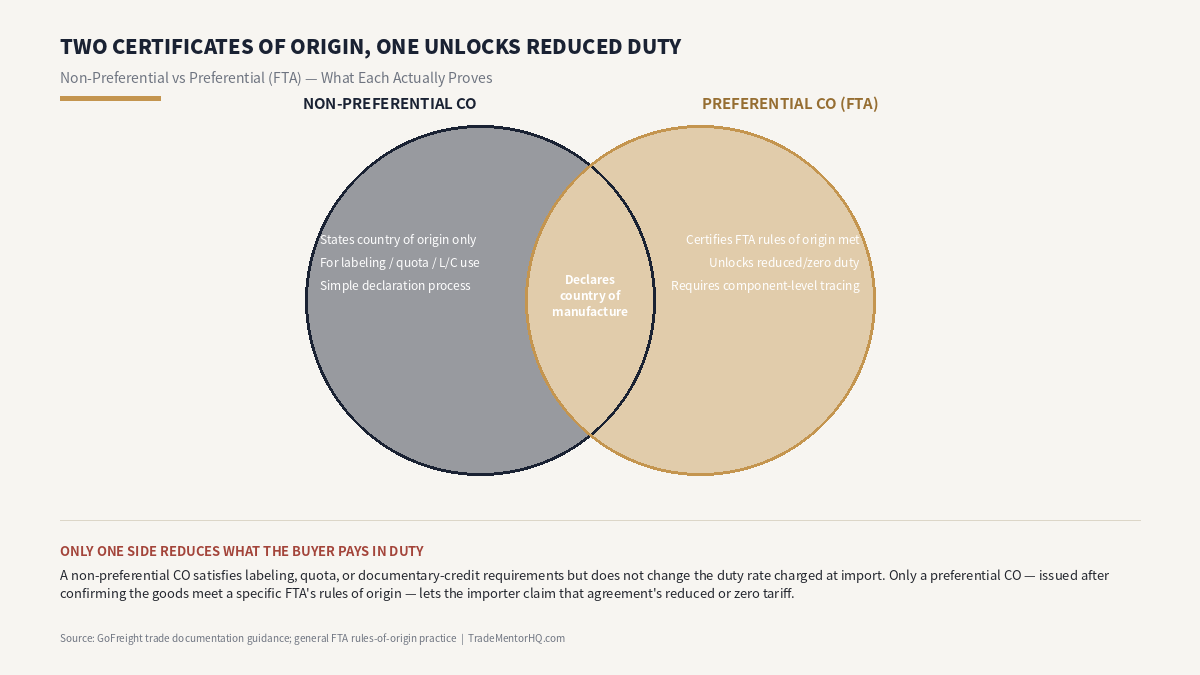
Certificate of origin preferential status is what actually unlocks a reduced or zero tariff rate under a free trade agreement — without it, customs treats the exact same shipment as fully dutiable.
An exporter fills out a “Certificate of Origin” form, gets it stamped by a chamber of commerce, and assumes the job is done — until the buyer’s customs broker rejects it because it doesn’t unlock the preferential duty rate the buyer was counting on. The document was real; it was just the wrong kind. A non-preferential certificate of origin simply states where goods were made, for statistical, labeling, or general customs purposes; a preferential certificate of origin certifies that goods meet a specific free trade agreement’s rules of origin, and only the preferential version can actually reduce or eliminate import duty.
Non-Preferential Certificates of Origin: Just a Statement of Fact
A non-preferential certificate of origin (often called an “ordinary” CO) does one job: it formally states which country goods originated in. It’s typically issued by a chamber of commerce or similar authorized body based on the exporter’s declaration and supporting documents, and it’s used for purposes that have nothing to do with duty reduction — satisfying country-of-origin labeling requirements, complying with import licensing or quota rules, meeting a letter of credit’s documentary requirements, or providing statistical data customs authorities collect regardless of trade agreements. Getting one is comparatively simple: the exporter declares the origin, provides commercial documentation to support it, and the issuing body verifies and stamps it.
No FTA rules of origin, no preferential tariff treatment attaches to this document by itself.
Preferential Certificates of Origin: The Key to Reduced Duty
A preferential certificate of origin certifies that goods qualify for reduced or zero duty under a specific free trade agreement — USMCA, an EU FTA, ASEAN agreements, and so on — because they meet that agreement’s particular rules of origin. Those rules are considerably more demanding than a simple “made in” declaration: they typically require the product to be “wholly obtained” in the exporting country, or to have undergone sufficient processing/transformation there (commonly measured by a tariff classification change, a regional value content percentage, or a specific process requirement written into the agreement).
Qualifying usually means tracing and documenting the origin of individual components and calculating whether the finished product meets the applicable threshold — meaningfully more work than a non-preferential declaration, but the payoff is that the importer can claim the FTA’s reduced tariff rate, sometimes the difference between paying a double-digit duty rate and paying nothing.
Why the Difference Trips Up Exporters
The confusion usually happens because both documents can look similar on the surface — a stamped form declaring a country of origin — and exporters who’ve only ever needed the non-preferential version for labeling or L/C purposes don’t realize a buyer’s request for “a certificate of origin” this time means the FTA-specific one.
Applying for the wrong type wastes time (a non-preferential CO won’t satisfy a customs broker asking for FTA qualification, and a full rules-of-origin analysis is unnecessary busywork if the buyer just needed a labeling document), and worse, an exporter who fills out a preferential CO without actually verifying the rules-of-origin threshold is met risks a customs audit later finding the goods didn’t qualify — exposing the importer to back duties, penalties, and interest, and damaging the exporter’s credibility with that buyer.
A Concrete Illustration
A furniture exporter ships a shipment to a buyer in a country with which their government has a free trade agreement. The buyer’s customs broker asks for “a certificate of origin” to support the import declaration. If the exporter sends a standard chamber-of-commerce non-preferential CO, customs will accept it as proof of origin for general purposes but won’t apply the FTA’s reduced tariff rate — the buyer pays full duty.
Only if the exporter first confirms the furniture meets the FTA’s specific rules of origin (say, a regional value content threshold based on where the wood, hardware, and labor came from) and then obtains the FTA-specific preferential certificate does the buyer actually get the reduced rate. The two documents can cost the buyer real money depending on which one shows up.
The Bottom Line
Both documents answer “where was this made,” but only one of them is built to unlock a trade agreement’s reduced duty rate — and confirming which one a buyer or customs broker actually needs, before spending time on either, avoids both wasted paperwork and a costly rejected duty claim.
Source: GoFreight trade documentation guidance; general FTA rules-of-origin practice as applied by customs authorities and chambers of commerce.
One thing that trips up first-time exporters: preferential certificates of origin (like a USMCA certification) don’t require a government-stamped form anymore — since July 2020, USMCA allows self-certification by the exporter, producer, or importer, using any format as long as it includes the nine required data elements.
Non-preferential certificates of origin, by contrast, are usually still issued through a local chamber of commerce, which typically charges a per-certificate fee in the $25–75 range and can take anywhere from same-day to a few business days depending on the chamber’s process. Mixing the two up — submitting a self-certified form where a non-preferential CO is required, or vice versa — is one of the more common reasons a shipment gets held at customs for documentation review.
Related Reading
- Free Trade Agreements 101: How to Check If Your Product Qualifies
- How to Classify Your Product with the Correct HS Code (and Avoid Costly Mistakes)
Written by the TradeMentorHQ editorial team. We research primary sources — trade documentation guidance and standard FTA rules-of-origin practice — before every article, and we’re upfront about how the site is produced on our About page. Spotted something that needs a correction? Let us know.
Preferential vs non-preferential certificate of origin
A certificate of origin preferential document certifies that goods qualify for reduced or eliminated duties under a specific free trade agreement, such as USMCA, based on rules of origin that typically require a minimum percentage of regional content or a specific tariff classification change during manufacturing. A non-preferential certificate of origin, by contrast, simply states where a product was manufactured without claiming any tariff benefit, and is often required for statistical purposes, country-of-origin marking compliance, or letter of credit documentation rather than to reduce duties.
Confusing these two documents is a common and costly mistake: submitting a non-preferential certificate of origin when a preferential one was needed to claim a trade agreement’s reduced tariff results in the importer paying full duty rates despite the goods actually qualifying for a lower rate, simply because the wrong paperwork was filed. Conversely, claiming certificate of origin preferential treatment for goods that do not actually meet the applicable rules of origin can trigger penalties, back duties, and interest if customs later audits the claim and finds it unsupported.
How to qualify for certificate of origin preferential treatment
Qualifying for certificate of origin preferential status requires meeting the specific rules of origin written into the relevant trade agreement, which vary considerably between agreements and even between product categories within the same agreement. Common qualification methods include a wholly-obtained standard (the product is entirely grown, mined, or manufactured within the trade area), a tariff-shift rule (raw materials from outside the region are transformed enough to change their tariff classification), or a regional value content threshold (a minimum percentage of the product’s value must originate within the trade area).
Who issues a certificate of origin preferential document
Depending on the trade agreement and country involved, a certificate of origin preferential document may be self-certified by the exporter or importer, issued by a chamber of commerce, or issued by a government customs authority. USMCA, for example, allows exporters, producers, and importers to self-certify preferential origin without a third-party stamp, while many older trade agreements still require a chamber of commerce or government-issued certificate of origin preferential document as formal proof.
Documentation needed to support a certificate of origin preferential claim
Supporting a certificate of origin preferential claim typically requires a bill of materials showing the origin of each component, supplier declarations confirming where inputs were sourced, and manufacturing records demonstrating the specific tariff shift or regional value content calculation used to qualify. Importers relying on a certificate of origin preferential document should keep this supporting documentation on file for the retention period required by customs, since an audit can occur years after the original import and the burden of proof rests with the party making the preferential claim.
Many companies underestimate how much documentation a certificate of origin preferential claim actually requires until faced with an audit, assuming the certificate itself is sufficient proof. In reality, customs authorities can and do request the full underlying calculation and sourcing records, and an importer unable to produce them may be assessed back duties, interest, and penalties even if the goods would have genuinely qualified had proper records been kept from the start.
Certificate of origin preferential rules vary by trade agreement
Every free trade agreement writes its own specific rules of origin, meaning a product’s certificate of origin preferential eligibility under USMCA does not automatically transfer to eligibility under a different agreement like the agreement between the US and Korea, even for the identical product and manufacturing process. Companies exporting to multiple trade agreement partners need to evaluate certificate of origin preferential eligibility separately for each destination market, since a product qualifying for preferential treatment in one agreement may fail to qualify under another agreement’s different rules of origin.
Common mistakes with certificate of origin preferential claims
A common mistake is treating a certificate of origin preferential claim as a one-time determination rather than something to revisit whenever suppliers, components, or manufacturing processes change. A product that originally qualified for certificate of origin preferential treatment can lose that qualification if a company switches to a non-qualifying supplier for even one key component, and continuing to claim preferential treatment after such a change — even unintentionally — can expose the importer to penalties during a subsequent audit.
Self-certification versus formal certificate of origin preferential documents
Under agreements like USMCA that allow self-certification, an importer, exporter, or producer completing a certificate of origin preferential claim takes on direct legal responsibility for the accuracy of that claim, without a third-party chamber of commerce or government body reviewing it beforehand. This shift toward self-certification speeds up trade but places more responsibility on the company itself to get the rules of origin analysis right, since there is no external check catching an error before the claim is made and duties are reduced accordingly at the border.
Older-style trade agreements that still require a chamber of commerce or government-issued certificate of origin preferential document provide a layer of independent verification, but also introduce processing time and fees that self-certification avoids. Companies should confirm which model applies to each specific trade agreement they rely on, since assuming self-certification is universal, when a specific partner country’s agreement actually requires formal third-party certification, can result in a certificate of origin preferential claim being rejected at the border for using the wrong process entirely.
How customs brokers help with certificate of origin preferential claims
Many importers rely on a licensed customs broker to help determine certificate of origin preferential eligibility and prepare the necessary documentation, particularly for companies without in-house trade compliance expertise. A good broker can run the rules-of-origin calculation, identify which supporting documents will be needed, and flag situations where a certificate of origin preferential claim looks marginal or risky before it is ever submitted, potentially avoiding a costly audit finding down the road.
Working with a broker does not remove the importer’s own legal responsibility for the accuracy of a certificate of origin preferential claim, since ultimate liability for an incorrect claim typically rests with the importer of record regardless of who prepared the paperwork. Reviewing a broker’s rules-of-origin analysis personally, rather than treating it as a black box, is worth the extra time for any company relying heavily on preferential tariff treatment as part of its cost structure.
Financial impact of getting certificate of origin preferential claims right
The financial stakes of a certificate of origin preferential claim can be substantial: tariff rates under many free trade agreements drop from several percent to zero, meaning a large-volume importer can save significant money annually by correctly claiming preferential treatment on qualifying goods. Conversely, incorrectly claiming certificate of origin preferential treatment on non-qualifying goods can result in an assessment of back duties plus interest and penalties covering every affected shipment going back to the start of the improper claims, sometimes representing years of accumulated liability discovered all at once during a single audit.
Building a repeatable process around certificate of origin preferential claims
Companies that import or export regularly under free trade agreements benefit from building a repeatable internal process for certificate of origin preferential determinations, rather than treating each claim as a one-off analysis. This typically means maintaining an up-to-date bill of materials with supplier origin data for every product, reviewing that data whenever a supplier changes, and re-running the applicable rules-of-origin calculation before renewing any certificate of origin preferential claim at the start of a new calendar year or contract period.
Assigning clear internal ownership for certificate of origin preferential compliance — whether to a dedicated trade compliance role or to whoever manages supplier relationships — prevents the common failure mode where responsibility falls into a gap between purchasing, logistics, and finance teams, none of whom feel fully accountable for keeping the underlying origin determination current as the business changes.
What happens during a certificate of origin preferential audit
When customs selects a certificate of origin preferential claim for audit, the importer is typically asked to produce the full supporting file: supplier declarations, bills of materials, manufacturing records, and the specific rules-of-origin calculation used to support the claim. Audits can be triggered randomly, by a pattern the customs authority’s risk-targeting system flags, or by information from a competitor or whistleblower alleging improper claims. Having organized, retrievable documentation ready before an audit request arrives, rather than scrambling to reconstruct records under a tight deadline, significantly improves the odds of a smooth audit outcome.
The bottom line on certificate of origin preferential documentation
Getting certificate of origin preferential claims right is one of the highest-leverage compliance activities available to a regular importer or exporter, since the potential savings from correctly claimed preferential tariff treatment, and the potential liability from incorrectly claimed treatment, can both be substantial relative to the effort required to get the underlying analysis right. Building a simple, repeatable process — accurate sourcing records, a clear rules-of-origin calculation, and periodic review as suppliers and products change — turns this from a source of risk into a genuine competitive advantage over competitors who treat their own certificate of origin preferential claims as a one-time formality rather than an ongoing responsibility.
For companies just beginning to explore trade agreement benefits, the smartest starting point is a focused review of the highest-volume products shipped to each preferential trade partner, checking whether those specific items actually meet the applicable rules of origin before assuming they do or do not qualify. This kind of targeted first pass, rather than an attempt to evaluate an entire catalog at once, usually surfaces the biggest savings opportunities quickly while building the internal habits needed to keep the analysis current as the business grows.
Over time, as more products and trade lanes are brought into this same review cycle, what started as a targeted project naturally becomes the standing process described above — proof that treating compliance as routine, rather than exceptional, is what actually makes it sustainable at scale.
A short annual checklist keeps this manageable: confirm every product currently claiming preferential treatment still meets the applicable rules of origin, verify no supplier changes have quietly broken a qualification, update supporting documentation for anything renewed, and note any new trade agreements or amendments that might open additional savings opportunities worth investigating. Ten or fifteen minutes per product line, done consistently once a year, is a small investment relative to the duty savings and audit protection it provides.

About the Author: TradeMentorHQ Team
The TradeMentorHQ team researches and writes practical, plain-language guides on Incoterms, customs clearance, trade finance, and shipping logistics for small business owners, first-time importers/exporters, and side-hustle sellers. Our articles are grounded in publicly available regulations and guidance from bodies like U.S. Customs and Border Protection (CBP), the International Chamber of Commerce (Incoterms 2020), and established industry practice, and we link to primary sources wherever a number or rule could change. We are not customs brokers, freight forwarders, or licensed trade attorneys, and nothing here is a substitute for advice from one on your specific shipment.