
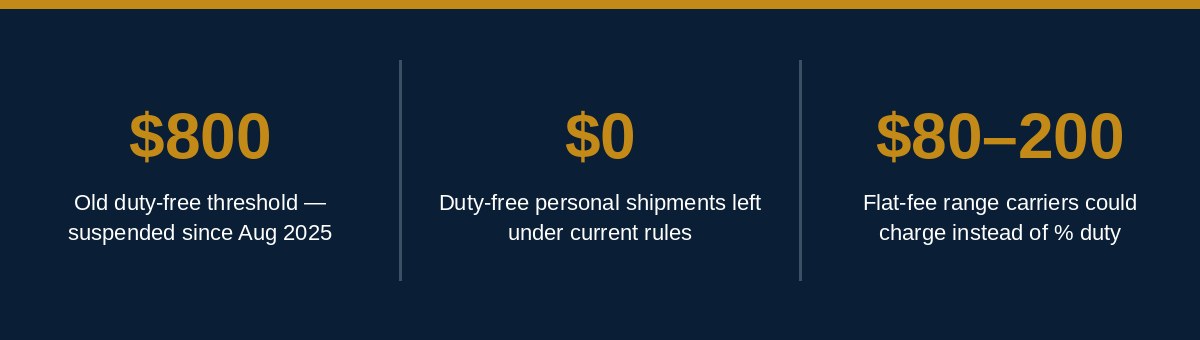
Short answer: as of 2026, there’s no reliable way to avoid customs duty on a personal package from China entirely — the $800 duty-free allowance that used to cover most personal imports was suspended starting August 2025, and the rules have tightened further since.
Short version up top: customs duty on a personal package from China is now the norm, not the exception, for 2026 orders.
What you’ll actually pay depends on the item’s declared value, its customs classification, and which of two fee structures the carrier uses. This guide walks through exactly what changed, how the current duty calculation works, and what realistic total landed cost looks like for a typical small package.
What Changed: The End of the $800 De Minimis Exemption
For years, personal shipments valued at $800 or less could enter the United States duty-free and with minimal paperwork under what’s known as the “de minimis” exemption — the rule that let a $30 AliExpress order arrive with no customs charge at all. That exemption is gone.
According to trade and logistics industry reporting, the suspension began on May 2, 2025 for shipments from China and Hong Kong specifically, then expanded to cover shipments from every country starting August 29, 2025.
A further tightening took effect June 24, 2026, extending the new entry requirements to postal shipments as well as commercial carriers, and current law is set to make the elimination permanent from July 1, 2027 onward. In practical terms: nearly every personal package entering the U.S. today, regardless of value, now goes through some form of formal or informal customs entry rather than the old duty-free fast lane.
Understanding customs duty on a personal package from China is now essential before you click buy on anything overseas.
How Customs Duty Is Actually Calculated Now
Reporting on the new rules describes two fee structures currently in use, and which one applies can depend on the carrier and shipping method. The first is an ad valorem structure, where you’re charged the standard tariff rate the United States applies to goods from that item’s country of origin — meaning the actual percentage varies significantly by country and product category rather than being a single flat number.
The second is a flat per-package fee, reported in the range of roughly $80 to $200 depending on the applicable country tariff tier; this flat-fee option was initially described as available to postal carriers for a limited window rather than as a permanent universal choice.
Because these mechanics are still evolving and vary by carrier, courier, and shipping method, the single most reliable way to know what a specific package will actually cost is to check your chosen carrier’s current customs terms at checkout and, for anything valuable, the official U.S. Customs and Border Protection guidance directly — treat any number you read online, including in this article, as a general guide rather than a guaranteed quote.
The rules around customs duty on a personal package have shifted three times in about a year, so what applied last year may not apply today.
A Worked Example: A $50 Order From China
Concrete numbers make the abstract rules easier to plan around. Say you order a $50 item from a China-based AliExpress seller with standard (non-DDP) shipping.
Under the ad valorem structure, you’d owe the applicable tariff rate for that product’s classification and country of origin, applied to the $50 declared value — tariff rates on Chinese-origin goods have generally run higher than average in recent years due to a series of trade actions layered on top of standard rates, so this can add up to a meaningfully larger charge than the modest sales-tax-like number many buyers expect.
Under the flat-fee structure some postal carriers have used, you might instead see a fixed processing charge in the reported $80–200 range regardless of the item’s actual $50 value — which, worked through, can mean the fee costs more than the item itself for a genuinely low-value order.
This is exactly why checking your specific carrier’s current terms before ordering matters so much more today than it did before 2025: the same $50 order can land at very different total costs depending entirely on which fee structure and carrier apply.
Most first-time importers underestimate customs duty on a personal package because the old duty-free threshold is still widely (and incorrectly) assumed to apply.
Why De Minimis Existed, and Why It Ended
The original $800 de minimis threshold existed to let customs authorities focus formal inspection resources on higher-value, higher-risk shipments rather than processing paperwork on every single low-value personal package, of which there are enormous volumes given how much e-commerce shopping crosses borders.
According to trade reporting, the policy shift away from that approach was driven largely by two concerns: the sheer volume of low-value parcels entering duty-free was seen as both a meaningful and growing gap in tariff revenue, and it made it harder for customs authorities to track and screen the flood of small parcels for prohibited or mislabeled goods.
Whatever the merits of that policy debate, the practical result for personal importers is the same: the administrative convenience that used to come with buying something small and inexpensive from overseas no longer exists, and every package is now, at least in principle, part of the same formal system that used to apply only to larger commercial shipments.
If you take one habit from this guide, make it checking customs duty on a personal package before you buy, not after the bill arrives.
What This Means for a Typical AliExpress or Temu Order
For everyday personal shopping — the $15–60 range that makes up most AliExpress, Temu, and Amazon Global orders — the practical effect is that the sticker price is no longer the full story.
Depending on which fee structure your shipment falls under, you should now budget for either a percentage-based duty charge on top of the item price, or a flat processing fee that can, for genuinely low-value items, represent a larger share of the total cost than the item itself.
This is exactly why comparing “AliExpress price” against “local store price” in isolation is now a misleading way to judge whether an overseas order is actually the better deal — the honest comparison has to include estimated duty and any carrier processing fee, not just shipping.
Take a concrete case: a $12 phone case bought on Temu. At a flat processing fee of $5–8 — a range several carriers have charged on low-value postal shipments — that’s a 40–65% markup before the item even reaches the buyer’s door, often more than the shipping cost itself.
At that price point, the same case bought from a U.S.-based Amazon seller for $18 with free shipping can end up cheaper once duty and processing fees are counted, even though the AliExpress listing looked $6 cheaper at checkout. Running that comparison before clicking “buy,” not after the package clears customs, is the only way to know which listing is genuinely the better deal.
Duty-Paid vs Duty-Unpaid Shipping: Reading the Fine Print
Increasingly, marketplaces and sellers adapting to these changes offer a choice at checkout between two shipping structures, and understanding the difference is worth the extra thirty seconds it takes to read.
Delivered Duty Paid (DDP) means the seller or platform has estimated the applicable duty and built it into the price you pay at checkout, so there’s no separate bill waiting for you at delivery — this is generally the more predictable, beginner-friendly option even if the upfront price looks slightly higher than a duty-unpaid alternative.
Carriers calculate customs duty on a personal package differently depending on whether they use the ad valorem or flat-fee structure described above.
Delivered At Place or Delivered Duty Unpaid (sometimes shown simply as standard shipping) means duty and any processing fee are assessed and collected separately, sometimes by the carrier at the point of delivery, which can mean a package held pending payment or an unexpected charge on a card on file with the carrier.
Neither option is inherently “cheaper” — the total cost should be similar either way if the estimate is accurate — but DDP removes the surprise, which matters most for buyers who want their landed cost known before they commit to a purchase rather than found out afterward.
How to Estimate Your Landed Cost Before You Buy
A few practical habits keep you from being surprised at delivery. Check whether the seller or platform offers “DDP” (Delivered Duty Paid) shipping at checkout — when available, this bakes estimated duty into the price you pay upfront rather than leaving you to pay a separate charge (or the carrier a processing fee) on delivery, and it’s increasingly common on marketplaces adapting to the new rules.
Budgeting for customs duty on a personal package upfront avoids the unpleasant surprise of a held package or an unexpected charge at delivery.
If DDP isn’t offered, look up the general tariff rate for the item’s country of origin and product category through official U.S. trade resources before you buy, so the potential duty charge is a known cost rather than a surprise.
Factor in that some carriers charge their own customs-processing or brokerage fee on top of the government duty itself — this is a carrier fee, not a government charge, and it varies between postal services and express couriers like the major private shipping companies. And for anything above roughly $100–150 in value, budget for the possibility of formal (rather than informal) entry, which can mean more paperwork and, occasionally, a longer customs hold.
Postal Shipping vs Express Carriers: Does It Matter?
Yes, and this is one of the more practical decisions a personal importer can make.
Whether customs duty on a personal package is charged on the item price alone or item-plus-shipping can vary by jurisdiction, which is one more reason to check your specific carrier’s terms.
Postal shipments (arriving via a national postal service) were, at least initially, given the option of the simpler flat-fee structure described above for a limited window, while express commercial carriers have generally moved more uniformly toward standard ad valorem duty assessment plus their own processing fee.
Because the postal flat-fee window is time-limited and the rules are actively evolving, don’t treat this comparison as a permanent rule — check current terms for your specific shipping option at the time you’re actually ordering, since a courier’s policy today may not match what’s true in a few months as the phased rule changes referenced above continue to take effect.
Does This Apply to Every Country, Not Just the U.S.?
This article focuses on U.S. rules specifically since they’ve changed the most dramatically and recently, but it’s worth knowing the broader picture if you’re comparing options or shipping from outside the U.S.
The European Union and United Kingdom have their own, separate de minimis thresholds and VAT rules for personal imports, which have also been tightening in recent years as governments respond to similar low-value-parcel volume concerns, though on a different timeline and with different mechanics than the U.S. changes described above.
Canada maintains its own personal exemption amounts that vary by how long you’ve been outside the country, in a system that’s structurally different again.
The core lesson generalizes even though the specific numbers don’t: assume duty-free personal importing based on an older article or a friend’s experience from a different country is exactly the kind of assumption that leads to a surprise bill, and checking your own country’s current customs authority guidance before a significant purchase is the only reliable approach anywhere.
Common Questions From First-Time Personal Importers
A recurring question is whether splitting one order into several smaller packages avoids duty — it does not, and deliberately undervaluing or splitting shipments to dodge customs assessment is a customs violation, not a savings strategy, and can result in packages being held or seized.
Another common question is whether gifts are treated differently — historically, genuine gift shipments under a certain value had their own more lenient allowance, but with the broader de minimis suspension in effect, gift shipments should now be assumed subject to the same general scrutiny unless you’ve confirmed otherwise through official guidance for the specific shipping method being used.
Finally, buyers often ask whether duty is charged on the item price alone or on item-plus-shipping — this can vary by customs jurisdiction and valuation method, which is one more reason to check the specific terms shown at checkout rather than assuming a single universal rule applies everywhere.
A Quick Pre-Purchase Checklist
Before completing an overseas order today, it’s worth running through a short checklist rather than clicking “buy” on autopilot: confirm whether DDP shipping is offered and, if so, whether the estimated duty shown feels reasonable for the item’s declared value and category; if DDP isn’t offered, look up the general tariff situation for that item’s country of origin so a possible duty charge isn’t a total surprise.
check whether your chosen carrier charges its own processing or brokerage fee on top of government duty, since that’s a separate line item many buyers miss; and, for anything above roughly $100–150, budget mentally for the possibility of formal entry procedures and a somewhat longer delivery window than a low-value order.
None of this takes more than a couple of minutes once it’s a habit, and it’s the difference between an accurate sense of what an overseas purchase actually costs and an unpleasant surprise weeks later.
As a final practical note, customs duty on a personal package can also apply retroactively if a carrier re-assesses a shipment after delivery, so keep records of what you paid.
What Personal Importers Should Watch For Next
Given how recently and rapidly these rules have shifted — three major changes in about fourteen months, with a further permanent codification scheduled for mid-2027 — treat any specific dollar figure or percentage you read today, including the figures in this article, as a snapshot rather than a permanent fact.
The most reliable long-term habit for a personal importer is checking your shipping carrier’s current customs terms at the time of each order and, for anything valuable or unusual, consulting official U.S. Customs and Border Protection guidance directly rather than relying on older articles (or outdated seller claims) that may reference the pre-2025 duty-free rules that no longer apply.
In short, the customs duty on a personal package is now a routine cost of overseas shopping, not an edge case, so factor it into every purchase decision going forward.
Frequently Asked Questions
Is the $800 duty-free threshold really gone for good? As of 2026, yes for practical purposes — it has been suspended in phases since mid-2025, with a further permanent elimination scheduled to be codified into law from July 1, 2027 onward, so personal importers should plan around it not returning.
Will I get a bill after delivery, or is duty charged upfront? It depends on the seller and carrier — DDP (Delivered Duty Paid) shipping charges estimated duty upfront at checkout, while other shipping methods may bill duty and any processing fee separately, sometimes at delivery, so check the specific terms shown before you pay.
Does the customs duty on a personal package apply the same way to every country? No — the applicable tariff rate depends on the item’s country of origin and product classification, which is exactly why two people ordering similar-value items from different countries can see different duty charges.
Can a customs broker help with a single personal package? Generally not necessary for typical personal orders under the informal entry threshold — customs brokers are mainly used for larger, formal-entry commercial shipments; for routine personal packages, your shipping carrier handles the customs paperwork as part of normal delivery.
What happens if I refuse to pay the duty charge? Refusing to pay typically means the package is held and eventually returned to the sender or destroyed rather than delivered, and you generally won’t get a refund for the item’s cost from the carrier itself — any refund would need to come from the seller, per their own return policy, which is one more reason to factor likely duty into your decision before you buy rather than after the bill arrives.
Does the customs duty on a personal package change based on how the seller labels the package? The declared value and customs description are supposed to reflect the actual transaction and item, and asking a seller to falsely mark a package as a “gift” or under-declare its value to dodge duty is a customs violation that can result in seizure or penalties — not a reliable savings tactic, however commonly it’s suggested informally.
To recap: customs duty on a personal package from China is no longer optional or avoidable in 2026, so build it into your budget before you buy.
Bottom Line
The free ride is over: nearly every personal package entering the U.S. from overseas today carries some form of customs duty or processing fee, whether that’s a percentage-based tariff or a flat carrier fee.
The best defense isn’t trying to find a workaround — it’s building the likely duty into your buying decision upfront, checking for DDP shipping where it’s offered, and treating any total landed cost estimate as provisional until you’ve confirmed current terms with your specific carrier. Rules this recent and this actively evolving reward buyers who check before they click “buy,” not buyers who assume last year’s numbers still apply.
One last practical note on customs duty on a personal package: keep your order confirmation and any DDP receipt, since that paperwork is what you’ll need if a charge is ever disputed.
Related Reading
U.S. Customs and Border Protection — basic importing guidance • CBP de minimis program information • How to Buy From AliExpress Safely: A Beginner’s Guide • About TradeMentorHQ
Customs regulations covered in this article are unusually fast-moving as of 2026 and vary by carrier, shipping method, and item category. This article is for general informational purposes only and is not a substitute for official U.S. Customs and Border Protection guidance or advice from a licensed customs broker for your specific shipment.

About the Author: TradeMentorHQ Team
The TradeMentorHQ team researches and writes practical, plain-language guides on Incoterms, customs clearance, trade finance, and shipping logistics for small business owners, first-time importers/exporters, and side-hustle sellers. Our articles are grounded in publicly available regulations and guidance from bodies like U.S. Customs and Border Protection (CBP), the International Chamber of Commerce (Incoterms 2020), and established industry practice, and we link to primary sources wherever a number or rule could change. We are not customs brokers, freight forwarders, or licensed trade attorneys, and nothing here is a substitute for advice from one on your specific shipment.