
Short answer: if your tracking page shows “in customs” or “clearance delay,” your package has physically arrived in the U.S. and is sitting with Customs and Border Protection, but neither USPS, FedEx, UPS, nor DHL can tell you exactly why until you ask the right question to the right party.
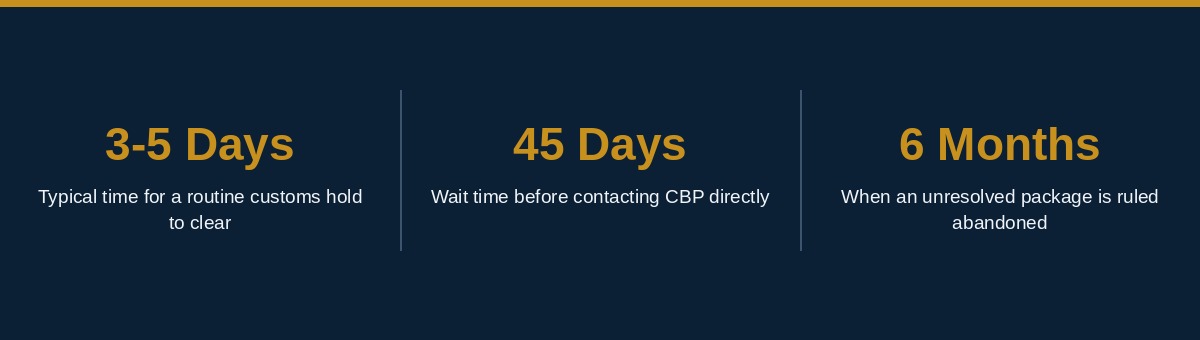
Most packages stuck in customs clear within 3 to 5 business days without you doing anything at all. But a meaningful minority sit for weeks because of a missing invoice, an undervalued declaration, or a random inspection, and knowing how to check a package stuck in customs — and when to actually escalate — can be the difference between a short delay and a package that quietly gets marked abandoned.
This guide walks through what customs tracking statuses really mean, exactly who to contact first, what information to have ready, and the hard deadlines that matter if your personal import is stuck in customs for months instead of days.
What “In Customs” Actually Means on Your Tracking Page
When a carrier’s tracking page shows “in customs,” “clearance delay,” or “held at origin/destination,” that message is simply confirming your package has reached a CBP-monitored facility. It is not a status that CBP itself publishes — Customs and Border Protection does not run a public tracking tool, and CBP staff generally cannot look up an individual package by tracking number the way a carrier can.
That distinction matters because it tells you where to start. The carrier who moved your package — USPS, FedEx, UPS, or DHL — works with licensed customs brokers who have direct visibility into why CBP is holding a shipment. CBP is the second call, not the first.
How to Check a Package Stuck in Customs, Carrier by Carrier
Before contacting anyone, gather five things: your tracking number, the sender and recipient names and addresses, a specific description of the item (brand, model, quantity), the declared value, and any invoice or receipt you have. Every carrier’s customer service line will ask for these before they can escalate to their brokerage team.
USPS (via International Postal channels): USPS-delivered international mail is often handled by CBP directly at a mail facility. Start with USPS’s international inquiry form, since USPS itself has limited ability to intervene once a package is in CBP’s hands.
FedEx and UPS: Both carriers use in-house licensed customs brokers by default on most international shipments. Call their customer service, ask specifically to be connected to the brokerage or customs clearance team, and reference your tracking number — they can usually tell you the exact hold reason within a business day.
DHL: DHL Express handles most of its own customs clearance in-house as well, and its tracking page will often show a more specific reason code (like “documentation required”) than USPS or a standard ground carrier.
Common Reasons a Package Gets Held
The most frequent reason a personal import gets stuck in customs is missing or incomplete paperwork — a commercial invoice that doesn’t match the declared contents, or a customs form filled out by the seller with vague language like “gift” or “merchandise.” Other common reasons include an item that appears undervalued relative to similar listings, unpaid duties or fees, items on a restricted or regulated list (electronics with batteries, supplements, cosmetics), and random compliance inspections that have nothing to do with your specific package.
One 2026-specific wrinkle worth knowing: the duty-free exemption that used to apply to personal packages under $800 was suspended for express carrier shipments in February 2026. That means far more low-value personal imports are now generating a duty bill and a documentation check than in prior years, which has measurably increased how often ordinary packages get flagged for a closer look.
How Long Is Normal, and When Should You Worry
A package stuck in customs for 1 to 5 business days is normal and usually resolves with no action from you. Somewhere between 1 and 3 weeks, it’s worth calling your carrier directly to confirm the hold reason instead of waiting passively. CBP’s own guidance is that you generally shouldn’t contact the agency directly until your carrier has been unable to resolve things after roughly 45 business days, since almost every hold that’s going to resolve quickly does so well before that point.
When and How to Contact CBP Directly
If your carrier confirms CBP is holding the package and can’t get a resolution, or if 45+ business days have passed with no movement, you can contact CBP directly through its online inquiry system. Have the same five pieces of information ready — tracking number, addresses, item description, value, and paperwork — since CBP will ask for identical details to locate your shipment in its system.
What Happens After 6 Months: General Order and Abandonment
If duties go unpaid or the required paperwork is never filed, a package that sits in customs for six months is classified as “general order” merchandise, and storage fees begin accruing. Beyond that point, CBP can treat the shipment as abandoned and has the authority to sell or destroy it. In practice, the overwhelming majority of personal imports never get anywhere close to this timeline — but it’s the reason ignoring a “package stuck in customs” notification for months is a real risk, not just an inconvenience.
Bottom Line
Most of the time, a package stuck in customs is a quiet, boring delay that clears itself within a business week. Your job is to know the difference between normal and actually stuck: check your tracking status, call your carrier’s brokerage team (not just general customer service) once you pass the one-week mark, keep your invoice and order confirmation handy, and only escalate to CBP directly after your carrier has genuinely run out of options. Handled this way, a customs hold is a paperwork problem you can usually solve in a phone call, not a package you should assume is gone for good.
When a package stuck in customs crosses the 5-day mark, it’s usually because it got flagged for a manual review (mismatched paperwork, an unclear product description, or a value near the informal-entry threshold of $800) — most customs holds on personal imports otherwise clear within 3–5 business days once the package reaches the inspection facility. In a flagged case, per CBP’s own published guidance, that window can stretch to 15–30 days without any status update in the tracking system.
A gap in tracking updates during this window is normal, not a sign something’s wrong — CBP’s hold process doesn’t always push live status changes back to the carrier’s tracking feed. If it’s been over 30 days with zero movement, that’s the point where contacting the carrier’s customs brokerage team directly (rather than just refreshing the tracking page) tends to actually surface what’s going on.
Related Reading
Customs Duty on a Personal Package From China: The Ultimate 2026 Guide
How to Buy From AliExpress Safely: 7 Rules for Personal Imports

About the Author: TradeMentorHQ Team
The TradeMentorHQ team researches and writes practical, plain-language guides on Incoterms, customs clearance, trade finance, and shipping logistics for small business owners, first-time importers/exporters, and side-hustle sellers. Our articles are grounded in publicly available regulations and guidance from bodies like U.S. Customs and Border Protection (CBP), the International Chamber of Commerce (Incoterms 2020), and established industry practice, and we link to primary sources wherever a number or rule could change. We are not customs brokers, freight forwarders, or licensed trade attorneys, and nothing here is a substitute for advice from one on your specific shipment.