
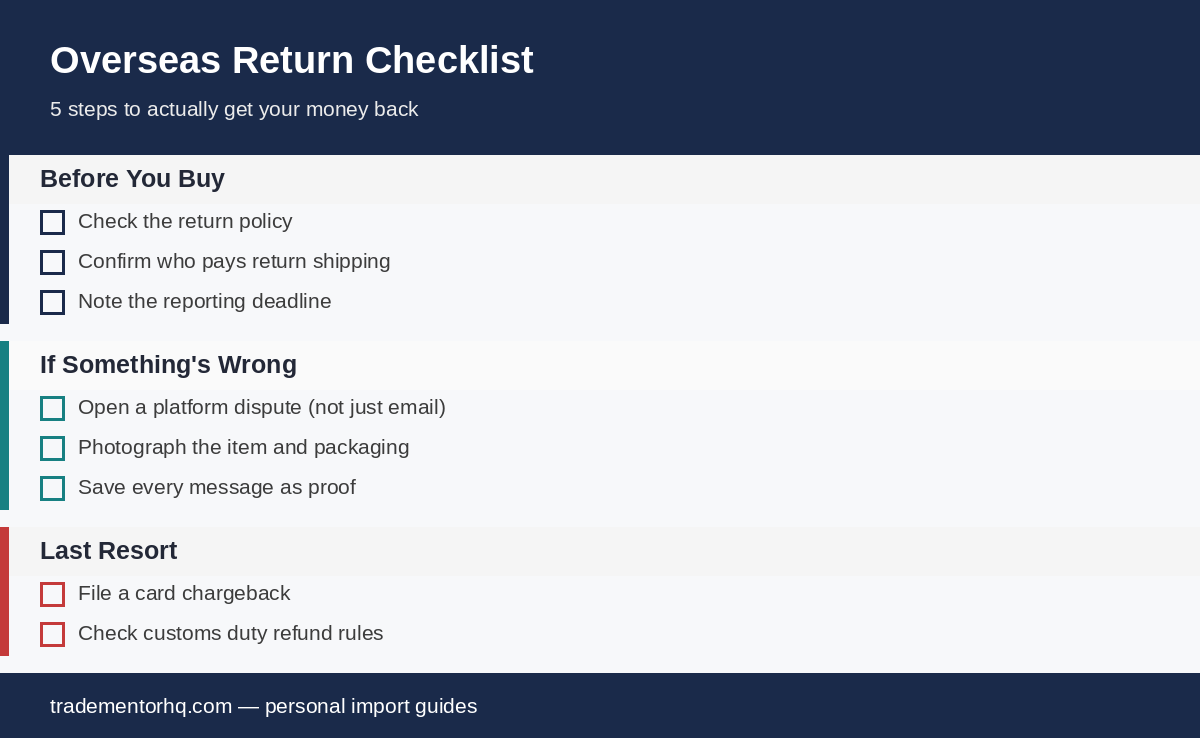
Returning an overseas purchase almost never works the way a domestic return does — you can’t just print a prepaid label and drop the box at your local post office and expect a full refund a week later. The seller is often on another continent, the return shipping can cost more than the item itself, and if customs duty was charged on the way in, nobody automatically hands that back to you. The short version: check the seller’s return policy and who pays return shipping before you buy, request a refund through the platform (not just email) the moment something’s wrong, and if the seller won’t cooperate, a card chargeback is usually your strongest fallback.
I learned most of this the hard way after a jacket I ordered from an overseas boutique showed up two sizes small. The seller offered a partial refund instead of a return, which sounded reasonable until I did the math — the return shipping quote alone was almost half of what I’d paid. I ended up keeping the partial refund, but it taught me to actually read the return terms before checkout instead of after.
Check the Return Policy Before Your Overseas Purchase
Cross-border return policies vary enormously by platform and by individual seller, and the details that matter most are usually buried a few clicks past the product page. Before ordering from an overseas seller, look for three things specifically: whether returns are accepted at all for your item category, who pays for return shipping, and how long you have to report a problem after delivery. Some marketplaces standardize this across all sellers on the platform; others leave it entirely up to each individual store, which means the same site can have wildly different return terms from one seller to the next.
Use the Platform’s Dispute Process, Not Just Email
If an item arrives damaged, wrong, or not as described, open a formal dispute or return request inside the platform rather than only emailing the seller directly. Marketplace dispute systems create a timestamped record, often pause your payment or hold funds in escrow, and give you an escalation path if the seller goes quiet. A friendly email can get ignored; a formal case usually can’t, since it puts the seller’s account standing on the line too.
Know Who Actually Pays Return Shipping on an Overseas Purchase
This is the detail that surprises people most. On many cross-border return policies, if the item is defective or misrepresented, the seller or platform is expected to cover return shipping or issue a refund without requiring the item back at all for lower-value goods. But if you’re returning something simply because you changed your mind or it didn’t fit, you’re very often on the hook for return shipping yourself — and international shipping quotes for returns can run surprisingly close to the item’s original price, which is exactly what happened with my jacket.
Don’t Forget About the Customs Duty You Already Paid
For an overseas purchase, if duty or import tax was charged when the package first cleared customs, that amount generally is not refunded automatically just because you return the item to the seller — you often have to file a separate duty drawback or refund claim with the customs authority that collected it, and the process and thresholds vary by country. In practice, for smaller personal-import orders many people find the refund isn’t worth the paperwork, but for a higher-value return it can be worth checking your country’s customs website for the specific reclaim process before writing that money off.
When the Seller Won’t Cooperate: The Chargeback Option
If a seller ignores your return request, refuses a clearly defective item, or the platform’s own dispute process stalls out on an overseas purchase, disputing the charge with your credit card issuer is usually the strongest remaining option. Card networks generally give you a window of a few months from the transaction or delivery date to file a dispute, so keep screenshots of the listing, your messages with the seller, and any photos of the problem — that documentation is exactly what your card issuer will ask for if the case goes to review.
Bottom Line
For more on your rights when disputing a charge, see the FTC’s guide to disputing credit card charges. The best protection against a painful overseas return is reading the return policy before you buy, not after something goes wrong. Once there is a problem, work through the platform’s formal dispute process instead of relying on email, keep every receipt and message as documentation, and remember that a credit card chargeback is your backstop if the seller stops responding entirely.
Related Reading
- Is Temu Safe in 2026? The Complete Guide to Avoid 5 Risks
- How to Buy From AliExpress Safely: 7 Rules for Personal Imports
- What Happens If Your Personal Import Gets Seized by Customs?

About the Author: TradeMentorHQ Team
The TradeMentorHQ team researches and writes practical, plain-language guides on Incoterms, customs clearance, trade finance, and shipping logistics for small business owners, first-time importers/exporters, and side-hustle sellers. Our articles are grounded in publicly available regulations and guidance from bodies like U.S. Customs and Border Protection (CBP), the International Chamber of Commerce (Incoterms 2020), and established industry practice, and we link to primary sources wherever a number or rule could change. We are not customs brokers, freight forwarders, or licensed trade attorneys, and nothing here is a substitute for advice from one on your specific shipment.