
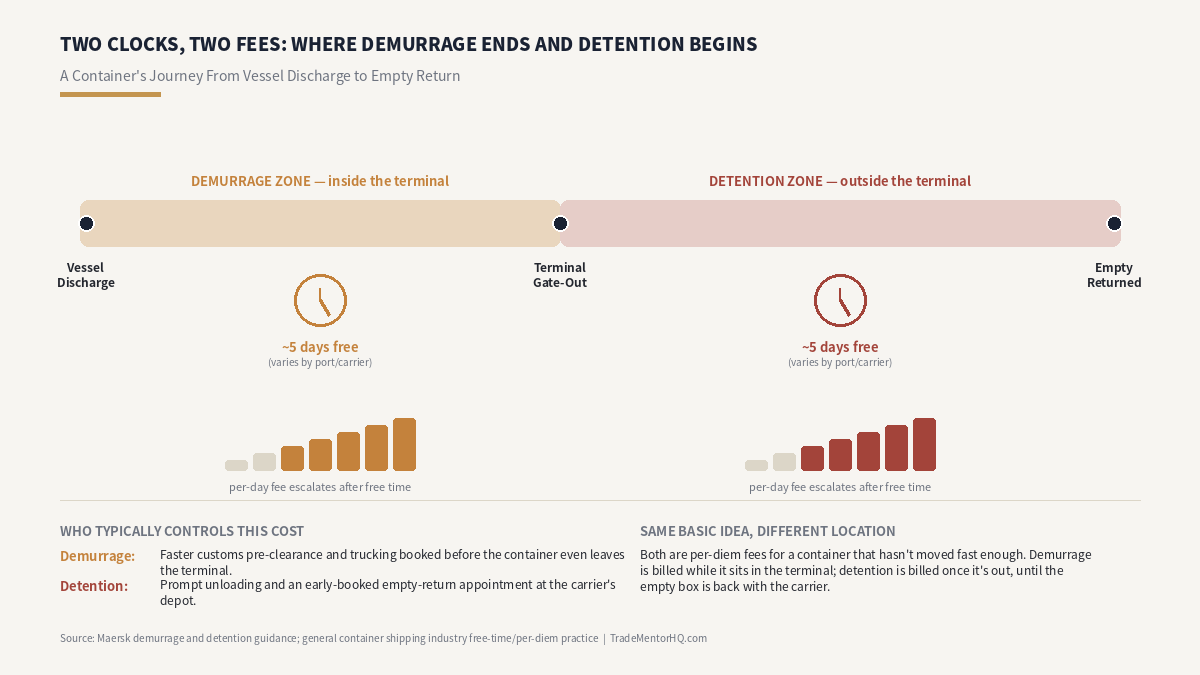
Demurrage vs detention confusion costs first-time importers real money, since both are per-day container fees but they apply to completely different phases of a shipment’s journey through port.
A container arrives, clears customs, and the importer still gets hit with fees they didn’t budget for — often because they assumed “demurrage” and “detention” were two names for the same late fee. They aren’t, and the difference determines who can actually control the cost. Demurrage is what a carrier or terminal charges for a container sitting inside the port/terminal past its free time; detention is what the carrier charges once that same container has left the terminal and is sitting outside — at a warehouse, on a chassis, anywhere — past its own separate free time, until the empty box is returned.
Demurrage: The Clock Inside the Terminal
Demurrage starts running once a container is discharged from the vessel and begins sitting in the terminal yard. Every carrier and terminal grants a “free time” window — commonly 3 to 7 days, though it varies by port, carrier, and negotiated contract — during which the consignee can pick up the container without charge. Once free time expires, a per-day demurrage fee kicks in and typically escalates the longer the container sits, since ports want the space back for incoming vessels.
The importer’s own actions (or lack of them) drive this clock: slow customs clearance, missing paperwork, or simply not arranging trucking in time all burn through free time before the container has even left the port.
Detention: The Clock Outside the Terminal
Detention starts the moment the container physically leaves the terminal gate. The carrier still owns the container (it’s their box, on lease or owned outright), and they grant a separate free-time window — again commonly a handful of days — for the importer to unload the cargo and return the empty container to a carrier-designated depot. If the empty box doesn’t get back in time, whether because the warehouse is backed up, the trucker can’t get a return appointment, or the depot itself is congested and not accepting returns, detention fees start accruing per day until the container is physically back in the carrier’s possession.
Why the Distinction Actually Matters
Demurrage and detention are billed by different triggers and often by different parties, and conflating them leads to disputes over an invoice that’s actually correct — or to missing a controllable cost entirely. Demurrage is largely within the importer’s control before pickup: faster customs pre-clearance, having trucking booked before the vessel even arrives, and prioritizing high-demurrage-risk containers first. Detention is control after pickup: unloading promptly, securing a depot return appointment early, and not treating the container as free extra warehouse space.
A business that only tracks “did we get charged a late fee” without separating which clock caused it can’t actually fix the recurring cause — pushing harder on customs brokers won’t help if the real problem is depot congestion on the return side.
A Concrete Illustration
An importer’s container is discharged on a Monday with 5 days of free time before demurrage starts. Customs clearance and paperwork issues eat 6 days, so the container leaves the terminal a day late — one day of demurrage, billed by the terminal or carrier. From gate-out, the importer has 5 days of detention free time to unload and return the empty box. The warehouse unloads it in 2 days, but the nearest empty-return depot is fully booked for 4 more days before it can accept the container — total 6 days outside the terminal, one day over the detention allowance, billed separately by the carrier.
Two different fees, two different causes, two different things to fix: faster customs pre-clearance would have avoided the demurrage day; booking a depot return appointment earlier (before the container even left the port) would have avoided the detention day.
The Bottom Line
Demurrage and detention are the same basic idea — a carrier charging for a container that hasn’t moved fast enough — applied to two different locations and two different windows of time. Knowing which one you’re looking at on an invoice, and which controllable step in your own process caused it, is what turns “unavoidable port fees” into a cost you can actually reduce.
Source: Maersk demurrage and detention guidance; general container shipping industry practice on free time and per-diem fee structures.
Common mistakes first-time importers make with demurrage vs detention
Even experienced logistics teams stumble on demurrage vs detention because the two charges look similar on an invoice but follow completely different clocks. The most frequent mistake is assuming that paying one fee automatically resolves the other — it does not. A shipper can clear demurrage by pulling the container off the terminal in time, yet still rack up detention charges by returning the empty container late. Treating demurrage vs detention as a single line item instead of two separate deadlines is how avoidable fees pile up month after month.
Another common error is relying on a freight forwarder’s verbal estimate of free time instead of confirming the actual tariff in writing. Free-time allowances for demurrage vs detention vary by carrier, by port, and even by vessel service, so a number that was accurate on the last shipment may not apply to the next one. First-time importers who skip this verification step often discover the gap only after the invoice arrives, at which point disputing it is far harder than preventing it would have been.
A third mistake is underestimating how quickly demurrage vs detention charges compound during peak season or port congestion. Many carriers apply escalating per diem rates — a flat daily fee for the first few days that increases sharply after that. Importers who plan around the initial, lower rate and get caught by the escalation clause end up paying far more than they budgeted, simply because they never modeled the worst-case scenario for demurrage vs detention on that specific trade lane.
Frequently asked questions about demurrage vs detention
Can demurrage vs detention fees be negotiated after the fact? Sometimes. Carriers and terminals will occasionally waive a portion of accrued charges if the delay was caused by their own equipment shortage, a customs system outage, or another documented disruption outside the importer’s control. Waivers are far from guaranteed, so the stronger strategy is preventing the charges in the first place rather than counting on a successful dispute later.
Do all carriers calculate free time the same way? No — free-time allowances and per diem escalation schedules differ by carrier, trade lane, and even by individual service contract. Always confirm the specific terms in writing for each shipment rather than assuming last month’s allowance still applies.
Who is ultimately responsible for paying these charges? Contractually, the consignee named on the bill of lading is usually liable, though many importers shift day-to-day monitoring to a customs broker or freight forwarder. Either way, the legal responsibility for unpaid fees typically sits with the importer of record, which is exactly why proactively tracking free-time windows matters so much for anyone new to managing ocean freight.
Keeping these answers in mind before a shipment departs — not after a terminal notice arrives — is the single most reliable way to keep container costs predictable and avoid unnecessary fees on every import.
For official guidance on container free-time rules and demurrage vs detention definitions, see the U.S. Federal Maritime Commission shipping guides. For more import cost-control strategies, see our TradeMentorHQ homepage.
Keeping Demurrage and Detention Charges Under Control
Demurrage vs detention charges are not random — they are a predictable, structured feature of container shipping, and predictable costs can be managed with the right habits. Understanding demurrage vs detention starts with knowing exactly which clock governs which fee: demurrage while the container sits at the port or terminal, detention once it leaves the terminal but has not been returned empty. From there, the fix is largely operational — book customs clearance early, coordinate trucking and warehouse slots before the vessel arrives, and track free-time deadlines the same way you track payment due dates.
For first-time importers, the safest approach is to build a simple internal checklist that flags every shipment’s demurrage vs detention free-time windows the moment the vessel is confirmed, rather than waiting for a terminal notice to force a reaction. Pairing that checklist with a reliable customs broker or freight forwarder who proactively monitors demurrage vs detention deadlines turns a recurring cost center into a manageable, budgeted line item — and that difference alone often separates profitable import operations from ones that quietly bleed margin on every shipment.
Real per-diem numbers help put this in perspective: at major U.S. ports like Los Angeles/Long Beach, ocean carriers typically grant 4–5 free days before demurrage kicks in, and once it starts, daily fees commonly run $100–250 per container and can escalate the longer the container sits.
Detention (the fee for holding the carrier’s equipment outside the port, usually after pickup) runs on a separate clock and separate rate, often $75–200 per day, so a container that’s both late leaving the terminal AND late returning empty can rack up both charges simultaneously. During the 2021–2022 congestion period some ports saw daily rates spike well above these ranges — a reminder that these are typical figures, not guaranteed caps, and it’s worth confirming the current free-time and per-diem schedule with your carrier before cargo even departs.
Related Reading
- FCL vs LCL Shipping: A Cost and Timing Comparison for First-Time Exporters
- Freight Forwarder vs Customs Broker: What’s the Difference?
Written by the TradeMentorHQ editorial team. We research primary sources — carrier demurrage/detention guidance and standard container shipping industry practice — before every article, and we’re upfront about how the site is produced on our About page. Spotted something that needs a correction? Let us know.
Demurrage vs detention: the core difference
Demurrage vs detention is fundamentally a question of location and timing. Demurrage charges accrue when a container sits at the port or terminal past its free time, waiting to be picked up by the consignee, while detention charges accrue after the container has left the port but has not yet been returned empty to the carrier, typically because it is still being unloaded at the importer’s warehouse or is stuck in transit. Understanding the demurrage vs detention distinction matters because different actions stop each type of fee: moving the container out of the port stops demurrage, while returning the empty container to the carrier’s designated depot stops detention.
Both demurrage and detention are billed by the carrier or terminal at a per-day rate that typically increases the longer the container is held, and free time — the number of days before charges start — varies by port, carrier, and contract terms. First-time importers often assume the free time clock starts when the shipment clears customs, when in reality the demurrage vs detention clock is usually tied to the vessel’s discharge date or the container’s actual pickup and return dates, regardless of customs clearance status.
Why demurrage vs detention charges catch first-time importers off guard
The demurrage vs detention distinction confuses new importers partly because both fees look identical on an invoice — a per-day charge tied to a container number — and partly because the triggering events (port pickup versus empty return) are not always obvious from the shipping documents alone. A customs hold, a drayage trucking delay, or a warehouse unable to unload quickly enough can each independently trigger demurrage vs detention charges, sometimes both at once for the same shipment, compounding the total cost significantly beyond what an importer budgeted.
How to avoid unnecessary demurrage vs detention fees
Minimizing demurrage vs detention exposure starts with tracking free time deadlines actively rather than reactively, coordinating trucking and warehouse unloading capacity in advance of a container’s arrival, and clearing customs as early as legally possible — often before the vessel even arrives, using pre-arrival processing where available. Some carriers also allow importers to purchase additional free time in advance at a lower rate than the per-day demurrage vs detention charges that accrue after the fact, which can be worth doing for shipments where delay risk is predictable.
Combined demurrage and detention: per diem charges
Some carriers simplify the demurrage vs detention distinction by billing a single combined “per diem” rate that covers both phases under one charge, rather than itemizing them separately. This can make it harder for an importer to identify exactly which phase of the process is causing delay charges, since a combined per diem invoice does not show whether the container sat too long at the port or too long after leaving it. Requesting an itemized breakdown when demurrage vs detention charges appear on an invoice helps importers identify exactly where the delay occurred and address the root cause for future shipments.
Who is responsible for demurrage vs detention charges
Responsibility for demurrage vs detention charges typically falls on the consignee named on the bill of lading, though the specific contractual arrangement between importer, freight forwarder, and trucking company can shift where the cost ultimately lands. Importers working with a freight forwarder should clarify in advance who monitors free time deadlines and who is contractually responsible if demurrage vs detention charges accrue due to a delay outside the importer’s direct control, such as a customs hold or a port congestion event.
Disputing demurrage vs detention charges
Not every demurrage vs detention charge is automatically valid, and importers can dispute charges that arose from circumstances outside their control, such as a carrier’s own documentation error, a port strike, or equipment shortages caused by the carrier rather than the importer. Successfully disputing demurrage vs detention charges requires clear documentation of the actual timeline and the specific cause of delay, which is another reason why tracking container milestones carefully, rather than only reacting to invoices after the fact, matters throughout the shipping process.
Demurrage vs detention in the context of port congestion
During periods of significant port congestion, demurrage vs detention charges can spike dramatically as terminals and carriers struggle with backlogs entirely outside any individual importer’s control. Some regulatory bodies have intervened during severe congestion periods to require carriers to waive or reduce demurrage vs detention charges caused by systemic port delays rather than importer inaction, though the specific rules and enforcement vary by country and time period. Staying informed about current port conditions on key trade lanes helps importers anticipate and budget for demurrage vs detention risk during unusually congested periods.
Budgeting for demurrage vs detention as a cost of doing business
Experienced importers build a small demurrage vs detention buffer into their landed cost calculations for shipments on trade lanes known for congestion or customs delays, rather than assuming every shipment will clear within standard free time. This proactive budgeting approach treats occasional demurrage vs detention charges as a manageable, anticipated cost rather than a recurring surprise that disrupts cash flow planning every time a shipment runs into an unexpected delay.
Negotiating longer free time periods as part of an ongoing carrier contract is another lever larger-volume importers use to reduce demurrage vs detention exposure systematically, rather than negotiating exceptions shipment by shipment after charges have already accrued. Carriers are often willing to extend free time for importers who ship consistent volume, since a longer-term contractual relationship is generally more valuable to the carrier than the marginal demurrage vs detention revenue from a single importer’s occasional delays.
How freight forwarders help manage demurrage vs detention risk
A good freight forwarder actively tracks free time deadlines across all of a client’s shipments and proactively alerts the importer when a container is approaching a demurrage vs detention trigger point, rather than simply passing along carrier invoices after charges have already accrued. Importers evaluating forwarders should specifically ask how each candidate handles demurrage vs detention monitoring, since this proactive tracking can meaningfully reduce avoidable charges compared to a forwarder that only reacts to problems after the fact.
Technology tools for tracking demurrage vs detention deadlines
Container tracking software and carrier portals increasingly provide real-time visibility into free time deadlines, helping importers and their logistics partners avoid demurrage vs detention charges through earlier awareness rather than after-the-fact invoice review. Larger importers with high shipment volume often integrate this tracking directly into their supply chain management systems, generating automatic alerts well before a demurrage vs detention deadline arrives, giving warehouse and trucking teams enough lead time to prioritize at-risk containers.
Demurrage vs detention clauses in shipping contracts
Reviewing the specific demurrage vs detention terms in a carrier or forwarder contract before a problem arises — free time allowances, per-day rates, and any dispute resolution process — gives importers a clearer picture of their actual exposure than assuming standard industry terms apply universally. These terms vary meaningfully between carriers and even between specific trade lanes with the same carrier, making a contract-by-contract review worthwhile for any importer shipping regularly enough for demurrage vs detention costs to matter to the bottom line.

About the Author: TradeMentorHQ Team
The TradeMentorHQ team researches and writes practical, plain-language guides on Incoterms, customs clearance, trade finance, and shipping logistics for small business owners, first-time importers/exporters, and side-hustle sellers. Our articles are grounded in publicly available regulations and guidance from bodies like U.S. Customs and Border Protection (CBP), the International Chamber of Commerce (Incoterms 2020), and established industry practice, and we link to primary sources wherever a number or rule could change. We are not customs brokers, freight forwarders, or licensed trade attorneys, and nothing here is a substitute for advice from one on your specific shipment.