
Choosing between documentary collections D/P vs D/A is one of the most consequential trade-finance decisions an exporter makes, since it directly determines when the buyer gains control of the shipping documents relative to when payment or acceptance actually happens.
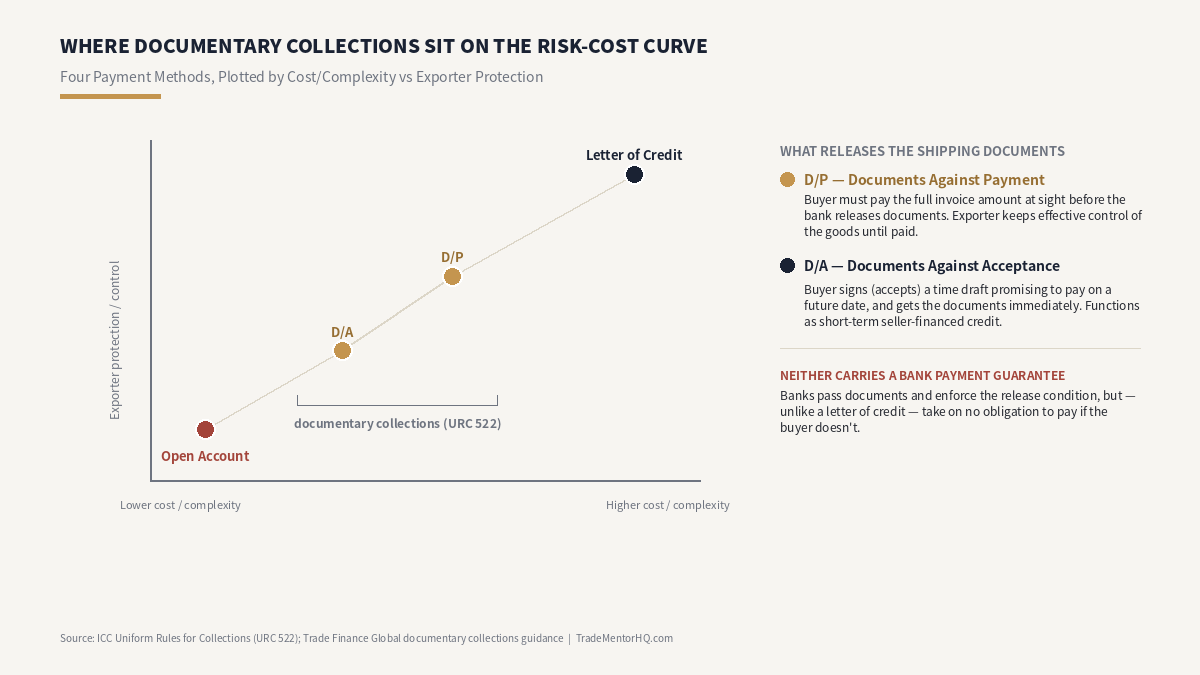
Most guides to trade payment methods present a simple spectrum: open account on one end (all risk to the seller), letter of credit on the other (most secure, most expensive), with T/T sitting somewhere in between. That framing skips an instrument that sits in a genuinely different place on the risk-versus-cost curve. A documentary collection — governed by the ICC’s Uniform Rules for Collections (URC 522) — routes shipping documents through the banking system so the buyer can’t take possession of the goods without either paying immediately (D/P) or formally committing to pay later (D/A), without the cost or complexity of a letter of credit’s document-compliance machinery.
How a Documentary Collection Actually Works
The mechanics run through the banking system but don’t involve a bank guaranteeing payment the way a letter of credit does. The exporter ships the goods and hands the shipping documents — the bill of lading, commercial invoice, packing list, and anything else the buyer needs to clear customs and take delivery — to its own bank, the remitting bank, along with collection instructions. The remitting bank forwards the documents to a bank in the buyer’s country, the collecting bank (often the same institution acting as the presenting bank), which holds them and contacts the buyer.
The buyer can only get the documents — and therefore the goods — by satisfying the condition the exporter specified. Crucially, under URC 522 the banks are just intermediaries handling paper; they check that documents match the collection instructions but take on none of the payment guarantee a letter of credit provides.
D/P: Documents Against Payment
” Until that payment clears, the buyer literally cannot get the paperwork needed to claim the goods from the carrier or clear them through customs, which gives the exporter meaningful leverage: the goods are, practically speaking, still under the exporter’s control even though they may have already left port. This is close to cash-on-delivery for international trade, minus a bank’s payment guarantee — if the buyer simply refuses to pay, the exporter is left holding shipping documents for goods now sitting in a foreign port, with re-routing or disposal costs to sort out.
D/A: Documents Against Acceptance
Under D/A terms, the collecting bank releases the documents once the buyer formally accepts a time draft (a bill of exchange) — signing a legal commitment to pay a specific amount on a specific future date, commonly 30, 60, or 90 days out. The buyer gets the goods immediately upon acceptance, well before actually paying, which functions as a form of short-term trade credit extended by the exporter.
That’s a materially different risk profile than D/P: once the buyer has the goods and has only promised to pay later, the exporter’s only recourse if payment doesn’t arrive on the due date is to pursue the accepted draft as a debt instrument — a slower, more uncertain path than still holding the shipping documents.
Why Choose a Documentary Collection Over a Letter of Credit
The appeal of documentary collections is cost and simplicity relative to a letter of credit, without giving up as much control as open account terms. Letters of credit require a bank to examine documents for strict compliance with the credit’s terms and to commit its own creditworthiness to the payment — services that come with issuance fees, amendment fees, and often a line of credit or cash collateral tied up at the applicant’s bank. A documentary collection skips all of that: the banks pass paper along and enforce the payment-or-acceptance condition, but neither bank is on the hook if the buyer walks away.
That makes documentary collections most sensible between trading partners who know and trust each other reasonably well — enough that the exporter is comfortable with the buyer’s willingness to pay, just not so much that open account (no conditions attached at all) feels safe.
A Concrete Illustration
An exporter with a new but promising buyer relationship — a few successful smaller orders already completed on open account — receives a larger order than usual and wants more protection without insisting on a letter of credit, which the buyer has pushed back on as expensive and slow. The exporter ships under D/A terms with a 60-day time draft: the buyer’s bank releases the documents once the buyer accepts the draft, the buyer takes delivery and sells the goods, and payment is due 60 days later.
If the buyer’s business is legitimate and cash flow holds up, this works well for both sides — the buyer gets 60 days of financing, the exporter gets a documented, legally enforceable payment commitment rather than just an invoice. If the buyer’s business fails before the due date, the exporter is an unsecured creditor holding an accepted draft, with the goods already gone — which is exactly why D/A is a trust-based instrument, not a risk-elimination one.
The Bottom Line
Documentary collections occupy real middle ground between open account and letter of credit — D/P keeps the goods effectively out of the buyer’s reach until payment clears, while D/A trades that leverage for a documented, if unsecured, payment commitment. Neither carries a bank’s guarantee the way a letter of credit does, which is exactly why they’re cheaper and faster — and exactly why they only make sense with a buyer relationship that’s already earned a meaningful amount of trust.
Source: ICC Uniform Rules for Collections (URC 522); Trade Finance Global documentary collections guidance.
What is a documentary collection, and where does it sit between open account and letter of credit?
A documentary collection is a trade payment arrangement in which the exporter’s bank forwards shipping documents to the importer’s bank with instructions to release them only once payment is made or a bill of exchange is accepted. Unlike a letter of credit, no bank guarantees payment — the banks in a documentary collection act purely as intermediaries handling paperwork, not as guarantors. This is exactly why understanding documentary collections D/P vs D/A matters so much: the two variants split control of the documents at very different points in the transaction, and that timing difference changes who bears the risk.
Documentary collections D/P vs D/A sit in the middle of the trade-finance spectrum for a reason. They are cheaper and faster to arrange than a letter of credit, since no bank is underwriting the payment risk, but they still route through the banking system, which gives exporters more structure and control than a pure open-account sale. For exporters selling to buyers they trust reasonably well but not enough to extend open-account terms, documentary collections D/P vs D/A offer a practical middle path.
D/P (Documents against Payment): how it works
Under a D/P arrangement — one half of the documentary collections D/P vs D/A pair — the importer’s bank releases the shipping documents (bill of lading, commercial invoice, packing list, certificate of origin) to the buyer only after the buyer pays the invoice amount in full. Because the buyer cannot take possession of the goods at the port without the bill of lading, D/P effectively ties document release to cash payment, which protects the exporter from a buyer walking away without paying.
D/P is the safer half of documentary collections D/P vs D/A from the exporter’s perspective, since payment happens before documents (and therefore practical control of the goods) change hands. The tradeoff is that D/P offers the buyer no financing grace period — they must pay immediately to get their goods, which can make D/P less attractive to buyers who were hoping for open-account-style payment terms.
D/A (Documents against Acceptance): how it works
D/A is the other half of documentary collections D/P vs D/A, and it works quite differently. Instead of requiring immediate payment, the importer’s bank releases the shipping documents once the buyer formally accepts a time draft (a bill of exchange promising to pay on a specified future date — commonly 30, 60, or 90 days after sight or after the shipment date). The buyer gets the goods immediately upon acceptance, but actual payment is deferred.
This is the critical risk distinction inside documentary collections D/P vs D/A: with D/A, the exporter has already released the documents — and therefore effectively released control of the goods — before receiving any money at all. If the buyer defaults on the accepted draft, the exporter has little recourse beyond a signed acceptance and whatever legal remedies are available in the buyer’s jurisdiction, which are often slow and expensive to pursue internationally.
Documentary collections D/P vs D/A: the key differences at a glance
The core distinction in documentary collections D/P vs D/A comes down to one question: does the buyer get the documents before or after paying? With D/P, documents against payment means the buyer pays first and receives documents second — cash and control move together. With D/A, documents against acceptance means the buyer only has to sign a promise to pay, and the documents (and goods) are released immediately, with actual cash arriving weeks or months later.
This single timing difference cascades into everything else when comparing documentary collections D/P vs D/A: credit risk, cash-flow impact, negotiating leverage, and even how each option is priced by banks. Exporters choosing between documentary collections D/P vs D/A should treat this timing question as the first and most important variable, before considering cost or buyer relationship at all.
When exporters should choose D/P over D/A
D/P is generally the better choice within documentary collections D/P vs D/A whenever the buyer relationship is newer, the destination market carries elevated political or economic risk, or the transaction value is large enough that a default would meaningfully hurt the business. Because D/P requires payment before document release, it removes the buyer’s ability to take the goods and then delay or refuse payment.
Industries that ship high-value, easily resellable goods — electronics, commodities, machinery — tend to lean toward D/P within documentary collections D/P vs D/A specifically because those goods are attractive to a buyer who might otherwise be tempted to accept a D/A draft and then default. When in doubt about a new trading partner, defaulting to the D/P side of documentary collections D/P vs D/A is the conservative, safer starting point.
When D/A makes sense despite the added risk
D/A becomes attractive within documentary collections D/P vs D/A when the exporter has an established, trusted relationship with the buyer and wants to offer payment terms that are more competitive than a strict cash-on-documents arrangement, without going all the way to open account. D/A effectively functions as short-term trade credit, extended through the banking system rather than informally.
Exporters sometimes use D/A within documentary collections D/P vs D/A as a stepping stone — offering it to a buyer who has built up a track record of on-time payment under D/P terms, as a reward that strengthens the commercial relationship, while still keeping the transaction routed through banks rather than moving to fully unsecured open account.
The role of banks in documentary collections D/P vs D/A
Both sides of documentary collections D/P vs D/A rely on two banks: the remitting bank (the exporter’s bank, which sends the documents and collection instructions) and the collecting/presenting bank (the importer’s bank, which presents the documents to the buyer under either D/P or D/A terms). Critically, neither bank guarantees payment in documentary collections D/P vs D/A — their role is limited to following instructions and releasing documents according to the agreed terms, which is why fees for documentary collections D/P vs D/A are much lower than for a letter of credit.
This limited-liability structure is the main reason documentary collections D/P vs D/A cost less than a letter of credit but also protect the exporter less. Exporters sometimes assume the bank is vouching for the buyer’s creditworthiness in documentary collections D/P vs D/A — it is not. The bank is only a paperwork intermediary, and the underlying credit risk in documentary collections D/P vs D/A stays with the exporter (for D/A) or is eliminated by the payment-first structure (for D/P).
Documentary collections D/P vs D/A compared with letter of credit and open account
Choosing among letter of credit, documentary collections D/P vs D/A, and open account is really a decision about how much risk transfer the exporter is willing to pay for. A letter of credit shifts payment risk to a bank, at the highest cost. Open account shifts all risk to the exporter, at the lowest cost. Documentary collections D/P vs D/A sit in between: cheaper than a letter of credit because no bank is guaranteeing payment, but safer than open account because the banking system still controls document release.
For exporters weighing documentary collections D/P vs D/A against these alternatives, a useful mental model is: use a letter of credit for new, high-value, high-risk buyers; use documentary collections D/P vs D/A for established buyers where some risk is acceptable in exchange for lower fees and faster processing; and reserve open account only for long-standing, trusted relationships.
Common mistakes exporters make with documentary collections D/P vs D/A
The most common mistake is treating documentary collections D/P vs D/A as equally safe, when D/A carries materially more risk than D/P because documents release before payment. Exporters who default to D/A purely because a buyer requested it — without weighing the buyer’s payment history — are effectively extending unsecured credit while believing they have bank-level protection.
A second mistake is underestimating how documentary collections D/P vs D/A interact with local collection laws in the buyer’s country. If a buyer refuses to pay under D/P or defaults on an accepted D/A draft, pursuing the goods or the debt through the local legal system can be slow, expensive, and uncertain — which is why documentary collections D/P vs D/A work best when paired with credit insurance or a conservative credit limit for each buyer.
Frequently asked questions about documentary collections D/P vs D/A
Which is riskier, D/P or D/A? D/A is riskier for the exporter because documents — and therefore the goods — are released before payment is received, based only on the buyer’s signed acceptance of a future payment obligation.
Do banks guarantee payment under documentary collections D/P vs D/A? No. Unlike a letter of credit, banks handling documentary collections D/P vs D/A only follow instructions to release documents; they do not guarantee or insure the payment itself.
Can documentary collections D/P vs D/A be combined with credit insurance? Yes, and this is common practice — exporters who want the lower cost of documentary collections D/P vs D/A but want to reduce buyer-default risk often pair D/A terms with trade credit insurance covering the specific buyer.
For official rules governing documentary collections, see the ICC’s trade finance resources (URC 522). For more payment-method comparisons, see our TradeMentorHQ homepage.
Choosing Between D/P and D/A With Confidence
Documentary collections D/P vs D/A give exporters a practical middle ground between the extremes of open account and letter of credit — lower cost and faster processing than a letter of credit, with meaningfully more structure than open account. The decision within documentary collections D/P vs D/A ultimately comes down to how much the exporter trusts a specific buyer: pick D/P when trust is limited or the transaction value is high, and consider D/A only once a buyer has demonstrated a reliable payment history.
Whichever side of documentary collections D/P vs D/A an exporter chooses, the fees are modest compared to a letter of credit, and the paperwork discipline the banking system enforces is still far better than shipping on open account with no structure at all. For most exporters selling into markets with moderate risk, mastering documentary collections D/P vs D/A is one of the highest-leverage trade-finance skills to develop early.
On fees, documentary collection charges are modest compared to a letter of credit — banks typically charge a collection fee of around 0.1–0.25% of the invoice value, often with a minimum flat fee in the $50–100 range, rather than the higher issuance and confirmation fees an LC carries.
For D/A terms specifically, the usance period (time between the buyer accepting the draft and actual payment) is commonly set at 30, 60, or 90 days from the bill of lading date — and because D/A releases the documents on acceptance rather than payment, the exporter is extending real credit risk for that entire window, which is worth pricing into your terms if you’re using D/A with a new buyer.
Related Reading
- Letter of Credit (LC) vs T/T: Which Payment Method Should You Choose?
- SWIFT Payments vs Escrow Services for International B2B Transactions
Written by the TradeMentorHQ editorial team. We research primary sources — ICC Uniform Rules for Collections and standard trade finance industry guidance — before every article, and we’re upfront about how the site is produced on our About page. Spotted something that needs a correction? Let us know.

About the Author: TradeMentorHQ Team
The TradeMentorHQ team researches and writes practical, plain-language guides on Incoterms, customs clearance, trade finance, and shipping logistics for small business owners, first-time importers/exporters, and side-hustle sellers. Our articles are grounded in publicly available regulations and guidance from bodies like U.S. Customs and Border Protection (CBP), the International Chamber of Commerce (Incoterms 2020), and established industry practice, and we link to primary sources wherever a number or rule could change. We are not customs brokers, freight forwarders, or licensed trade attorneys, and nothing here is a substitute for advice from one on your specific shipment.