
Letter of credit vs T/T is the single most common payment method decision in international trade, and the wrong choice can leave one side exposed to serious non-payment or non-delivery risk. This guide compares letter of credit vs T/T side by side, covering cost, risk, and speed, so you can choose confidently for a specific deal and counterparty relationship.
Ask ten exporters how they get paid and you’ll hear two answers more than any other: “we run everything on T/T” or “we won’t ship a container without an LC.” Both camps are usually right — for their own risk tolerance and their own buyers. The mistake is picking one and using it for every deal regardless of who’s on the other end of the contract.
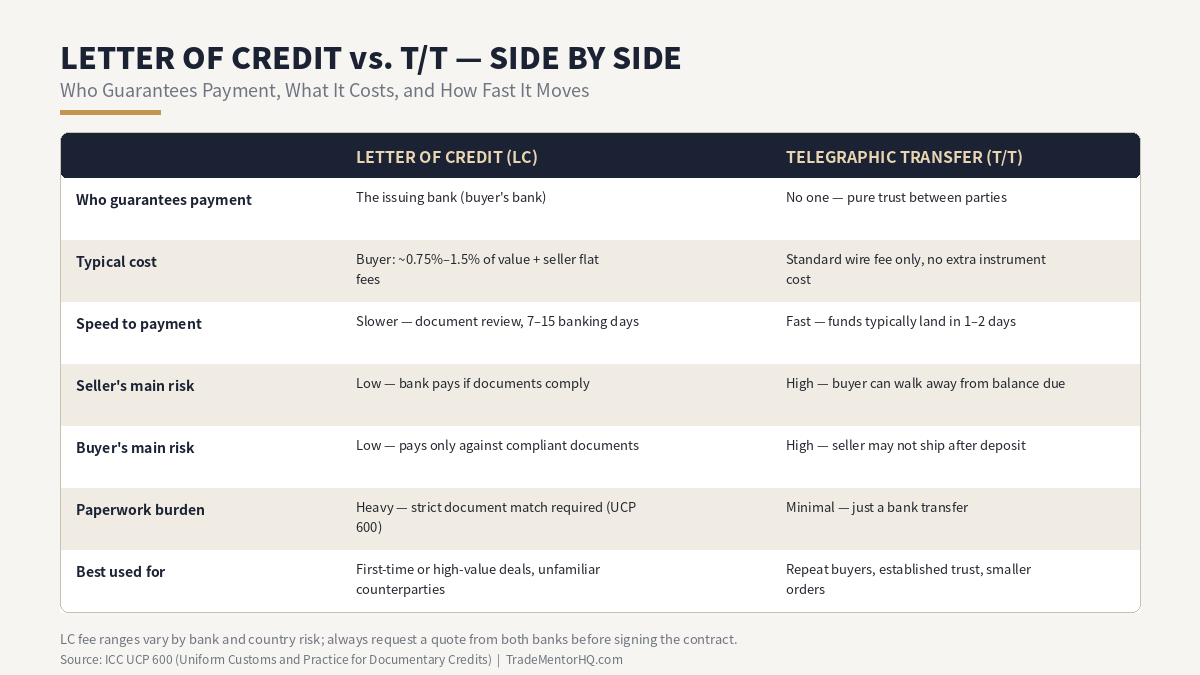
Short version: T/T (telegraphic transfer, i.e. a bank wire) is fast and cheap but relies entirely on trust between buyer and seller, while a Letter of Credit (LC) is slower and more expensive but shifts the payment guarantee onto a bank instead of a person. Which one is “better” depends on how well you know the counterparty, the size of the order, and how much risk either side can absorb if something goes wrong.
Letter of Credit vs T/T: What T/T Actually Is
A telegraphic transfer is just a bank-to-bank wire — the same mechanism as any international transfer, routed through SWIFT. There’s no document review, no bank guarantee, no conditions attached. The buyer’s bank sends money to the seller’s bank, and that’s the whole transaction.
In practice, very few exporters accept 100% of the payment upfront. The arrangement I see most often is a split — commonly 30% deposit on order confirmation, with the remaining 70% due either before shipment or against a scanned copy of the bill of lading. The exact split is negotiable and shifts with how much leverage each side has; a buyer with years of clean payment history can often talk a supplier down to a smaller deposit, while a brand-new buyer will usually be asked for more upfront.
The appeal is speed and simplicity. Once a wire is sent, funds typically land in the receiving account within a day or two, and there’s no bank fee structure to negotiate beyond a standard wire charge. For established relationships — a buyer and supplier who’ve done a dozen deals together — T/T is usually the right default. It’s cheap, it’s fast, and it doesn’t bury either party in paperwork.
Letter of Credit vs T/T: What a Letter of Credit Actually Is
An LC flips the trust relationship. Instead of the buyer promising to pay the seller, the buyer’s bank (the “issuing bank”) promises to pay the seller, provided the seller submits the exact documents specified in the credit — commercial invoice, bill of lading, packing list, certificate of origin, whatever the contract requires. The rules governing how this works globally come from the ICC’s UCP 600 framework, which is used in roughly 175 countries and underpins something on the order of a trillion dollars in trade financing every year. That’s not a niche instrument — it’s the backbone of a huge share of global trade.
The parties involved are worth knowing by name, because they show up on every LC document you’ll ever see: the applicant (the buyer, who requests the credit), the beneficiary (the seller, who gets paid), the issuing bank (the buyer’s bank, which takes on the payment obligation), and often an advising or confirming bank on the seller’s side, which notifies the seller the credit exists and — if it’s a confirmed LC — adds its own guarantee on top of the issuing bank’s.
That last point matters more than people expect. An unconfirmed LC is only as reliable as the issuing bank and the country it operates in — if that bank is in a market with capital controls, political instability, or shaky reserves, “the bank guarantees payment” is a weaker promise than it sounds. A confirmed LC, where a bank in the seller’s own country (or another stable jurisdiction) adds its guarantee, is the version experienced exporters ask for when the buyer’s bank is an unknown quantity.
Where the Real Difference Shows Up: Risk
This is the part that actually matters for deciding between them.
Under T/T, if a seller takes a 30% deposit and the buyer disappears before paying the balance, the seller is out the cost of production already sunk, minus whatever the deposit covered. If commodity prices move against the buyer mid-transit, “walking away from the deposit” is a real, documented failure mode — it happens more than either side likes to admit, especially in volatile commodity markets. On the flip side, if a buyer wires 100% upfront and the seller never ships, the buyer has no recourse beyond whatever’s in the sales contract and however enforceable that contract is across borders.
Under an LC, that risk moves to the banks. The issuing bank is on the hook to pay once compliant documents are presented — full stop, regardless of whether the buyer is happy with the goods, going through cash flow problems, or has simply changed their mind. ” The tradeoff is that LCs are unforgiving about paperwork. A misspelled company name, a bill of lading dated one day outside the credit’s shipment window, a quantity that doesn’t match to the unit — any of these can trigger a “discrepancy,” and a discrepant LC can delay payment or, worst case, let the issuing bank refuse it entirely until it’s corrected.
What Each One Actually Costs
T/T is close to free beyond the standard wire transfer fee your bank already charges — there’s no separate instrument being created, so there’s no separate fee schedule for it.
LCs cost real money, and the cost structure is asymmetric. 5% of the transaction value to their issuing bank, depending on the bank, the buyer’s credit standing, and the countries involved. Sellers typically pay a separate set of smaller flat fees — advising fees, negotiation fees, sometimes a confirmation fee if a confirming bank is added — rather than a percentage. There’s no universal fee table here; every bank prices this differently, so the only reliable way to know the real cost on a specific deal is to ask both banks for a quote before the contract is signed, not after.
So Which One Should You Use?
A few practical guidelines that hold up reasonably well across different situations:
Use T/T when you have an established relationship with the counterparty, the order size is small enough that a worst-case loss wouldn’t be catastrophic, or the buyer/seller is in a market where LCs are unusual or hard to arrange. Most repeat business between known partners settles this way for a reason — it’s simpler for everyone and nobody wants to pay LC fees on the fiftieth order with a supplier they’ve worked with for three years.
Use an LC when this is a first-time or high-value transaction with a counterparty you don’t have a payment history with, when the buyer’s country carries meaningful political or currency risk, or when either party’s internal finance/compliance team simply requires it for deals over a certain threshold. New exporters in particular tend to underestimate how much an LC protects them on that very first order with an unfamiliar buyer — it’s the one time the extra cost and paperwork is usually worth it.
A middle path worth knowing about: some buyers and sellers split the difference with a partial LC plus a T/T deposit, or use documents-against-payment (D/P) through a collecting bank, which sits somewhere between the two in both cost and risk. If neither pure T/T nor a full LC feels right for a specific deal, it’s worth asking your bank what hybrid structures they support before defaulting to whichever method you’ve always used.
👉 Read the ICC’s UCP 600 rules for documentary credits
The Bottom Line
Neither payment method is universally “safer” — they just move the risk to a different place. T/T is fast and cheap but puts the risk on trust between two companies; an LC is slower and costs real money but puts the risk on a bank’s balance sheet instead. The right call depends less on which instrument sounds more professional and more on an honest read of how well you actually know the party on the other side of the deal.
Source: ICC UCP 600 (Uniform Customs and Practice for Documentary Credits) — iccwbo.org; Trade Finance Global.
Letter of Credit vs T/T: Common Scenarios Where the Choice Matters
Real deal scenarios make the letter of credit vs T/T decision clearer than definitions alone. A first-time buyer working with a new, unverified supplier overseas typically benefits from insisting on a letter of credit vs T/T arrangement that favors LC, since the issuing bank’s involvement adds a layer of verification and payment security neither party gets with a simple wire transfer. An established relationship between a buyer and seller who have transacted successfully many times often shifts toward T/T, since the trust built over prior transactions reduces the need for a bank-mediated letter of credit vs T/T structure that adds cost and paperwork.
A seller shipping to a buyer in a country with capital controls or currency instability often insists on LC specifically for the payment certainty it provides over a T/T arrangement that depends entirely on the buyer’s bank actually releasing funds.
- New, unverified trading relationship — letter of credit vs T/T analysis usually favors LC.
- Long, trusted trading relationship — letter of credit vs T/T analysis often favors T/T for speed and lower cost.
- Buyer in a country with currency or capital control risk — letter of credit vs T/T considerations often favor LC.
Letter of Credit vs T/T: A Side-by-Side Comparison
Comparing letter of credit vs T/T directly on the factors that matter most makes the trade-offs concrete.
| Factor | Letter of Credit | T/T |
|---|---|---|
| Payment security | High — bank-guaranteed | Lower — depends on trust |
| Cost | Higher — bank fees | Lower — minimal bank fees |
| Speed | Slower — document review required | Faster — direct transfer |
| Best suited for | New or higher-risk relationships | Established, trusted relationships |
Frequently Asked Questions: Letter of Credit vs T/T
Is letter of credit vs T/T always about trust level? Trust is the biggest factor, but letter of credit vs T/T decisions also depend on deal size, country risk, and how time-sensitive the transaction is.
Can letter of credit vs T/T terms be mixed within one deal? Yes — some contracts use a partial T/T deposit combined with a letter of credit for the balance, blending elements of both approaches.
Which is faster, letter of credit vs T/T? T/T is almost always faster, since a letter of credit requires document preparation and bank review before funds release.
Letter of Credit vs T/T: Negotiating Terms
The letter of credit vs T/T choice is often negotiable rather than fixed, and the party with more leverage in a deal typically gets their preferred method. A seller in high demand can often insist on LC terms even with an established buyer, while a buyer purchasing in large volume can sometimes push a seller toward T/T despite the seller’s preference for bank-guaranteed payment. Understanding which party actually holds more leverage in a specific deal helps set realistic expectations before proposing a letter of credit vs T/T structure to a counterparty.
Letter of Credit vs T/T: Documentation Requirements
Documentation demands differ substantially between the two methods. A letter of credit requires a precise set of documents — commercial invoice, bill of lading, packing list, certificate of origin, and often an inspection certificate — all matching the LC’s terms exactly, since even a minor discrepancy can delay or block payment release by the issuing bank. T/T requires none of this bank-mediated document matching, since payment is simply transferred based on the buyer’s own decision to pay, typically upon receiving an invoice or after goods ship.
This documentation burden is one of the main reasons letter of credit vs T/T decisions favor T/T for straightforward, low-risk transactions where the extra paperwork of an LC adds cost without adding meaningful protection.
Letter of Credit vs T/T: Bank Fees and Total Cost
Bank fees for a letter of credit typically include issuance fees charged to the buyer’s bank, advising fees charged to the seller’s bank, and sometimes confirmation fees if a second bank guarantees payment beyond the issuing bank’s own creditworthiness. These fees can add up to a meaningful percentage of smaller transactions, making the choice between the two methods partly an economic one — the added security may not be worth the cost for smaller, lower-risk deals, while it becomes clearly worthwhile as transaction size and counterparty risk both increase.
Letter of Credit vs T/T: Hybrid Approaches
Many deals don’t settle on a pure letter of credit vs T/T choice but instead blend elements of both. A common hybrid is a partial T/T deposit — often 30% upfront — with the balance paid via letter of credit or upon presentation of shipping documents, splitting risk between both parties rather than placing it entirely on one side. Another hybrid structure uses a standby letter of credit purely as a backup guarantee, with actual payment flowing via T/T under normal circumstances, only drawing on the LC if the buyer fails to pay as agreed.
These hybrid letter of credit vs T/T structures are especially common in relationships that are established but not yet fully trusted, offering a middle ground between the cost of a full LC and the risk of a pure T/T arrangement.
Letter of Credit vs T/T: A Decision Framework
Working through a simple decision framework helps settle the letter of credit vs T/T question for a specific deal. First, how long has this trading relationship existed, and how many successful transactions have already occurred? Second, what is the deal size relative to the business’s overall risk tolerance? Third, does the destination country carry meaningful currency, political, or banking-system risk? Deals scoring high on relationship trust and low on country risk generally lean toward T/T, while the reverse points toward LC, with hybrid structures filling the middle ground for deals that don’t clearly fall into either category.
Letter of Credit vs T/T: Common Disputes and How to Avoid Them
Disputes under a letter of credit typically arise from document discrepancies — a shipping date that doesn’t match the LC’s stated deadline, a quantity mismatch between the invoice and packing list, or a missing certificate the LC required. Careful document preparation, cross-checked against the LC’s exact terms before submission, avoids the vast majority of these issues. Disputes under T/T more often arise from timing disagreements — a buyer claiming payment was sent when the seller hasn’t received it, or a seller shipping before confirming funds actually cleared.
Clear written agreement on exactly when payment must clear relative to shipment, documented before goods ship, prevents most letter of credit vs T/T timing disputes regardless of which method is chosen.
Final Verdict: How to Decide Between Letter of Credit and T/T
Letter of credit vs T/T ultimately comes down to trust, deal size, and country risk — there’s no universally correct answer, only the option that best fits a specific relationship and transaction. Revisiting this choice as a trading relationship matures, rather than defaulting permanently to whichever method was used on the first deal, tends to save money as trust builds over time.
On cost and speed: issuing a letter of credit typically costs the buyer’s bank fee of around 0.75–1.5% of the LC value (plus separate confirming/advising bank fees on the seller’s side), and the documentary review process commonly takes 5–10 business days once documents are presented.
A T/T (wire transfer), by contrast, usually costs a flat $15–50 bank fee and can settle same-day to a couple of business days — but that speed and low cost come with zero built-in payment security, since T/T offers no mechanism forcing the buyer to pay before or upon shipment unless you’ve structured it that way contractually. The fee gap is real, but it’s worth weighing against what an LC actually buys you: a bank-backed payment guarantee contingent on compliant documents, not just “more paperwork.”
Related Reading
- Incoterms 2020 Explained: A Practical Guide for Importers and Exporters
- How to Classify Your Product with the Correct HS Code (and Avoid Costly Mistakes)
Written by the TradeMentorHQ editorial team. We research primary sources — ICC rules, WCO and customs-authority guidance, and UCP 600 — before every article, and we’re upfront about how the site is produced on our About page. Spotted something that needs a correction? Let us know.

About the Author: TradeMentorHQ Team
The TradeMentorHQ team researches and writes practical, plain-language guides on Incoterms, customs clearance, trade finance, and shipping logistics for small business owners, first-time importers/exporters, and side-hustle sellers. Our articles are grounded in publicly available regulations and guidance from bodies like U.S. Customs and Border Protection (CBP), the International Chamber of Commerce (Incoterms 2020), and established industry practice, and we link to primary sources wherever a number or rule could change. We are not customs brokers, freight forwarders, or licensed trade attorneys, and nothing here is a substitute for advice from one on your specific shipment.