
Incoterms 2020 explained plainly: these eleven trade terms define exactly who pays for freight and insurance, and precisely where risk shifts from seller to buyer during shipment. This article keeps Incoterms 2020 explained through real-world scenarios rather than dense legal language, so both new and experienced traders can apply the rules confidently to an actual contract.
If you’ve ever stared at a purchase order that says “FOB Shanghai” or “DDP Los Angeles” and quietly wondered what you actually just agreed to, you’re not alone. Incoterms confuse even people who’ve been in freight for years, mostly because the terms sound similar but shift very different obligations — and costs — between buyer and seller.
Here’s the short version before we get into the details: Incoterms 2020 are eleven three-letter rules, published by the International Chamber of Commerce, that define exactly where the seller’s responsibility ends and the buyer’s begins — for costs, risk, and (in some terms) insurance. Get the wrong one on a contract and you can end up paying for insurance you didn’t need, or discovering that “your” cargo was legally the buyer’s problem the moment it left the warehouse.
Incoterms 2020 Explained: Why This Isn’t Just Paperwork
I’ve reviewed enough purchase orders to say this with confidence: the Incoterm on the contract is usually the single line item that decides who eats the cost when something goes wrong mid-shipment. A container gets damaged in transit, a vessel is delayed at port, customs holds a shipment for inspection — the Incoterm, not the invoice total, tells you whose problem that is.
That’s also why Incoterms matter for pricing. Two suppliers quoting the “same” price under EXW and DDP are not actually comparable numbers — one excludes freight, insurance, and duties entirely, and the other bundles all of it in. New importers compare these headline prices directly more often than you’d expect, and it’s an easy way to end up over budget.
Incoterms 2020 Explained: The Two Families of Terms
The eleven rules split into two groups, and the split itself is useful to remember because it tells you when each group applies:
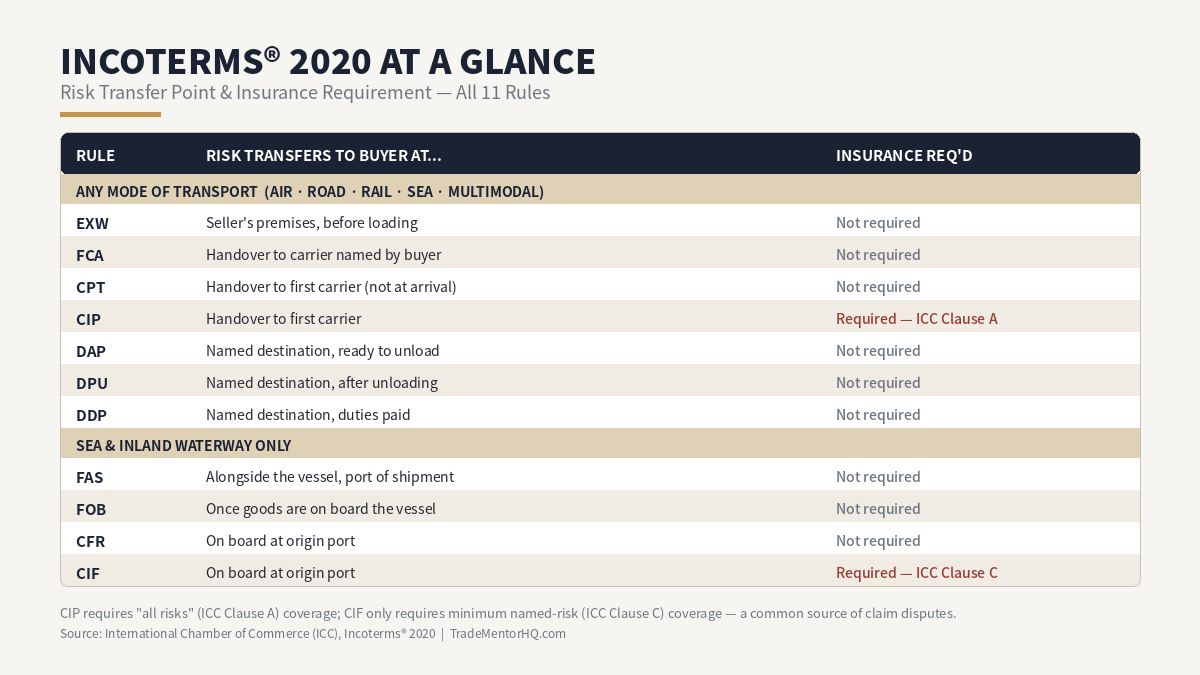
Rules for any mode of transport (used for air, road, rail, sea, or multimodal shipments): EXW, FCA, CPT, CIP, DAP, DPU, DDP.
Rules for sea and inland waterway transport only (bulk cargo, break bulk, or anything where the goods are handed over at a specific vessel or port): FAS, FOB, CIF, CFR.
That second point trips people up constantly. FOB and CIF were written for an era of break-bulk shipping where cargo crossed a ship’s rail by crane. If you’re shipping in a container, the goods are handed to the carrier at a container yard well before the vessel — so technically FOB doesn’t describe what’s physically happening. The ICC’s own guidance recommends FCA instead for containerized freight, precisely for this reason. A lot of contracts still use FOB for container shipments out of habit, and it mostly works out — but it’s worth knowing you’re using a term slightly outside its intended scope.
Breaking Down All 11 Terms
Below is the practical breakdown: who arranges transport, who pays, and where risk actually transfers from seller to buyer. This is the part worth bookmarking.
Any mode of transport
- EXW — Ex Works. Seller’s only job is to make the goods available at their own premises. Buyer handles everything from there: loading, export clearance, main transport, import clearance, delivery. Maximum obligation on the buyer, minimum on the seller.
- FCA — Free Carrier. Seller delivers the goods, cleared for export, to a carrier or location named by the buyer. Risk transfers at that handover. This is the term ICC recommends over FOB for container cargo.
- CPT — Carriage Paid To. Seller arranges and pays for transport to the named destination, but risk transfers to the buyer once the goods are handed to the first carrier — not when they arrive. That gap surprises people.
- CIP — Carriage and Insurance Paid To. Same as CPT, but the seller must also buy cargo insurance — and as of the 2020 revision, at a higher minimum coverage level (Institute Cargo Clauses A, “all risks”) than the old CIF/CIP standard.
- DAP — Delivered at Place. Seller delivers the goods, ready for unloading, at the named destination. Buyer handles import clearance and duties.
- DPU — Delivered at Place Unloaded. The only Incoterm where the seller is responsible for unloading at the destination. Everything else about it mirrors DAP.
- DDP — Delivered Duty Paid. Maximum obligation on the seller: delivery, import clearance, and duties all included. Sounds convenient for the buyer, but sellers who aren’t set up to handle foreign customs procedures can create serious delays trying to fulfill this one.
Sea and inland waterway only
- FAS — Free Alongside Ship. Seller delivers the goods alongside the vessel at the port of shipment. Buyer takes over from there, including loading.
- FOB — Free on Board. Seller delivers once the goods are loaded on board the vessel. Widely used, technically intended for non-containerized cargo.
- CFR — Cost and Freight. Seller pays for transport to the destination port, but risk transfers once goods are on board at the origin port — same timing quirk as CPT.
- CIF — Cost, Insurance and Freight. Same as CFR, plus the seller must insure the cargo — though at a lower minimum coverage level than CIP (Institute Cargo Clauses C is acceptable here, which only covers named risks, not “all risks”).
Where People Actually Get Burned
Three mistakes show up over and over in the contracts I’ve seen:
First, treating FOB and FCA as interchangeable for container shipments. They’re not — the risk transfer point is genuinely different, and in a dispute, that difference is what an insurer or arbitrator will look at.
Second, assuming CIF and CIP insurance coverage is the same. It isn’t, and this one has real money behind it: CIF only requires minimum coverage (Institute Cargo Clauses C), while CIP now requires the broader “all risks” coverage (Institute Cargo Clauses A) as of the 2020 update. A buyer who assumes CIP-level protection under a CIF contract can find out the hard way, after a claim gets denied, that partial losses like water damage from rough handling simply weren’t covered.
Third — and this is the one that costs the most in practice — first-time exporters quoting DDP without actually knowing how to clear customs in the destination country. It looks like a value-add on the quote. It becomes a demurrage bill and an angry buyer when the shipment sits at a foreign port because nobody on the seller’s side knew how to file the import declaration.
How to Actually Choose One
A rough rule of thumb that holds up reasonably well: the less experience you have shipping internationally, the more you want a term that keeps responsibility on the side of whoever has that experience. New exporters are often better off quoting FCA or CPT and letting an experienced buyer (or their freight forwarder) handle the international leg, rather than reaching for DDP because it “sounds more professional.”
On the buying side, the questions worth asking a supplier are simple: Where exactly does risk transfer? Who’s arranging insurance, and at what coverage level? And does the quoted price include duties, or not? If a supplier can’t answer those three questions clearly, that’s worth treating as a signal on its own.
👉 See the official ICC Incoterms® 2020 rules and full rule text
The Bottom Line
Incoterms 2020 aren’t just abbreviations on a purchase order — they’re the actual allocation of cost, risk, and responsibility between two parties who may never meet in person. Misreading one term can mean paying for insurance twice, discovering a claim isn’t covered, or absorbing a customs delay that was never supposed to be your problem. Worth the ten minutes it takes to actually check.
Source: International Chamber of Commerce (ICC), Incoterms® 2020 official rules — iccwbo.org.
Incoterms 2020 Explained Through a Real Shipment
Walking through a single hypothetical shipment makes Incoterms 2020 explained far more concrete than reading rule text alone. Picture a furniture manufacturer in Vietnam selling a container of dining tables to a retailer in Germany. Under FOB terms, Incoterms 2020 explained here means the seller’s job ends once the goods are loaded aboard the vessel at the Vietnamese port — everything after that, including ocean freight, insurance, and destination customs, becomes the buyer’s responsibility. Under DDP terms, the same Incoterms 2020 explained scenario flips entirely: the seller now handles freight, insurance, and even German import duties, delivering the tables all the way to the retailer’s warehouse door.
The furniture itself never changes — only who is contractually on the hook for each leg of the journey changes, which is exactly what Incoterms 2020 explained through a concrete example makes obvious in a way abstract definitions don’t.
Incoterms 2020 Explained: Reading a Term Correctly
A term like “FCA Rotterdam” only makes sense once you know how to parse it, and Incoterms 2020 explained properly always breaks a term into two parts: the three-letter code itself, and the named place that follows it. The code defines the allocation of cost and risk; the named place defines exactly where that allocation takes effect. Traders who only memorize the eleven codes without paying attention to the named place often make costly assumptions — Incoterms 2020 explained correctly means recognizing that “FCA Seller’s Factory” and “FCA Destination Port” shift risk at two completely different points, even though both use the identical three-letter code.
| Term Component | What it defines in Incoterms 2020 explained terms |
|---|---|
| Three-letter code | Who pays for freight, insurance, and duties |
| Named place | Exactly where risk transfers from seller to buyer |
Frequently Asked Questions: Incoterms 2020 Explained
Do Incoterms 2020 apply automatically to a contract? No — Incoterms 2020 explained simply means the rules only apply when a contract explicitly references them, so omitting that reference leaves the term’s meaning open to dispute.
Are all eleven Incoterms 2020 terms used equally often? No — in practice, FOB, CIF, FCA, and DDP account for the large majority of real-world usage, while several of the eleven terms appear rarely outside specific niche trades.
Does choosing an Incoterm affect who owns the goods? No — Incoterms 2020 explained clearly separates risk transfer from ownership transfer, which is typically governed by separate contract clauses or the applicable sale of goods law.
Incoterms 2020 Explained: A Short Glossary of Related Terms
A few adjacent terms often come up alongside Incoterms 2020 explained discussions and are worth knowing. “Named place” refers to the specific location — a port, a factory, a warehouse — that anchors where risk actually transfers. “Multimodal” describes shipments using more than one mode of transport, relevant since several Incoterms 2020 terms are usable for any mode while a handful apply only to sea and inland waterway transport. “Ex Works” (EXW) represents the minimum obligation a seller can take on, useful as a reference point when Incoterms 2020 explained comparisons discuss how much responsibility shifts as you move toward DDP at the opposite end of the spectrum.
Incoterms 2020 Explained: The Insurance Question
Insurance obligations are one of the more commonly misunderstood pieces once Incoterms 2020 explained moves past the basic risk-transfer concept. Only two terms — CIF and CIP — actually obligate the seller to purchase insurance on the buyer’s behalf, and the 2020 revision raised the required coverage level under CIP specifically, from minimum coverage to a broader standard.
Under every other term, insurance is left entirely to whichever party bears the risk at that stage of the journey, meaning a buyer relying on FOB or FCA terms needs their own cargo insurance arranged independently, since Incoterms 2020 explained without that insurance in place leaves a real gap between where risk transfers and where actual financial protection exists.
Incoterms 2020 Explained: What Changed From the 2010 Version
Contracts sometimes still cite the 2010 rules, so Incoterms 2020 explained alongside its predecessor helps clarify what actually changed. The most significant update raised CIP’s insurance requirement as noted above. A second change renamed DAT (Delivered at Terminal) to DPU (Delivered at Place Unloaded), broadening where delivery under that term can occur beyond a fixed terminal location. The revision also expanded guidance on security-related obligations and on arranging transport using the buyer’s or seller’s own vehicles rather than exclusively through third-party carriers.
Older contracts referencing the 2010 rules remain legally valid, but Incoterms 2020 explained recommends updating new agreements to reference the current version to avoid any ambiguity about which rule set actually governs.
Incoterms 2020 Explained: A Checklist Before Signing a Contract
A short checklist helps catch the most common errors before a term is written into a contract. Confirm the three-letter code and the named place are both spelled out explicitly — never leave “FCA” standing alone without a location attached. Confirm the mode of transport matches the term: sea-only codes like FOB and CIF should never appear on an air freight or trucking-only contract. Confirm which party is responsible for insurance, and at what coverage level, since only two of the eleven terms address this automatically. Confirm which party handles export and import customs clearance, since this differs dramatically between a term like EXW and a term like DDP.
Running through this checklist every time keeps Incoterms 2020 explained principles from staying theoretical and turns them into a practical habit applied consistently across every contract.
Incoterms 2020 Explained: Why Freight Forwarders Matter Here
A freight forwarder often plays a quiet but significant role in how a specific Incoterm actually plays out in practice, since forwarders frequently recommend a term based on what’s operationally convenient for them rather than what best serves either the buyer or seller. Asking a forwarder directly why they’re recommending a particular term, and comparing that reasoning against what Incoterms 2020 explained about risk and cost allocation, helps confirm the recommendation actually serves your interests rather than simply matching the forwarder’s usual workflow.
A client who understands these rules well enough to ask informed questions tends to end up with better-negotiated terms than one who defers entirely to whatever a forwarder suggests first.
Incoterms 2020 Explained: Common Pitfalls to Avoid
A handful of recurring pitfalls trip up even experienced traders. Using FOB or CIF for a containerized ocean shipment is one of the most common — these two terms were built for break-bulk cargo loaded directly over a ship’s rail, and Incoterms 2020 explained through the lens of modern containerized shipping recommends FCA or CIP instead for that scenario. Assuming DDP eliminates every import obligation for the buyer is another pitfall, since local VAT registration or specific import licenses can still require buyer involvement even under DDP.
A third pitfall is treating the named place as optional detail rather than a core part of the term itself, since two contracts using the identical three-letter code but different named places can allocate risk very differently. Avoiding these three pitfalls resolves the large majority of real-world Incoterms disputes before they ever reach a courtroom or arbitration panel.
Picking the Right Incoterm for Your Shipment
Incoterms 2020 explained at its simplest is a shared vocabulary that prevents costly misunderstandings between a buyer and seller who may never have negotiated a shipping contract together before. Referencing the correct term and named place explicitly in every contract, rather than assuming both parties share the same informal understanding, is the single habit that prevents most Incoterms 2020 disputes before they start.
One Incoterm worth extra caution on: DDP (Delivered Duty Paid) requires the seller to act as the Importer of Record in the buyer’s country, which in the U.S. specifically means having a customs bond and, in most cases, an IRS-issued EIN or equivalent registration — something many overseas sellers simply aren’t legally set up to do on their own. In practice, an overseas seller quoting DDP terms into the U.S.
is usually relying on a customs broker to act as Importer of Record on their behalf (for a fee), and if that arrangement isn’t actually in place, the shipment can get stuck at the border with no legal importer to clear it. If you’re a buyer being quoted DDP pricing, it’s worth directly asking the seller who their Importer of Record will be rather than assuming the term alone guarantees smooth customs clearance.
Related Reading
- Letter of Credit (LC) vs T/T: Which Payment Method Should You Choose?
- How to Classify Your Product with the Correct HS Code (and Avoid Costly Mistakes)
Written by the TradeMentorHQ editorial team. We research primary sources — ICC rules, WCO and customs-authority guidance, and UCP 600 — before every article, and we’re upfront about how the site is produced on our About page. Spotted something that needs a correction? Let us know.

About the Author: TradeMentorHQ Team
The TradeMentorHQ team researches and writes practical, plain-language guides on Incoterms, customs clearance, trade finance, and shipping logistics for small business owners, first-time importers/exporters, and side-hustle sellers. Our articles are grounded in publicly available regulations and guidance from bodies like U.S. Customs and Border Protection (CBP), the International Chamber of Commerce (Incoterms 2020), and established industry practice, and we link to primary sources wherever a number or rule could change. We are not customs brokers, freight forwarders, or licensed trade attorneys, and nothing here is a substitute for advice from one on your specific shipment.