
Short answer: Amazon FBA for beginners is still workable in 2026, but it’s a slower, more capital-intensive side hustle than the “quit your job in six months” pitch you’ll see online.
Bottom line up front for anyone skimming: amazon fba for beginners works in 2026, but only with realistic capital and realistic patience.
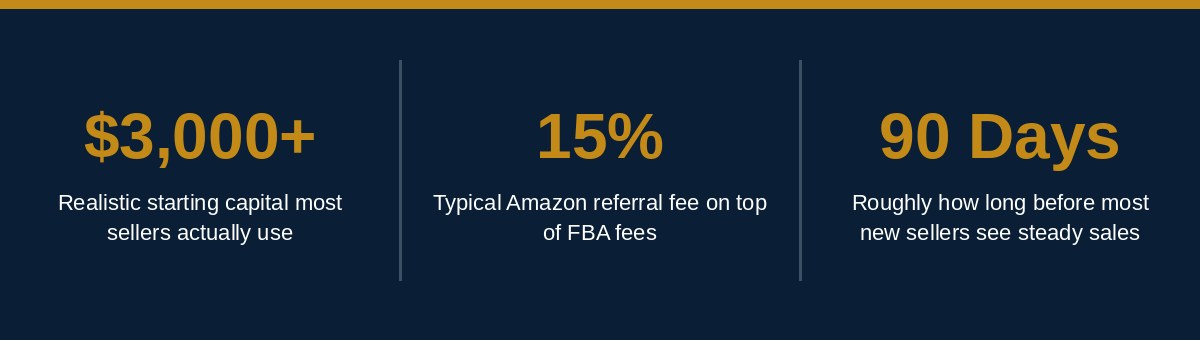
Realistic starting capital is closer to $3,000–5,000 once you account for inventory, Amazon’s referral and fulfillment fees, and a cushion for the first few months before sales become predictable. This guide walks through what FBA actually costs today, how the fee structure works, the sourcing methods that are still realistic for a beginner, and the honest tradeoffs against reselling on eBay, Poshmark, or Depop instead.
Why Amazon FBA for Beginners Still Gets So Much Attention
Amazon FBA for beginners keeps showing up in side-hustle content for a straightforward reason: Amazon’s built-in customer base is enormous, and FBA removes the single biggest operational headache of e-commerce — packing and shipping every order yourself — in exchange for fees that, done right, still leave room for profit.
That combination is genuinely attractive compared to building a standalone online store from scratch and driving your own traffic to it. The gap between the pitch and reality is mostly about pace and capital: FBA rewards patience and enough starting cash to survive a slow first product test, and it punishes sellers who go all-in on inventory before validating that a product actually sells.
What Amazon FBA Actually Is
Fulfillment by Amazon means you send inventory to an Amazon warehouse, and Amazon handles storage, packing, shipping, customer service, and returns for every order — in exchange for storage and fulfillment fees on top of Amazon’s standard referral fee (commission) on each sale.
That’s the entire value proposition: you’re trading a meaningful chunk of your margin for not having to personally pack and ship every order, which is what makes FBA appealing to people running it as a side hustle around a full-time job rather than a full-time operation. The alternative, Fulfillment by Merchant (FBM), keeps more of your margin but means you’re personally responsible for shipping every order fast enough to satisfy Amazon’s performance metrics.
What It Actually Costs to Start
Beyond the inventory itself, three fee categories matter for Amazon FBA beginners. Amazon’s referral fee is typically around 15% of the item’s sale price for most categories, though it varies by category and can run higher or lower. FBA fulfillment fees are charged per unit based on size and weight, and cover picking, packing, and shipping the order to the customer.
Monthly storage fees are charged based on the space your inventory occupies in Amazon’s warehouses, and they increase substantially during the October–December peak season, which catches a lot of first-time sellers off guard if they’ve overstocked ahead of the holidays.
Stacking these together, a realistic rule of thumb many sellers use is that Amazon’s combined fees eat somewhere in the range of 30–40% of the sale price once referral fee, fulfillment fee, and storage are all counted, before you’ve subtracted the cost of the product itself. That’s the number beginners consistently underestimate when they first pencil out whether a product idea is actually profitable.
This is a common question for anyone new to reselling: is amazon fba for beginners actually a realistic way to start, or just marketing hype?
Sourcing: Where Beginner Inventory Actually Comes From
There are three realistic sourcing paths for a beginner, each with a different risk and effort profile. Retail arbitrage means buying discounted or clearance items from local retail stores and reselling them at a markup on Amazon — low upfront cost and easy to learn the mechanics on, but genuinely time-intensive and hard to scale past a part-time hustle.
Online arbitrage is the same idea but sourcing from online clearance and discount listings instead of physically visiting stores, trading some of the driving-around time for more hours spent scanning listings.
Private label — sourcing a generic product from a manufacturer (often found through supplier platforms like Alibaba) and selling it under your own brand — has higher profit potential per unit but requires more upfront capital, a minimum order quantity from the supplier, and real product research to avoid oversaturated categories. Most beginners start with retail or online arbitrage to learn Amazon’s systems with lower financial risk, then consider private label once they understand the fee structure and have some cash flow to work with.
A Worked Fee Example
Numbers make this concrete. Say you source a small kitchen gadget for $6 per unit and plan to sell it on Amazon for $20. Amazon’s referral fee at roughly 15% takes about $3.
A typical FBA fulfillment fee for a small, lightweight item might run around $4–5 depending on exact size and weight tier. Add a modest per-unit share of monthly storage fees, and you’re looking at total Amazon fees in the neighborhood of $8–9 on that $20 sale — before subtracting your $6 product cost.
That leaves a gross margin of roughly $5–6 per unit, which sounds thin until you realize this is exactly the calculation beginners skip, listing a product at a price that looks profitable until the fees are actually itemized. Running this exact math — product cost, referral fee, fulfillment fee, and a storage estimate — on any product idea before ordering inventory is the single highest-leverage habit a new FBA seller can build, and Amazon’s own revenue calculator tool will do this arithmetic for a specific product and size tier automatically.
How to Pick a Product Category as a Beginner
Category choice matters more than most first-time sellers expect. A few practical filters help narrow the field: avoid categories requiring Amazon’s separate “ungating” approval process until you have some seller history, since gated categories (including many health, grocery, and some electronics subcategories) add friction beginners don’t need on a first product. Favor small, lightweight, non-fragile items, since size and weight drive fulfillment fees directly and fragile items increase return and damage rates.
Look for products with steady, moderate demand rather than viral trend items, since trend-driven products can collapse in demand as fast as they spiked, leaving you with unsellable inventory. And check existing review counts on top listings in a category before entering it — a category where every top result has thousands of reviews is much harder to break into than one where competition is thinner. None of these rules guarantee a winning product, but they meaningfully reduce the odds of a beginner’s first, smallest test order becoming an expensive lesson.
Most guides aimed at amazon fba for beginners skip the part where fees quietly eat a third of your revenue.
Is FBA Reselling Still Worth It in 2026?
The honest answer is: it depends on your expectations. FBA is not the easy passive-income path some course-sellers market it as — it’s a real small-business operation with real inventory risk, and it typically takes new sellers on the order of a few months of consistent listing and iterating before sales become steady rather than sporadic.
Where it’s still genuinely worth it: as a side hustle you run for a few hours a week around a job, treating the first several months as a learning period rather than expecting immediate profit, and reinvesting early proceeds into better inventory rather than withdrawing them. Where it’s not worth it: expecting to source products you don’t understand, in categories you haven’t researched, and turn a profit within weeks with no working capital cushion — that’s the scenario responsible for most of the “I lost money on FBA” stories.
Amazon FBA vs Reselling on eBay, Poshmark, or Depop
FBA isn’t the only reselling path, and it isn’t automatically the best one for every beginner. eBay, Poshmark, and Depop all let you list and ship items yourself (no warehouse fees, no minimum inventory), which means lower fixed costs and more control, at the cost of handling every shipment personally and generally reaching a smaller, more curated buyer pool than Amazon’s search traffic. For clothing, collectibles, and one-off or vintage finds, a peer-to-peer platform is often the better starting point precisely because those categories don’t scale well on Amazon anyway.
For generic, repeatable products where you can source the same item multiple times, Amazon’s larger built-in customer base and FBA’s hands-off fulfillment tend to win out once you’re past the learning phase. Many sellers who stick with reselling long-term eventually run both channels side by side rather than picking one permanently.
Returns, Reviews, and Customer Service Under FBA
One underappreciated advantage of FBA for a beginner is that Amazon handles customer service and returns on your behalf, following Amazon’s own policies rather than requiring you to negotiate every return request personally — a meaningful time savings compared to FBM or a peer-to-peer platform, where you’re fielding every message yourself.
The tradeoff is that you have less control over how a return dispute is resolved, since Amazon’s policies favor the buyer in most ambiguous cases, and a high return rate on a product (common in categories like apparel or anything size-dependent) eats directly into margin regardless of who’s at fault.
Reviews matter enormously on Amazon specifically because they’re the main signal new buyers use to choose between near-identical listings; a product with even a handful of detailed, photo-included reviews will consistently outsell an identical product with none, which is why many sellers prioritize customer follow-up and product quality over aggressive pricing in their first few months.
The reason amazon fba for beginners content performs so well online is simple: everyone wants passive income, and few explain the real timeline.
Common Mistakes First-Time FBA Sellers Make
The single most common mistake is underestimating total fees and pricing a product with a margin that looks fine on paper but evaporates once referral fee, fulfillment fee, and storage are all subtracted. A close second is over-ordering inventory before validating that a product actually sells, which then triggers long-term storage fees on unsold stock sitting in an Amazon warehouse.
Beginners also frequently skip researching a category’s competition and reviews before committing to a product, entering an oversaturated niche where dozens of near-identical listings are already fighting on price. Finally, many new sellers underestimate how much customs duty and import cost matters if they’re sourcing inventory directly from an overseas manufacturer rather than a domestic wholesaler — a cost that changed meaningfully in 2025 and is worth understanding before you commit to an overseas sourcing plan (see our companion guide on personal import customs duty for the current rules).
FBA vs FBM: Which Fits a Beginner Better
The FBA-versus-FBM decision comes down to what resource you have more of: time or margin. FBA trades a chunk of your per-sale profit for Amazon handling storage, packing, shipping, and returns, which suits someone running this as a side hustle around a full-time job or other commitments.
FBM keeps more margin per sale but means personally packing and shipping every order fast enough to meet Amazon’s own performance standards for seller-fulfilled listings, which is realistically a much bigger time commitment once order volume picks up. Some sellers start with FBM on a small first batch specifically to validate that a product sells at all before committing to FBA’s upfront shipping-to-warehouse cost and storage fees — a reasonable way to de-risk a first product test, even though it means more manual work in that initial phase.
A Realistic First 90 Days
Here’s what that timeline tends to look like in dollar terms, following the $6-cost, $20-price kitchen gadget from the fee example above. A first order of 100 units runs about $600 in inventory plus roughly $150–200 in FBA prep and initial inbound shipping, so a seller is realistically $750–800 out of pocket before a single unit sells.
If that batch sells through in the first four to six weeks at even a modest pace — say 3–5 units a day once the listing is dialed in — the $5–6 per-unit margin from the fee example turns into roughly $450–600 in profit, enough to fund a second, larger reorder without pulling from savings. Sellers who instead order 500 units on the first try because a supplier’s per-unit price drops are the ones most likely to be sitting on $3,000 of unsold inventory with no sales data to explain why it isn’t moving.
By roughly the 90-day mark, sellers who’ve stayed consistent typically have enough sales history to tell whether a product is worth reordering and scaling, or worth cutting losses on and moving to the next idea. Treating that first quarter as a paid research phase, rather than expecting it to already be profitable, is the mindset that separates sellers who stick with FBA long enough to see it work from those who quit after one disappointing month.
If you take one thing from this guide on amazon fba for beginners, let it be this: undercapitalized sellers quit before their first product has a fair chance.
Frequently Asked Questions
How much money do I need to start Amazon FBA? Most beginners realistically need $3,000–5,000 to cover a meaningful first inventory order, Amazon’s seller account fee, and a cushion for slow early weeks — starting with much less is possible but limits you to very small test orders.
Is Amazon FBA better than dropshipping? They’re different models — FBA means you own inventory and Amazon fulfills it, while dropshipping means a third party ships directly to the customer and you never hold stock; dropshipping has lower upfront cost but thinner margins and less quality control, while FBA requires more capital but generally more control over quality and delivery speed.
Do I need an LLC to sell on Amazon? No — you can start as an individual seller, though many sellers eventually form an LLC for liability protection and tax purposes once the business grows; this is worth discussing with a tax professional rather than assuming one path is universally correct.
Every amazon fba for beginners checklist should start with a real fee calculation, not a product idea.
How long until Amazon FBA becomes profitable? Highly variable, but a few months of consistent selling and listing optimization before sales and profit stabilize is a realistic general expectation, not the days-or-weeks timeline sometimes implied by course marketing.
Can I do Amazon FBA part-time around a full-time job? Yes, and this is how most beginners actually start — the workload is front-loaded into research, sourcing, and listing setup, and once inventory ships to Amazon’s warehouse, the day-to-day fulfillment doesn’t require constant hands-on time, which is exactly why FBA is a popular side-hustle structure compared to FBM.
What happens to unsold FBA inventory? You can request Amazon remove and ship it back to you, have it disposed of, or (where eligible) liquidated, though each option carries its own fee — and long-term storage fees accrue the longer slow-moving inventory sits in an Amazon warehouse, which is why beginners are usually advised to start with smaller test orders rather than large first purchases.
For amazon fba for beginners specifically, the biggest lever you control early on is how small your first test order is.
Do I need to source products from overseas to start FBA? No — many beginners start with domestic retail or online arbitrage, buying already-imported products at a discount rather than importing directly; sourcing straight from an overseas manufacturer usually comes later, once a seller has more experience and capital.
In short, amazon fba for beginners remains a legitimate side hustle in 2026, provided you treat the first quarter as a research phase rather than a payday.
Bottom Line
Amazon FBA for beginners in 2026 is a legitimate side hustle, not a scam and not a shortcut — it rewards people who treat the first few months as a research phase, understand the real fee structure before pricing anything, and start with inventory small enough to survive a wrong guess.
If that matches your expectations and you have a few thousand dollars you can afford to have tied up in inventory while you learn, it’s still worth doing in 2026. If you’re expecting fast, low-effort income, a peer-to-peer platform or a smaller test on eBay first will teach you the same lessons with much less money at risk.
To sum up the amazon fba for beginners math one more time: small test order, real fee math, and patience through the first slow months is what separates amazon fba for beginners who stick with it from those who quit after one bad month.
Related Reading
Amazon Seller Central • U.S. Small Business Administration — business guide • How Much Customs Duty Will You Pay on a Personal Package From China? • About TradeMentorHQ
This article is for general informational purposes and reflects fee structures and platform policies as of publication; Amazon’s fee schedule and seller policies change periodically, so confirm current rates directly in Seller Central before finalizing a pricing plan.

About the Author: TradeMentorHQ Team
The TradeMentorHQ team researches and writes practical, plain-language guides on Incoterms, customs clearance, trade finance, and shipping logistics for small business owners, first-time importers/exporters, and side-hustle sellers. Our articles are grounded in publicly available regulations and guidance from bodies like U.S. Customs and Border Protection (CBP), the International Chamber of Commerce (Incoterms 2020), and established industry practice, and we link to primary sources wherever a number or rule could change. We are not customs brokers, freight forwarders, or licensed trade attorneys, and nothing here is a substitute for advice from one on your specific shipment.