
Choosing between SWIFT vs escrow international payments is a decision every first-time B2B buyer eventually faces, and defaulting to whichever method feels familiar without weighing the tradeoffs can leave real money exposed to a counterparty who never delivers.
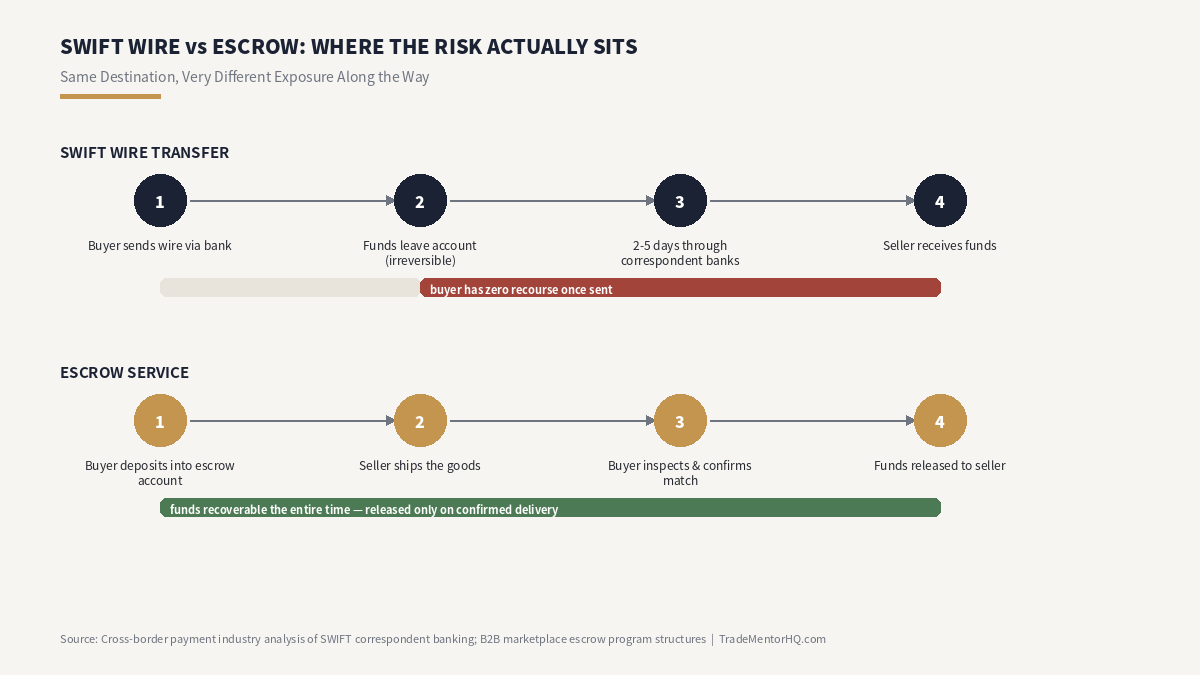
Most first-time B2B buyers default to a SWIFT wire transfer simply because it’s the payment method they already know from every other business expense — and for a domestic invoice, that instinct is fine. For a new overseas supplier you’ve never shipped with before, it’s worth pausing, because a SWIFT wire and an escrow service protect two very different things. A SWIFT wire moves money quickly between banks but offers no built-in recourse once it’s sent, while an escrow service holds the buyer’s funds with a neutral third party and only releases them once agreed conditions — like confirmed shipment or inspection — are actually met.
How a SWIFT Wire Transfer Actually Works
SWIFT itself isn’t a payment system — it’s a secure messaging network that coordinates settlement between banks through a chain of correspondent banks using what are called Nostro and Vostro accounts. In practice, a typical international wire takes two to five business days to clear, depending on the currencies involved, the number of intermediary banks in the chain, and time zone overlap. Costs are less transparent than the timing: on top of a fixed wire fee, buyers absorb variable intermediary bank charges and an often-opaque foreign exchange markup, and hidden fees across the full chain can erode the value of a transaction by 3-5% before it even reaches the seller.
The larger issue isn’t cost, though — it’s reversibility. Once a wire has left the originating account, halting or recalling it is difficult and often impossible in practice, and if a dispute arises afterward, getting funds back involves a secondary currency conversion that can compound the original loss on top of whatever the dispute was about.
How an Escrow Service Actually Works
An escrow arrangement inserts a neutral third party between buyer and seller, and the funds only move in stages tied to actual performance: the buyer deposits funds into the escrow account, the seller ships the goods, the buyer inspects and confirms the shipment matches what was agreed, and only then does the escrow provider release payment to the seller. That structure is what makes escrow fundamentally different from a wire — it doesn’t just move money faster or cheaper, it removes the moment where either party is fully exposed with nothing to show for it.
Fees run higher than a typical wire on a percentage basis, generally landing somewhere around 1-3% of the transaction value depending on the provider, though that’s often still competitive once a wire’s own FX markup and flat fees are added up. In exchange, the buyer gets confirmation that funds actually exist and are committed before the seller ships, the seller gets a guarantee that payment is available before goods leave the warehouse, and both sides get a structured dispute-resolution process if the shipment doesn’t match what was agreed — none of which a wire transfer provides once the money has already moved.
Where This Overlaps with Letters of Credit
Readers familiar with the tradeoffs between a Letter of Credit and a straight T/T wire transfer will recognize the underlying logic here — escrow is, in effect, a more accessible, lower-friction cousin of an LC. A traditional Letter of Credit accomplishes something similar by having a bank guarantee payment against compliant shipping documents, but it requires bank involvement, documentary precision, and often a credit line or cash collateral that smaller buyers and sellers don’t have easy access to.
Escrow services, particularly the ones built into B2B marketplaces, offer a lighter-weight version of that same buyer-seller protection without the banking overhead — which is part of why they’ve become the default recommendation for first-time transactions between parties with no trading history.
A Concrete Illustration
A US buyer wires $40,000 via SWIFT to a new supplier in Vietnam ahead of production, based only on a few email exchanges and a company website. The supplier turns out to be operating in bad faith, delays for weeks, and eventually stops responding entirely — and because the wire already cleared days earlier, the buyer’s bank has no mechanism to reverse it; recovering the funds would require pursuing the supplier directly, likely in a foreign jurisdiction, with no guarantee of success.
Compare that to the same order routed through an escrow service: the buyer’s $40,000 sits in the escrow account, visible and confirmed to the supplier, but it isn’t released until the buyer confirms the goods actually shipped and match the agreed specification. If the supplier never ships, the buyer simply gets the funds back — the loss never happens in the first place, rather than needing to be recovered after the fact.
When a Wire Transfer Is Still the Right Call
None of this makes SWIFT wires obsolete — for an established supplier relationship with a solid payment history, a straight wire is faster to arrange, cheaper on a percentage basis, and entirely adequate, since the trust that escrow exists to substitute for has already been built through prior transactions. Wires also remain the norm for smaller, lower-risk payments where the cost of setting up escrow isn’t justified by the amount at stake.
The decision really comes down to how well you already know the counterparty: a new supplier, a large first order, or any transaction where non-delivery would be financially painful is exactly the scenario escrow was built for, while a repeat supplier with years of on-time shipments is a reasonable candidate for a plain wire.
The Bottom Line
SWIFT wires and escrow services aren’t competing on speed or cost so much as on what happens if something goes wrong. A wire is fast and familiar but offers no safety net once sent; escrow costs a bit more and takes an extra step but keeps funds recoverable until the seller has actually delivered. For a first-time overseas supplier or a payment large enough to hurt if it disappears, that difference is usually worth the extra percentage point or two.
Source: Industry analysis of SWIFT correspondent banking mechanics and cross-border payment costs; B2B marketplace escrow/trade-assurance program structures.
How SWIFT wire transfers work for B2B payments
A SWIFT wire transfer moves funds directly between banks using the SWIFT messaging network, typically settling within one to a few business days depending on the corridor and correspondent banking chain involved. Comparing SWIFT vs escrow international payments starts with recognizing that SWIFT transfers are fast and final — once sent, funds generally cannot be recalled, and there is no built-in mechanism verifying that the seller actually ships the goods before payment clears.
This finality is exactly why SWIFT vs escrow international payments differ so much on buyer protection. A SWIFT transfer sent to a new, unverified supplier carries real non-delivery risk, since the buyer has no leverage to withhold funds once the transfer completes, unlike payment methods structured around a neutral third party holding funds until conditions are met.
How escrow services work for B2B payments
Escrow services hold the buyer’s funds with a neutral third party until agreed conditions are met — typically confirmed delivery, inspection, or documentary proof of shipment — before releasing payment to the seller. In the SWIFT vs escrow international payments comparison, escrow directly addresses the non-delivery risk that a direct SWIFT transfer leaves completely exposed.
The tradeoff is cost and speed: escrow services typically charge a percentage-based fee and add processing time compared to a direct SWIFT transfer, since funds must be verified as received and held before any release conditions can be confirmed and payment disbursed to the seller.
SWIFT vs escrow international payments: comparing cost and speed
Cost is one of the clearest dividing lines in SWIFT vs escrow international payments. A SWIFT wire transfer typically costs a flat fee per transaction, often modest relative to the transaction size. Escrow services instead charge a percentage of the transaction value, which can become a meaningful cost on larger deals, making SWIFT vs escrow international payments a genuine cost-versus-protection tradeoff rather than a simple better-or-worse choice.
Speed follows a similar pattern in the SWIFT vs escrow international payments comparison: SWIFT transfers settle in days, while escrow arrangements add the time needed to confirm delivery conditions before releasing funds, which can extend total transaction time by a week or more depending on shipping and inspection timelines.
Put numbers on it: a SWIFT wire transfer typically runs $25–50 in sending-bank fees plus another $15–30 in intermediary and receiving-bank charges, so a $50,000 payment might cost $40–80 total regardless of size — a rounding error on that transaction.
An escrow service charging a typical 1–3% fee on the same $50,000 deal runs $500–1,500, thirty times more expensive in dollar terms, though the buyer is paying for a fundamentally different thing: a third party holding the funds until delivery is confirmed, rather than an irreversible transfer with no recourse if the goods never arrive. On a $2,000 first order from a new, unverified supplier, that same 1–3% escrow fee is only $20–60 — cheap insurance against a total loss the SWIFT route can’t offer.
When SWIFT makes more sense than escrow
For established trading relationships with a long history of on-time delivery, defaulting to a direct SWIFT transfer within the SWIFT vs escrow international payments decision often makes sense — the relationship itself has already built the trust that escrow’s third-party verification is designed to substitute for with new or unfamiliar counterparties.
Smaller transaction values also tip the SWIFT vs escrow international payments decision toward SWIFT, since escrow’s percentage-based fee can represent a disproportionate cost on a modest transaction, even though the underlying non-delivery risk is proportionally the same as on a larger deal.
When escrow makes more sense than SWIFT
New buyer-seller relationships, high transaction values, or deals involving a counterparty in a jurisdiction with weak legal recourse all push the SWIFT vs escrow international payments decision toward escrow. The added cost and time are a reasonable price for verified delivery before funds are released, especially when a failed transaction would be difficult or impossible to recover through other means.
Marketplaces and platforms facilitating first-time B2B introductions increasingly build escrow into their standard payment flow specifically because SWIFT vs escrow international payments risk is highest exactly when two parties have no prior trading history to rely on instead.
Risks specific to each method
The core risk in SWIFT vs escrow international payments on the SWIFT side is straightforward non-delivery or fraud: once a wire transfer is sent, recovering funds from an uncooperative or fraudulent counterparty is extremely difficult, often requiring litigation in the seller’s jurisdiction with no guarantee of success. Wire fraud targeting exactly this gap — impersonating a legitimate supplier to redirect a SWIFT payment — remains a persistent B2B threat.
Escrow is not risk-free either. Choosing a disreputable or fraudulent escrow provider undermines the entire premise of SWIFT vs escrow international payments protection, since a fake escrow service can simply disappear with funds just as easily as a fraudulent direct-payment counterparty. Verifying that an escrow provider is licensed and reputable is a necessary step, not an optional one.
Combining methods for extra protection
Some B2B buyers manage SWIFT vs escrow international payments risk by combining approaches — using escrow for a first, trust-building transaction with a new supplier, then transitioning to direct SWIFT transfers once a track record of reliable delivery is established. This staged approach captures escrow’s protection when it matters most while avoiding its added cost on every future transaction indefinitely.
Trade credit insurance and letters of credit are additional tools that can layer onto either side of the SWIFT vs escrow international payments decision, providing further protection for buyers or sellers who want more security than either method alone provides.
Frequently asked questions about SWIFT vs escrow international payments
Is escrow always safer than a direct SWIFT transfer? Generally yes for new counterparties, since escrow verifies delivery conditions before releasing funds, but only if the escrow provider itself is legitimate and properly vetted.
Does using escrow eliminate all payment risk? No — it substantially reduces non-delivery risk but does not eliminate every risk, including fraud involving the escrow provider itself or disputes over whether release conditions were actually met.
Can escrow be used for very large international transactions? Yes, and it is often specifically recommended for larger transactions precisely because the percentage-based fee is proportionally smaller relative to the risk being mitigated.
How to vet an escrow provider before using one
Before committing to escrow on either side of the SWIFT vs escrow international payments decision, confirm the provider is properly licensed as a money transmitter or escrow agent in its operating jurisdiction, check for independent reviews or trade association endorsements, and avoid any provider that pressures for unusually fast fund release or resists standard verification steps.
Reputable platforms facilitating SWIFT vs escrow international payments transactions typically publish their licensing information and dispute resolution process clearly, and a legitimate provider will not object to a buyer or seller asking detailed questions about how funds are held and released before agreeing to use the service.
Documentation both methods should include
Regardless of which side of SWIFT vs escrow international payments a transaction uses, clear documentation protects both parties: a detailed purchase order or contract specifying delivery terms, inspection rights, and payment release conditions reduces the chance of a dispute regardless of the payment mechanism chosen.
For SWIFT transfers specifically, retaining bank confirmation and correspondence proving the payment instruction matched the agreed invoice details helps guard against wire fraud. For escrow, retaining the escrow agreement and release condition documentation protects against disputes over whether funds were released appropriately under the SWIFT vs escrow international payments arrangement chosen.
How platforms and marketplaces are changing this decision
B2B marketplaces increasingly bake payment protection directly into their platforms, offering built-in escrow-style holds as a default rather than requiring buyers and sellers to separately arrange SWIFT vs escrow international payments themselves. This shift reflects growing recognition that non-delivery risk is a major barrier to first-time cross-border trade between parties who have never worked together before.
Even as platform-native protection grows more common, understanding the underlying SWIFT vs escrow international payments tradeoffs remains valuable for transactions that happen outside a marketplace — direct supplier relationships, custom manufacturing orders, and any deal negotiated independently still require buyers and sellers to make this choice deliberately rather than relying on a platform to make it for them.
For businesses that transact regularly across borders, it is worth periodically reviewing which payment method each recurring counterparty currently uses and whether that choice still matches the actual risk profile of the relationship — a supplier that started on escrow years ago due to unfamiliarity may now be a safe candidate for faster, cheaper direct transfers, while a longtime SWIFT relationship that has recently shown payment or delivery friction may warrant moving back toward escrow protection.
For background on international wire transfer standards, see the SWIFT’s official resources. For more B2B payment guidance, see our TradeMentorHQ homepage.
Choosing the Safer Payment Rail for Your Deal
There is no universal winner in the SWIFT vs escrow international payments decision — it depends on transaction value, counterparty trust, and how much cost and time you are willing to trade for non-delivery protection. New, high-value, or cross-border-unfamiliar relationships favor escrow; established, lower-value, trusted relationships favor direct SWIFT transfers.
Whichever side of SWIFT vs escrow international payments you choose for a given transaction, pairing the payment method with clear contractual terms and proper documentation meaningfully reduces risk beyond what the payment mechanism alone provides, and revisiting the choice as a relationship matures keeps costs proportional to actual remaining risk.
Related Reading
- Letter of Credit (LC) vs T/T: Which Payment Method Should You Choose?
- Trade Credit Insurance Explained: Protecting Your Business from Buyer Default
Written by the TradeMentorHQ editorial team. We research primary sources — cross-border payment industry analysis and B2B marketplace escrow program documentation — before every article, and we’re upfront about how the site is produced on our About page. Spotted something that needs a correction? Let us know.

About the Author: TradeMentorHQ Team
The TradeMentorHQ team researches and writes practical, plain-language guides on Incoterms, customs clearance, trade finance, and shipping logistics for small business owners, first-time importers/exporters, and side-hustle sellers. Our articles are grounded in publicly available regulations and guidance from bodies like U.S. Customs and Border Protection (CBP), the International Chamber of Commerce (Incoterms 2020), and established industry practice, and we link to primary sources wherever a number or rule could change. We are not customs brokers, freight forwarders, or licensed trade attorneys, and nothing here is a substitute for advice from one on your specific shipment.