HS code classification is one of the most consequential steps in preparing any international shipment, since the code determines duty rates, whether an export license is required, and how customs authorities treat the goods at every border they cross. Getting HS code classification wrong doesn’t just risk a paperwork correction — it can trigger a full customs audit, retroactive duty assessments, and penalties. This guide walks through HS code classification in plain terms, so you can avoid the mistakes that cost traders the most.
Somewhere in the first few months of shipping internationally, almost every new exporter asks the same question in a slightly panicked tone: “wait, who decides what HS code my product gets?” The honest answer is a little uncomfortable — you do, at least in the first instance. Customs can (and does) disagree with you later, and that disagreement can get expensive.
Short version: the Harmonized System (HS) is a six-digit international product classification code maintained by the World Customs Organization, used by virtually every country to determine duty rates and trade statistics — and misclassifying your product, even by accident, can trigger real financial penalties, not just a paperwork correction. Getting it right isn’t optional busywork; it’s the single number that decides how much duty you or your buyer pays, and whether your shipment clears without a hitch.
HS Code Classification: What an HS Code Actually Is
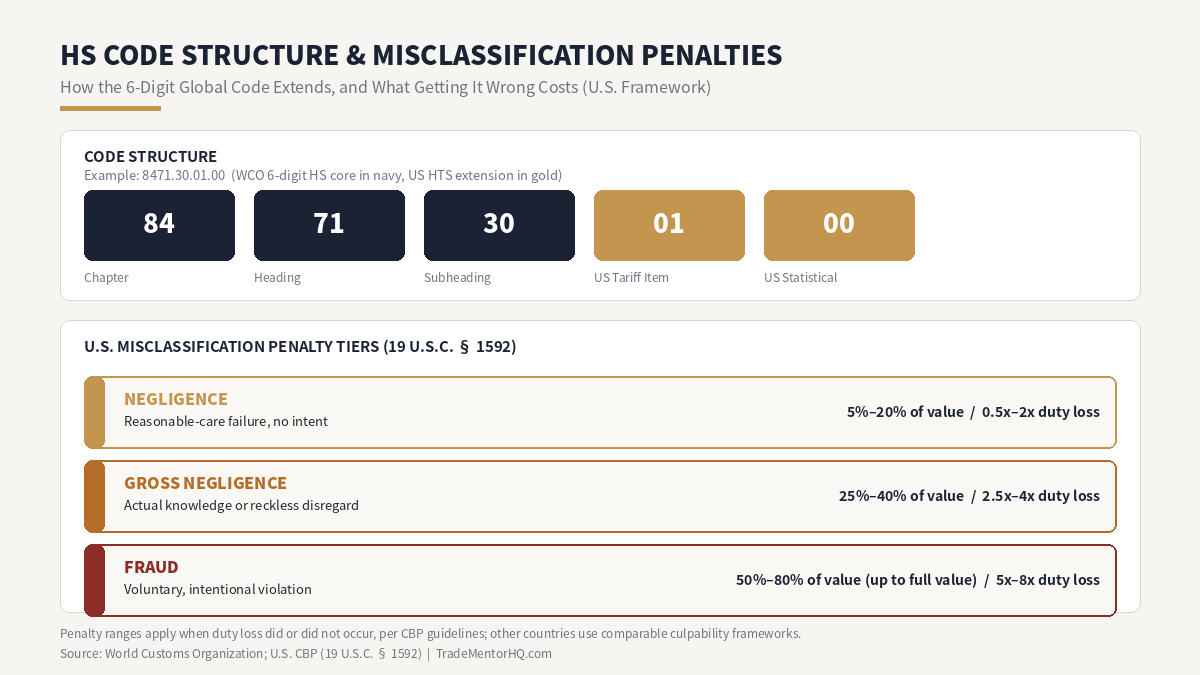
The first six digits of an HS code are identical in every country that uses the system — and that’s most of the world. Those six digits are set by the World Customs Organization and revised on a five-year cycle, which is worth remembering if you’re working from an old reference sheet; codes do shift between revisions.
Past those six digits, countries bolt on their own extensions for finer-grained tariff and statistical purposes. The U.S. is the clearest example of this: imports use a 10-digit Harmonized Tariff Schedule (HTS) code, and exports use a 10-digit Schedule B code — different systems, administered by different agencies, but both built on the same 6-digit international foundation. If you’re shipping the same product both directions across a border, don’t assume the import and export codes will look identical past the sixth digit, because they often won’t.
HS Code Classification: How It Actually Works
Customs authorities don’t classify by vibe — there’s a formal, ordered rulebook called the General Rules for the Interpretation of the Harmonized System (GRI), and it’s meant to be applied in sequence, not cherry-picked.
- Rule 1 says the actual legal text of the heading and its notes control — not the section title, and not what the product is colloquially called. Chapter titles exist for convenience only; they aren’t legally binding.
- Rule 2 covers unfinished or unassembled goods (classify as the finished article if it already has its “essential character”) and mixtures of materials.
- Rule 3 is the one that resolves most real disputes: if a product could fit under more than one heading, use the most specific description first, then fall back to whichever material or component gives the product its essential character, and only as a last resort, use whichever qualifying heading comes last numerically.
- Rules 4 through 6 handle edge cases — goods with no obvious heading get classified alongside the “most akin” goods that do have one, packaging is generally classified with its contents, and the same rules repeat one level down at the subheading.
In practice, most classification questions get resolved at Rule 1 or Rule 3. If you find yourself needing Rule 4, that’s usually a sign the product is unusual enough to be worth a formal binding ruling request rather than a best guess.
What Getting It Wrong Actually Costs
This is the part people underestimate. In the U.S., customs penalties for misclassification scale with how careless the error was, under a three-tier framework: negligence, gross negligence, and fraud.
For a simple negligence finding — you made a reasonable mistake without willful disregard — penalties run 5% to 20% of the merchandise’s domestic value if no duty was actually lost, or 0.5x to 2x the lost duty if duty underpayment did occur. Gross negligence, where there was actual knowledge or reckless disregard of the correct classification, jumps that to 25%–40% of value or 2.5x–4x the duty loss. Fraud — a deliberate, intentional misclassification — can run 50%–80% of the merchandise’s value, up to the entire value of the goods, or 5x–8x the lost duty.
Beyond the fines themselves, a misclassification can trigger shipment delays at the border, seizure of goods, and in repeat or severe cases, a loss of import/export privileges. None of this requires intent to hurt you financially — an honest, careless mistake alone is enough to land in the negligence tier, and 5%–20% of a shipment’s value adds up fast on anything beyond a small order.
How to Actually Get It Right
A few things that consistently separate exporters who classify correctly from ones who guess:
First, classify the product as it actually is at the time of shipment — not as a kit, not as a future finished product, and not by the name on your marketing material. A partially assembled unit that already has the essential character of the finished good gets classified as the finished good under Rule 2(a); a component that’s genuinely just a part gets its own code.
Second, don’t trust a single online HS code lookup tool as a final answer. These tools are useful for narrowing down candidates, but the actual legal text of the heading, chapter notes, and section notes control — and those notes routinely carve out exceptions that a keyword search won’t surface.
Third, if a product genuinely sits in a gray area between two plausible headings, it’s worth requesting a formal binding ruling from your country’s customs authority (CBP’s ruling program in the U.S., for example) before you ship at volume. A binding ruling is slower than guessing, but it’s authoritative — customs can’t retroactively penalize you for following a ruling they issued.
Fourth, keep a documented classification rationale for every product you ship — which heading, which GRI rule got you there, and why. If customs ever questions a classification, “we have a documented, reasonable process” is the difference between a negligence finding (or no finding at all) and a gross negligence one.
👉 Explore the WCO’s official Harmonized System resources
The Bottom Line
An HS code isn’t paperwork trivia — it’s a legal classification with real financial consequences attached, decided by a formal rulebook rather than intuition. Six digits are standardized worldwide, your country adds more for its own purposes, and getting those digits wrong can cost anywhere from 5% of a shipment’s value to the whole thing, depending on how the mistake happened. Treat classification as a step worth doing carefully the first time, not a box to check on the way to the parts you’d rather be doing.
Source: World Customs Organization (Harmonized System); U.S. Customs and Border Protection penalty guidelines (19 U.S.C. § 1592); Canada Border Services Agency, General Rules for the Interpretation of the Harmonized System.
HS Code Classification: Common Mistakes That Cost Money
Getting HS code classification wrong tends to follow a few predictable patterns. The most common is choosing a code based on how a product is marketed rather than what it actually is physically made of and how it functions — HS code classification rules care about composition and function, not branding. Another frequent mistake is reusing an old HS code classification without checking for periodic updates, since the World Customs Organization revises the harmonized system every five years or so, and country-specific tariff schedules change even more often.
A third mistake: assuming a single HS code classification applies globally, when in fact many countries add extra digits beyond the internationally standardized six, meaning the same product can carry a different final code depending on the destination.
- Classifying by marketing description instead of physical composition and function.
- Reusing an outdated HS code classification without checking for revisions.
- Assuming one global code applies everywhere, ignoring country-specific extensions.
HS Code Classification: A Quick Reference
Understanding the structure of an HS code makes HS code classification far less intimidating.
| Digits | What it represents in HS code classification |
|---|---|
| First 2 | Chapter — broad product category |
| First 4 | Heading — more specific product group |
| First 6 | Subheading — internationally standardized HS code classification |
| 7-10 | Country-specific extension beyond the international standard |
Frequently Asked Questions: HS Code Classification
Who is responsible for correct HS code classification? Ultimately the importer or exporter of record, even if a customs broker assists — HS code classification errors can still result in penalties against the business, not just the broker.
Can HS code classification be appealed if customs disagrees? Yes — most countries offer a binding ruling process where traders can request an official HS code classification determination in advance, avoiding disputes at the border entirely.
Does HS code classification affect more than duty rates? Yes — it can also determine whether an export license is required, whether anti-dumping duties apply, and eligibility for free trade agreement preferential rates.
HS Code Classification: Getting a Binding Ruling
Requesting a binding ruling is one of the most reliable ways to lock in correct HS code classification before a shipment ever leaves the warehouse. Most customs authorities allow importers or exporters to submit product specifications and receive an official, legally binding HS code classification determination that customs officers must honor at the border. This process typically takes several weeks, so it’s worth requesting well before a new product line begins shipping rather than waiting for a classification dispute to force the issue. A binding ruling on HS code classification also provides a paper trail that protects the business if a customs audit later questions the code used.
HS Code Classification: Working With a Customs Broker
Many businesses lean on a licensed customs broker to handle HS code classification, and this is often money well spent, particularly for products with ambiguous or complex compositions. A good broker stays current on tariff schedule revisions and can flag when a previously correct HS code classification has become outdated due to a rule change. That said, ultimate legal responsibility for HS code classification accuracy generally rests with the importer or exporter of record, not the broker, so it’s worth reviewing a broker’s recommended classification rather than accepting it without question, especially for high-volume or high-value product lines where an error compounds across many shipments.
HS Code Classification: Consequences of Getting It Wrong
The consequences of incorrect HS code classification extend well beyond a simple duty recalculation. Customs authorities in many countries can assess retroactive duties going back several years if an audit discovers a pattern of misclassification, along with penalties and interest on the underpaid amounts. Repeated HS code classification errors can also trigger more frequent inspections on future shipments, adding delays that compound the original financial cost. In more serious cases involving intentional misclassification to avoid duties or licensing requirements, HS code classification errors can escalate into criminal investigations rather than simple civil penalties, making accuracy from the outset far more valuable than any short-term savings from an aggressive classification.
HS Code Classification: Tools and Databases to Cross-Check
Several free and paid resources help verify HS code classification before it’s finalized. Most countries publish their own tariff schedule online, searchable by keyword or by browsing chapter and heading structure. The World Customs Organization also publishes explanatory notes that clarify how borderline products should be classified when the plain text of a heading is ambiguous. Cross-checking a proposed HS code classification against both the destination country’s specific tariff schedule and the WCO’s explanatory notes catches most classification errors before a shipment is booked, and takes only a few extra minutes compared to the cost of a customs dispute later.
HS Code Classification for Multi-Component Products
Products assembled from multiple components — a piece of furniture with both wood and metal parts, for example — often present the trickiest HS code classification challenges, since international classification rules generally require identifying the component that gives the product its essential character. This determination isn’t always obvious, and reasonable classifiers can disagree on which component is “essential” for a given product. For genuinely ambiguous multi-component products, requesting a binding ruling becomes especially valuable, since HS code classification disputes on composite goods are among the most common sources of customs audits and retroactive duty assessments.
Free Trade Agreements and Classification
Correct classification is often the gateway to preferential duty rates under a free trade agreement — an incorrect code can mean paying full duty on a product that would otherwise qualify for a reduced or zero rate. Rules of origin under most agreements are written against specific tariff headings, so an error at the classification stage can cascade into a missed savings opportunity that only becomes visible during a much later review. Businesses that regularly ship under a specific trade agreement often find it worthwhile to have their product classifications formally verified at least once, specifically to confirm eligibility for the preferential rate they’ve been assuming applies.
Keeping Classifications Current Over Time
Tariff schedules are not static — revisions happen periodically at both the international and country level, and a code that was correct several years ago can become outdated without any change to the underlying product. Building a periodic review into a company’s compliance calendar, checking existing product classifications against the current tariff schedule every year or two, catches drift before it becomes a costly surprise during an unrelated customs audit. This is a small recurring task compared to the potential cost of years of accumulated misclassification suddenly surfacing all at once.
Documenting the Classification Decision
Keeping a written record of the reasoning behind an HS code classification decision — the product specifications reviewed, the heading and explanatory notes consulted, and who made the final call — pays off significantly if a customs authority later questions the choice. This documentation demonstrates good-faith diligence, which most customs enforcement regimes treat far more leniently than an error with no supporting reasoning on file. A simple one-page memo per product line, stored alongside other compliance records, is usually enough to satisfy an auditor that the classification wasn’t arbitrary, even if the final determination is later revised.
HS Code Classification: Training Staff Who Handle It
Because HS code classification decisions often get made by whoever happens to be preparing a shipment’s paperwork that day, investing in basic classification training for anyone touching export or import documentation pays dividends across every future shipment. Staff who understand the general rules of interpretation — how essential character is determined for composite goods, how to read a tariff heading’s legal notes, when to escalate an ambiguous case rather than guess — make far fewer costly HS code classification errors than staff simply matching product names to whatever code was used last time.
Even a short annual refresher session, covering recent tariff schedule changes and a review of any classification disputes from the past year, keeps this knowledge current across a team rather than concentrated in one person who might eventually leave the company.
Getting the Classification Right From the Start
HS code classification determines far more than most first-time exporters realize — duty rates, licensing requirements, and free trade agreement eligibility all trace back to getting this one step right. Taking the time to classify correctly upfront, or requesting a binding ruling for ambiguous products, is far cheaper than resolving an HS code classification dispute after goods are already in transit or held at a border.
The financial stakes of getting HS classification wrong are higher than most first-time importers realize: under 19 U.S.C. § 1592, a negligent misclassification can carry a penalty of up to 2× the lost revenue (unpaid duties), gross negligence up to 4×, and fraud can expose the importer to a penalty up to the full domestic value of the merchandise — on top of still owing the correct duty amount.
The good news is CBP offers a free binding ruling request process through the CROSS database and eRulings portal, which typically takes 30–90 days to get a definitive, legally reliable classification for a specific product — worth doing before your first shipment of a new product line rather than guessing and hoping customs doesn’t flag it.
Related Reading
- Incoterms 2020 Explained: A Practical Guide for Importers and Exporters
- Letter of Credit (LC) vs T/T: Which Payment Method Should You Choose?
Written by the TradeMentorHQ editorial team. We research primary sources — ICC rules, WCO and customs-authority guidance, and UCP 600 — before every article, and we’re upfront about how the site is produced on our About page. Spotted something that needs a correction? Let us know.

About the Author: TradeMentorHQ Team
The TradeMentorHQ team researches and writes practical, plain-language guides on Incoterms, customs clearance, trade finance, and shipping logistics for small business owners, first-time importers/exporters, and side-hustle sellers. Our articles are grounded in publicly available regulations and guidance from bodies like U.S. Customs and Border Protection (CBP), the International Chamber of Commerce (Incoterms 2020), and established industry practice, and we link to primary sources wherever a number or rule could change. We are not customs brokers, freight forwarders, or licensed trade attorneys, and nothing here is a substitute for advice from one on your specific shipment.