
Short answer: is Temu safe? Mostly yes for placing an order and getting a real product, but not risk-free — you’ll want to accept meaningful data collection, screen for counterfeit or misdescribed items, and budget for import fees that didn’t exist a couple of years ago.
Temu has become one of the most-downloaded shopping apps in the country by undercutting almost everyone else on price, shipping directly from manufacturers and warehouses in China to individual buyers. That business model is exactly what makes the safety question worth asking seriously — the same structure that keeps prices low is also what creates the data-privacy, counterfeit, and customs questions covered below.
This guide walks through what Temu actually collects about you, how it handles payments, the real state of counterfeit and product-quality risk, and the pricing changes since 2025 that mean a Temu order in 2026 can cost noticeably more at checkout than the sticker price on the product page suggests.
What Temu Actually Is
Temu is an online marketplace, launched in the U.S. in 2022 by the parent company behind Pinduoduo, that connects individual shoppers directly to manufacturers and wholesalers, mostly based in China. The pitch is simple: cutting out the usual layers of retail markup lets Temu sell items for a fraction of what comparable products cost through traditional retailers.
That direct-from-manufacturer structure is also why most Temu orders historically shipped as small, individually declared international packages rather than domestic next-day deliveries — a shipping model that used to matter mainly for delivery time, and now matters for your final price too, covered further down.
Is Temu Safe for Your Personal Data?
Temu’s privacy policy discloses that it collects a wide range of personal information: your name, email, phone number, shipping address, purchase and browsing history, device identifiers, and location data, and it shares that data with affiliates, payment processors, service providers, and advertising partners. This is broader data collection than many established U.S. retailers disclose, though not unusual for a fast-growing app-first marketplace competing on ad targeting.
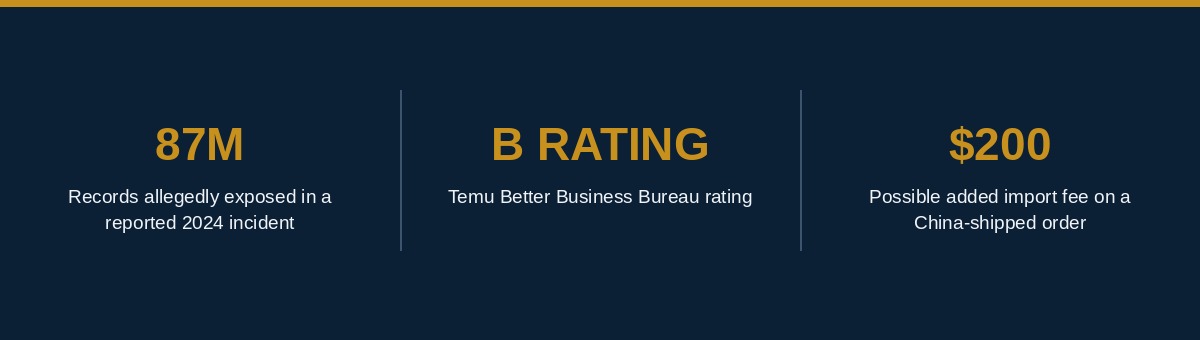
A more concrete concern: a reported June 2024 incident allegedly exposed around 87 million records tied to Temu accounts, though Temu publicly denied that a breach of its systems occurred. Independent verification of the incident’s scope is limited, which is itself a reason for caution rather than dismissal — treat the claim as unresolved rather than confirmed, and manage your own exposure regardless of which account of events is accurate.
Practical steps that reduce your exposure regardless of how that specific incident is ultimately characterized: use a unique password for your Temu account rather than reusing one from elsewhere, avoid linking the account to a primary email you use for banking or other sensitive services, and periodically review what app permissions (contacts, camera, location) Temu has been granted on your phone.
Is Temu Safe for Payments?
On payment security specifically, Temu’s setup looks fairly standard for a major e-commerce platform: it supports 3D Secure authentication, states adherence to PCI DSS card-data security standards, and offers multiple payment methods including major credit cards, PayPal, Apple Pay, and Google Pay. Using a credit card or a payment service like PayPal rather than a debit card gives you an extra layer of dispute protection if an order goes wrong.
The weaker link isn’t the payment processing itself but customer service consistency — Temu holds a B rating with the Better Business Bureau, with several thousand complaints on file, many centered on delivery and refund disputes rather than payment fraud specifically. That pattern suggests the checkout itself is reasonably secure, but resolving a problem after the fact can take more persistence than with a retailer offering domestic customer support.
Product Quality and Counterfeit Risk on Temu
The most consistent complaint across independent reviews isn’t security in the technical sense — it’s that products sometimes don’t match their listing photos or descriptions, and that recognizable name-brand items are generally not genuine when they appear at all. Temu’s catalog leans heavily toward generic and white-label goods rather than licensed brand merchandise, and that’s by design, not an accident of moderation gaps.
For lower-stakes purchases — phone accessories, home decor, craft supplies — a mismatch between listing and reality is a mild annoyance solved by Temu’s return process. For anything involving safety (electrical items, children’s products, cosmetics applied to skin), the calculus is different, and it’s worth reading recent buyer reviews with photos on the specific listing rather than trusting the product page images alone.
Temu Prices Are Changing: The End of Duty-Free Shipping From China
Until May 2025, most individual Temu orders shipped under the “de minimis” exemption, which let low-value international packages (historically under $800) enter the U.S. without duty. Executive Order 14256 ended that exemption specifically for goods from China and Hong Kong, effective May 2, 2025, which directly affects the large majority of Temu’s supply chain.
In practice, this means many Temu orders now carry an added import charge that wasn’t part of the checkout total a couple of years ago — either a flat per-item postal fee (which reached $200 per item for shipments processed that way starting June 1, 2025) or a percentage-based duty plus tariffs for orders routed through formal customs entry, depending on how a given shipment is processed.
Temu has adjusted by disclosing import charges at checkout in many cases and by expanding U.S.-based warehousing for some product lines to avoid the fee entirely — but the $2 phone case that looked essentially free two years ago is no longer a reliable assumption.
Because this policy area has already shifted more than once since 2025 and remains subject to further change, don’t assume the exact fee amount quoted in this guide is still current by the time you’re reading it — check the total at checkout before confirming an order, and treat any number here as a snapshot rather than a promise.
How to Shop on Temu More Safely
A few habits meaningfully lower your risk without requiring you to avoid the platform altogether. Pay with a credit card or PayPal rather than a debit card linked directly to your bank account, so you have dispute leverage if something goes wrong. Start with a small first order from a new seller on the platform before committing to a larger purchase, and read the most recent reviews with photos rather than the overall star average, since quality can vary by batch even for the same listing.
For anything you’re planning to resell rather than keep — a growing use case, per our AliExpress buying guide covering the same personal-import landscape — check the checkout total including any disclosed import charge before assuming your margin, and track your package through customs tracking if it goes quiet for more than a few days, since formal-entry shipments can sit longer than the shipping estimate suggests.
Is Temu Legit Compared to AliExpress and Shein?
Is Temu safe relative to its closest competitors, rather than in isolation? Is Temu safe enough to trust over the other two? The three platforms share more than they differ: all three ship largely from Chinese manufacturers, all three were affected by the same 2025 de minimis policy change, and all three carry similar counterfeit and quality-consistency risk on branded-sounding items.
The practical differences are smaller than the marketing suggests. Temu tends to run more aggressive discount and gamification promotions (spin-to-win discounts, countdown timers) that push faster purchase decisions than AliExpress’s more traditional storefront-by-storefront browsing. Neither difference changes the underlying safety calculus much — the same precautions (dedicated payment method, reading recent photo reviews, budgeting for potential import charges) apply across all three.
What Happens If Your Temu Order Goes Wrong?
Temu’s stated return window is generally 90 days, longer than most domestic retailers, and refunds for items that never arrive or arrive significantly not-as-described are usually processed through the app’s support chat rather than by phone. The Better Business Bureau’s several-thousand-complaint history suggests this process works inconsistently rather than never — most complaints center on response speed and refund timing rather than outright refusal.
If Temu’s in-app support stalls on a legitimate issue, the fastest secondary path is disputing the charge directly with your credit card issuer or PayPal, which is exactly why paying with one of those methods rather than a debit card matters more here than with a retailer that has reliable phone support.
Is Temu Safe? The Bottom Line
Is Temu safe enough to use? For most non-safety-critical purchases, yes, with the same basic precautions you’d apply to any unfamiliar online marketplace: a dedicated payment method with dispute protection, realistic expectations about counterfeit and name-brand claims, and awareness that your data is being used for advertising more broadly than at many established retailers.
Where Temu genuinely differs from buying at a familiar domestic retailer isn’t really the security of the checkout — it’s the combination of thinner customer-service recourse, real counterfeit exposure on branded-sounding items, and a pricing model that’s meaningfully less predictable since the 2025 customs changes than it was when Temu first launched. None of that makes it unsafe outright, but it does make “is Temu safe” a question worth actually thinking through rather than assuming the answer is simply yes or no.
A habit worth adopting from experienced Temu buyers: check the individual seller’s shop rating on the item listing page itself, not just Temu’s overall app store rating, before ordering anything electronic or anything worn against skin. Temu is a marketplace of thousands of third-party sellers under one brand, so quality and shipping reliability vary shop to shop even though every listing looks identical.
When weighing is Temu safe for a specific order, tracking gaps are one area that causes unnecessary alarm: items under about $10 also frequently show no tracking movement past “left origin facility” for 2–3 weeks, which is normal for Temu’s standard shipping tier rather than a sign something’s wrong — the built-in purchase protection window is the more useful safeguard than trying to read tracking updates.
Related Reading
How to Buy From AliExpress Safely: 7 Rules for Personal Imports
Customs Duty on a Personal Package From China: The Ultimate 2026 Guide
How to Track a Package Stuck in Customs: A Personal Import Guide

About the Author: TradeMentorHQ Team
The TradeMentorHQ team researches and writes practical, plain-language guides on Incoterms, customs clearance, trade finance, and shipping logistics for small business owners, first-time importers/exporters, and side-hustle sellers. Our articles are grounded in publicly available regulations and guidance from bodies like U.S. Customs and Border Protection (CBP), the International Chamber of Commerce (Incoterms 2020), and established industry practice, and we link to primary sources wherever a number or rule could change. We are not customs brokers, freight forwarders, or licensed trade attorneys, and nothing here is a substitute for advice from one on your specific shipment.