
Short answer: to calculate landed cost for a reselling side hustle, add your product cost, international shipping, insurance, customs duty and any per-item entry fees, then divide by the number of units — and as of 2025, that duty line is no longer something small importers from China can skip, since the old $800 duty-free exemption is gone.
Landed cost is the true, all-in price of getting one unit of product from a supplier’s shelf to your own hands, ready to resell. Most beginner resellers price their side hustle off the product cost alone — what showed up on the invoice — and then wonder why a “profitable” batch barely broke even once everything actually arrived.
This guide walks through every cost that belongs in an accurate landed-cost number, why the math changed meaningfully for anyone ordering from China after 2025, a full worked example, and the mistakes that most often wreck a reseller’s margin before they even list the first item.
How to Calculate Landed Cost: The Full Formula
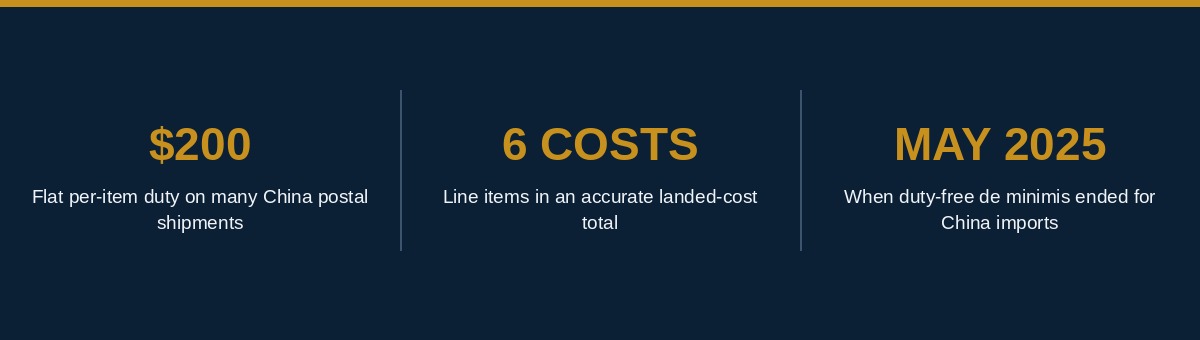
The formula itself is simple addition — the discipline is in not forgetting a line item. Landed cost per unit equals: product cost, plus international shipping, plus insurance (if purchased), plus customs duty and tariffs, plus any customs broker or entry fees, plus final domestic delivery to your door — all added together, then divided by the number of units in the shipment.
Each of those six components matters, but the two most commonly skipped by beginners doing the math in their head are customs duty and the flat entry fee that can apply to formal customs processing. Both used to be irrelevant for most personal-scale orders from China under $800. That’s no longer true.
Why the De Minimis Change Matters for Your Landed Cost Math
Until May 2025, packages valued under $800 from any country — including China — generally entered the United States duty-free under what’s called the “de minimis” exemption. Executive Order 14256 ended that treatment specifically for goods originating in China and Hong Kong, effective May 2, 2025.
In its place, low-value postal shipments from China faced a flat per-item fee — $100 per item from May 2 through May 31, 2025, rising to $200 per item starting June 1, 2025 — while shipments processed through formal (non-postal) customs entry instead face standard ad valorem duty rates plus Section 301 tariffs (commonly 7.5% on many product categories) and additional reciprocal tariffs layered on top. On a real example cited by trade compliance sources, a $50 item that once cleared customs free could face more than 50% in combined duty plus $20–$40 in entry fees.
Because these rates and structures have already changed multiple times since 2025 and remain politically active, treat any specific percentage you read online — including in this guide — as a snapshot rather than a guarantee. Before sourcing a batch of resale inventory from China, check the current rate directly at cbp.gov/trade or run your specific product’s HTS code through an updated tariff calculator.
A Worked Landed Cost Example for a Reselling Side Hustle
Say you’re sourcing a batch of 50 phone accessories from a supplier in China, priced at $2.40 per unit ($120 total), with international shipping quoted at $60 for the batch and no separate insurance purchased. Under today’s rules, this kind of low-value postal shipment may be subject to the flat per-item entry fee rather than a percentage-based duty, depending on exactly how it’s shipped and declared.
If a $200 flat per-item fee applied (the postal-shipment structure that took effect in June 2025), a single package containing all 50 units as one declared item would land very differently than 50 separate small packages each treated individually — which is exactly why shipment structuring is now a real cost decision, not just a logistics preference. This is a case where getting professional guidance from your freight forwarder or a customs broker before you place a bulk order is worth the phone call, since the difference between shipment structures here isn’t small change.
Assuming a more typical formal-entry scenario instead — ad valorem duty plus Section 301 tariffs totaling roughly 30% of the $120 product cost ($36), plus a $25 customs broker fee, plus $60 shipping, plus $15 domestic delivery — the batch’s total landed cost is $120 + $36 + $25 + $60 + $15 = $256, or $5.12 per unit. Compare that to the $2.40 sticker price on the supplier invoice: the true cost is more than double.
Building a Landed Cost Calculator You’ll Actually Use
You don’t need special software — a simple spreadsheet with one row per cost category and a running total per unit is enough for most side-hustle volumes. The key is filling in every row before you commit to an order, not after the shipment clears customs and you’re stuck with whatever the number turns out to be.
Set up columns for: product cost, shipping, insurance, duty/tariffs, broker or entry fees, and domestic delivery — then a final column dividing the sum by unit count. Reuse the same sheet for every new sourcing run, updating the duty percentage or flat fee each time, since that’s the line most likely to have changed since your last order.
If you’re scaling from occasional personal buys into something closer to formal small-batch importing, our original landed cost calculator walkthrough covers the same math from a business-exporter’s perspective, including HS code classification, which becomes more relevant at higher order volumes.
Common Landed Cost Mistakes That Wreck a Reseller’s Margin
The single most common mistake is pricing resale listings off the supplier’s per-unit invoice price alone, before any shipping or duty is added — exactly the trap in the worked example above, where the real per-unit cost was more than double the sticker price.
The second is assuming last year’s duty rate still applies. Because tariff policy on Chinese-origin goods has changed multiple times since 2025, a landed-cost spreadsheet built from an old order can quietly under-price an entire new batch. Rebuild the duty line for every new sourcing run rather than copying forward an old number.
The third is ignoring the domestic delivery leg — the cost from the port or customs facility to your actual doorstep — which is easy to forget because it often arrives as a separate, smaller charge days after the international shipping invoice.
When Landed Cost Makes an Item Not Worth Reselling
Sometimes the honest answer, once you calculate landed cost properly, is that an item simply isn’t worth sourcing anymore. If duty and entry fees push your per-unit cost close to (or above) what the item resells for, that’s the calculator doing its job — better to find out on a spreadsheet than after a shipment has already cleared customs.
This is also why experienced resellers increasingly compare a landed-cost total against what the same item would cost as a straightforward personal import versus sourcing it in bulk — sometimes the bulk discount no longer outweighs the added duty exposure at current rates, and buying smaller, more frequent batches turns out cheaper per unit once everything is counted.
Do You Need Shipping Insurance in Your Landed Cost?
Insurance is the one line item in the landed cost formula that’s genuinely optional, and whether to include it depends on order size and supplier reliability. On a $120 test batch from a new supplier, skipping the roughly $3–$8 insurance cost to save a few dollars is a common beginner move — right up until a shipment is lost or damaged in transit and there’s no recourse.
A reasonable rule: insure any shipment where the total value exceeds what you’d be comfortable simply writing off as a loss. For a $50 test order, most resellers skip it. For a $500 restock from a supplier you’ve used successfully before, the small insurance premium is cheap protection against a single bad shipment wiping out a month of margin.
AliExpress vs Alibaba: How Landed Cost Math Differs by Platform
The formula stays the same across sourcing platforms, but the inputs differ in ways that change your total. AliExpress orders tend to be smaller, individually declared shipments — closer to the personal-import end of the spectrum — which historically leaned on de minimis treatment and now more often falls under the flat per-item postal fee structure described above.
Alibaba orders are typically consolidated into a single larger shipment through formal customs entry, which means ad valorem duty and Section 301 tariffs calculated as a percentage of the full shipment value, plus a customs broker fee, rather than a flat per-item charge. At small order volumes, the AliExpress-style flat-fee structure can actually cost more per unit than the Alibaba-style percentage duty — which is the opposite of what most beginners assume before they run the numbers.
This is exactly why the landed cost calculation needs to be redone per sourcing platform and per order size rather than treated as one fixed percentage you memorize once. A duty structure that was cheap for a 10-unit test order can flip to being the more expensive option once you scale to 200 units, or vice versa.
How Often Should You Recalculate Landed Cost?
At minimum, recalculate before every new sourcing run — not just when the product changes, but when the shipping method, order size, or country of origin changes, since any of those three can shift which duty structure applies to your shipment. Given how frequently China-specific tariff policy has moved since 2025, treat any landed-cost spreadsheet older than about three months as due for a rate check before you rely on it again.
Keeping a simple running log — date, product, cost inputs, and the final per-unit landed cost — also makes it obvious over time whether your margins are trending up or down as policy shifts, rather than discovering the trend only when a batch unexpectedly barely breaks even.
A mistake that shows up constantly in landed cost spreadsheets: people remember freight and duty but forget MPF (Merchandise Processing Fee — a minimum of roughly $32 and a maximum of around $634 per entry, calculated as 0.3464% of shipment value) and HMF (Harbor Maintenance Fee, 0.125% of value, ocean shipments only) as separate CBP line items, not part of the duty rate itself.
On a $3,000 shipment those two fees alone can add $10–15 that a duty-rate calculator won’t show. If you’re building landed cost by hand, treat freight, duty, MPF, HMF, and your broker’s entry fee as five separate line items, not two.
Related Reading
Customs Duty on a Personal Package From China: The Ultimate 2026 Guide
Alibaba for Beginners: How to Buy Wholesale Without Getting Scammed
Landed Cost Calculator: The Best 2026 Guide to Export Pricing

About the Author: TradeMentorHQ Team
The TradeMentorHQ team researches and writes practical, plain-language guides on Incoterms, customs clearance, trade finance, and shipping logistics for small business owners, first-time importers/exporters, and side-hustle sellers. Our articles are grounded in publicly available regulations and guidance from bodies like U.S. Customs and Border Protection (CBP), the International Chamber of Commerce (Incoterms 2020), and established industry practice, and we link to primary sources wherever a number or rule could change. We are not customs brokers, freight forwarders, or licensed trade attorneys, and nothing here is a substitute for advice from one on your specific shipment.