Short answer: duty-free limits by country vary sharply in 2026 — the United States is the only major destination that has suspended its duty-free personal import allowance, and as of the 2025 interim final rule, nearly every package into the U.S. owes duty regardless of value. Everywhere else you’re likely to order from — Canada, the UK, the EU, Australia, Japan — still has a duty-free threshold, but the number is different in every country and none of them are as generous as the old $800 U.S. exemption.
If you regularly buy from overseas sellers, whether that’s AliExpress, a UK-based Etsy shop, or a Japanese hobby store, knowing your country’s actual de minimis threshold — not the U.S. number you might remember from a few years ago — is the difference between an accurate budget and a surprise charge at the door.
This guide breaks down the duty-free limits by country for the destinations most personal importers ship to and from, what “de minimis” actually means, and how to avoid getting caught off guard by duty you didn’t plan for.
What “De Minimis” Actually Means
De minimis is the value threshold below which a country doesn’t bother collecting customs duty on an imported package — the idea being that collecting a few dollars of duty on a cheap package costs more in processing than it raises in revenue. This is the mechanism behind every set of duty-free limits by country you’ll see below.
Every country sets its own threshold, and many separate the duty threshold from the tax threshold (VAT or GST can still apply even when duty doesn’t), which is the detail that trips up a lot of first-time importers who assume “duty-free” means “no charges at all.”
United States: The Exemption Is Suspended, Not Just Lowered
This is the big one for anyone shopping U.S.-bound: the $800 Section 321 de minimis exemption was suspended for commercial shipments from all countries effective August 2025, and remains suspended. In practice this means almost every low-value package now goes through formal or informal customs entry and owes duty, and postal shipments from countries without a formal international postal agreement can instead be charged a flat per-package fee — $80, $160, or $200 depending on the exporting country’s effective tariff rate — rather than a percentage-based duty. If you’re ordering into the U.S. from overseas in 2026, budget for duty on every order, not just the large ones.
You can confirm the current rule directly on CBP’s internet purchases page before you order — it’s the clearest sign of how differently the U.S. now treats duty-free limits by country compared to its old $800 exemption.
Canada, the UK, and the EU
Canada keeps a split threshold: packages shipped by courier from the U.S. or Mexico get a CAD $150 duty-free allowance, but that drops to just CAD $20 for couriered goods from anywhere else — a distinction that catches a lot of Canadian shoppers off guard when they order from Asia instead of the U.S.
The United Kingdom’s duty threshold sits at £135, but VAT is charged on imports regardless of value, so a £40 order can still show up with a tax bill attached. The EU-wide rule (covering all 27 member states, including Germany) sets the duty threshold at €150, with the same catch as the UK — VAT applies from the very first euro through the IOSS system, so “under the threshold” only ever means duty-free, never charge-free.
Australia, Japan, and Other Common Destinations
Australia’s threshold is considerably higher at AUD $1,000, though GST is typically collected at checkout by registered overseas sellers rather than at the border. Japan sets its de minimis at ¥10,000 and, unusually, exempts both duty and consumption tax below that line — one of the few countries where crossing under the threshold really does mean no charges at all.
These duty-free limits by country shift periodically as trade policy changes, so treat every figure here as a starting point to verify against your destination country’s customs authority before a large or time-sensitive order, rather than a number to rely on indefinitely.
Quick Reference: Duty-Free Limits by Country
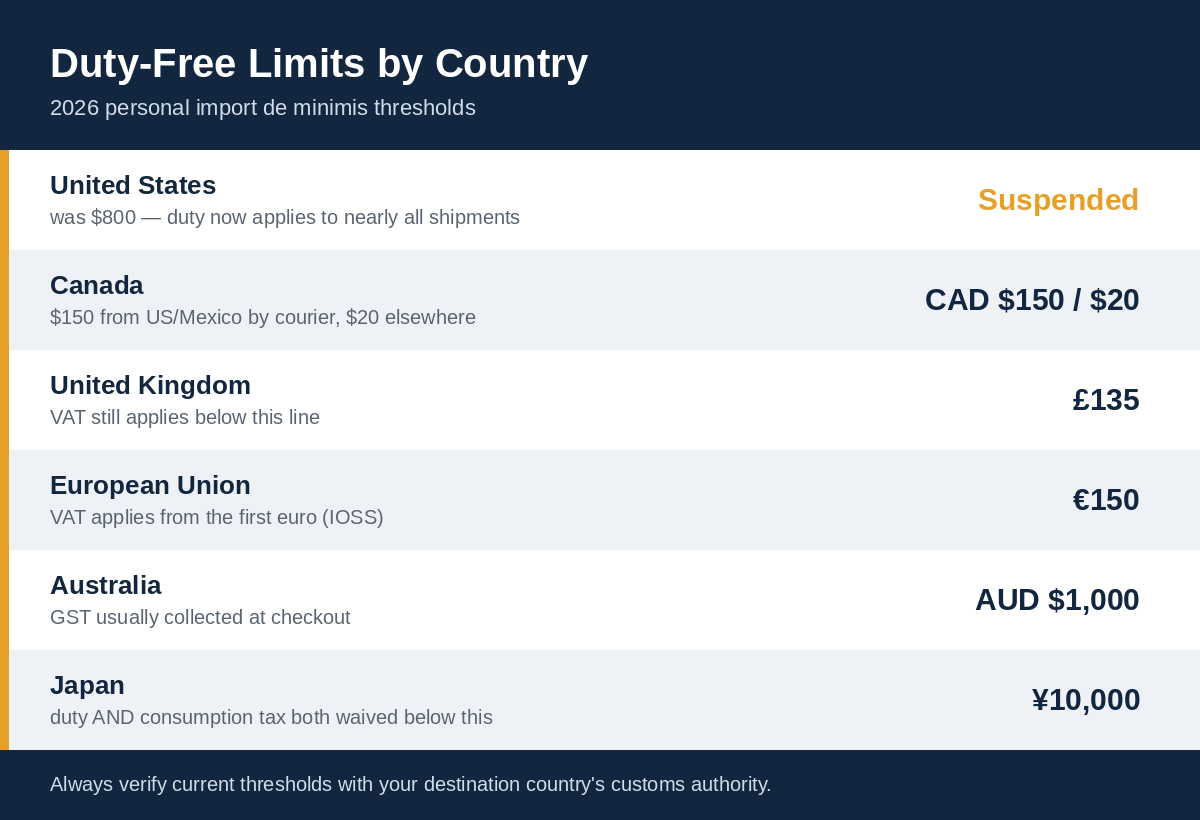
United States — suspended (was $800); duty now applies to nearly all shipments. Canada — CAD $150 from the U.S./Mexico by courier, CAD $20 from elsewhere. United Kingdom — £135 for duty, but VAT applies below that anyway. European Union — €150 for duty, VAT applies from the first euro. Australia — AUD $1,000, with GST usually collected at checkout. Japan — ¥10,000, exempting both duty and consumption tax below that line.
How to Avoid a Surprise Duty Bill
Before ordering something you’re shipping internationally, check the current threshold for your specific destination country directly with its customs authority (a quick search for “[country] customs de minimis” usually turns up the official page) rather than relying on a number you saw once, since these figures move with trade policy.
Also separate the duty question from the tax question in your head — as the UK and EU cases show, a package can be fully duty-free and still arrive with a VAT bill, so “under the threshold” is not the same guarantee everywhere. Bookmarking the duty-free limits by country table above and rechecking it before a large or unusual order takes less than a minute and can save you from an unpleasant surprise at delivery.
Bottom Line
The U.S. suspension of its de minimis exemption is the headline change for 2026, but it’s easy to assume the rest of the world moved the same direction — it didn’t. Canada, the UK, the EU, Australia, and Japan all still have functioning duty-free limits by country, just at different (and generally lower) values than the old U.S. number, and several of them still charge tax below the duty line. Knowing your specific country’s threshold, and treating it as something to verify rather than assume, is the simplest way to keep your landed cost estimate accurate.
Related Reading
- Customs Duty on a Personal Package From China: What You’ll Actually Pay
- How to Buy From AliExpress Safely: 7 Rules for Personal Imports
- eBay vs Poshmark vs Mercari: The Best Marketplaces for Reselling in 2026

About the Author: TradeMentorHQ Team
The TradeMentorHQ team researches and writes practical, plain-language guides on Incoterms, customs clearance, trade finance, and shipping logistics for small business owners, first-time importers/exporters, and side-hustle sellers. Our articles are grounded in publicly available regulations and guidance from bodies like U.S. Customs and Border Protection (CBP), the International Chamber of Commerce (Incoterms 2020), and established industry practice, and we link to primary sources wherever a number or rule could change. We are not customs brokers, freight forwarders, or licensed trade attorneys, and nothing here is a substitute for advice from one on your specific shipment.