
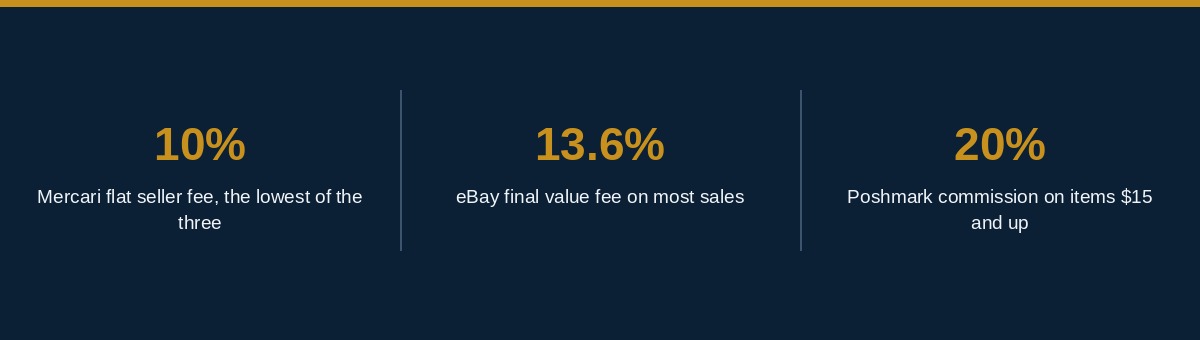
Short answer: in the eBay vs Poshmark vs Mercari comparison, Mercari charges the lowest flat seller fee at 10%, eBay sits in the middle around 13.6% plus a small per-order fee, and Poshmark takes the largest cut at 20% on items $15 and up.
Bottom line up front for anyone skimming: eBay vs Poshmark vs Mercari isn’t just about fees — it’s about which audience actually wants to buy what you’re selling. Fees matter, but the wrong platform for your inventory will cost you more in unsold listings than any fee difference ever could.
This guide compares eBay vs Poshmark vs Mercari on seller fees, shipping costs, payout speed, and audience fit, using each platform’s current published numbers, so you can pick the marketplace that actually matches what you’re reselling in 2026.
eBay vs Poshmark vs Mercari: Seller Fees Compared
Mercari charges a flat 10% fee on the item price plus buyer-paid shipping, with payment processing already folded into that 10% since Mercari eliminated its separate processing charge in early 2025. Buyers separately pay a 3.6% Buyer Protection fee, which doesn’t come out of your payout.
eBay charges roughly 13.6% on most categories, calculated on the total sale — item, shipping, and tax combined — plus a small per-order fee that runs $0.30 for orders under $10 and $0.40 for orders over $10. Above $7,500 in a single sale, the rate on the excess drops to 2.35%.
Poshmark charges the highest standard rate: 20% on any item selling for $15 or more, or a flat $2.95 on anything under $15. That commission includes payment processing and a prepaid shipping label, which changes the math slightly compared to eBay and Mercari.
On a straightforward $50 sale, the eBay vs Poshmark vs Mercari gap becomes concrete: you’d keep roughly $45 on Mercari, about $42.80 on eBay after its per-order fee, and $40 on Poshmark — a real $5 swing between the cheapest and most expensive option on one sale.
eBay vs Poshmark vs Mercari: Shipping Costs and Logistics
Poshmark uses a single flat shipping rate — $6.49 for packages up to 5 pounds, regardless of what’s inside. That’s simple to plan around, but it’s expensive for small, light items and a bargain for heavy ones.
Mercari uses weight-tiered shipping instead, starting around $4.87 for anything under 4 ounces and scaling up from there across USPS, UPS, and FedEx options. That rewards sellers of small, light items like jewelry or phone cases.
eBay gives sellers the most control: you can set your own shipping price, offer free shipping baked into the item price, or let eBay calculate rates automatically based on buyer location and package weight. More control also means more decisions to get right.
For anyone comparing eBay vs Poshmark vs Mercari on shipping alone, the honest answer depends entirely on what you sell — light, small items favor Mercari’s tiered system, while bulkier items often do better under Poshmark’s flat rate or eBay’s calculated shipping.
eBay vs Poshmark vs Mercari: Payout Speed
Both Poshmark and Mercari process payouts on a similar timeline, roughly three days after the buyer confirms delivery, which is standard for peer-to-peer resale platforms built around buyer protection windows.
eBay’s payout speed depends on your seller history and standing — established sellers with a solid track record often see funds released faster, sometimes within a day or two of a confirmed sale, while newer sellers may see a short hold.
If cash flow speed matters more to your side hustle than the fee percentage, this is worth weighing seriously in the eBay vs Poshmark vs Mercari decision, especially if you’re reinvesting sale proceeds into new inventory every week.
eBay vs Poshmark vs Mercari: Audience and What Sells Best Where
Poshmark’s audience skews heavily toward fashion — clothing, shoes, and accessories, often with a strong emphasis on specific brands. Its social features, like sharing other sellers’ closets, reward sellers who stay active on the app rather than just listing and waiting.
Mercari’s audience is broader and less fashion-specific, with strong demand for electronics, collectibles, home goods, and general household items alongside clothing. It functions more like a general marketplace than a fashion-first community.
eBay remains the default for anything collectible, vintage, or hard to find, and it still has the largest overall buyer base of the three. Auction-style listings can also work in eBay’s favor for rare or unusual items where competitive bidding pushes the final price up.
Matching your inventory to the right audience often matters more than the eBay vs Poshmark vs Mercari fee difference — a rare collectible in the wrong marketplace can sit unsold for months regardless of how low the seller fee is.
So Which Should You Actually Use?
If you’re reselling mostly clothing and want an engaged, brand-conscious audience, Poshmark’s higher fee can still pay off through faster sales and better prices for the right items, especially recognizable labels.
If you’re reselling a mix of categories — electronics, home goods, collectibles, and clothing — Mercari’s lower flat fee and broader audience make it a strong default, particularly for lighter items where its shipping tiers help your margin.
If you’re selling anything rare, vintage, or likely to attract competitive bidding, eBay’s massive buyer base and auction format are hard to beat, even with its middle-of-the-road fee structure.
Many resellers who compare eBay vs Poshmark vs Mercari seriously end up listing across two or even all three platforms — cross-listing tools exist specifically to make that manageable without duplicating all the photography and description work.
Getting Started With Cross-Listing
Start with the platform that best fits your current inventory rather than trying to be everywhere at once. Learn one platform’s quirks — its photo requirements, its fee timing, its buyer expectations — before adding a second.
Once you’re comfortable, cross-listing tools can push the same listing to multiple platforms simultaneously, which saves significant time but requires you to track inventory carefully so you don’t sell the same item twice.
Whichever you choose first, factor the real fee numbers above into your pricing from day one rather than discovering them after your first sale — a $50 item priced without accounting for a 20% commission is a $10 miscalculation you’ll only make once.
To close out the eBay vs Poshmark vs Mercari comparison: Mercari wins on fees, Poshmark wins on fashion-focused audience engagement, and eBay wins on overall reach and format flexibility — the right pick depends on what’s actually in your closet or storage unit.
The fee structures genuinely change which platform wins for a given item: eBay charges a final value fee around 13.25% for most categories (lower for a few, with a cap on very high-priced items), Poshmark takes a flat 20% on sales of $15 or more (a flat $2.95 fee on sales under $15), and Mercari charges roughly 10% selling fee plus payment processing around 2.9% + $0.30.
For a $50 item, that works out to roughly $6.60 on eBay, $10 on Poshmark, and about $6.45 on Mercari after processing — meaning Poshmark’s simplicity comes at a real cost on mid-priced items, while eBay and Mercari end up close to each other once processing fees are factored in.
Related Reading
Amazon FBA for Beginners: Is Reselling Still Worth It in 2026?
How to Buy From AliExpress Safely: A Beginner’s Guide to Personal Imports
FTC Consumer Advice: Online Shopping and Selling
This article is for general informational purposes only and is not financial or business advice. Seller fees and shipping rates change often — verify current numbers directly on each platform before pricing your listings.

About the Author: TradeMentorHQ Team
The TradeMentorHQ team researches and writes practical, plain-language guides on Incoterms, customs clearance, trade finance, and shipping logistics for small business owners, first-time importers/exporters, and side-hustle sellers. Our articles are grounded in publicly available regulations and guidance from bodies like U.S. Customs and Border Protection (CBP), the International Chamber of Commerce (Incoterms 2020), and established industry practice, and we link to primary sources wherever a number or rule could change. We are not customs brokers, freight forwarders, or licensed trade attorneys, and nothing here is a substitute for advice from one on your specific shipment.