
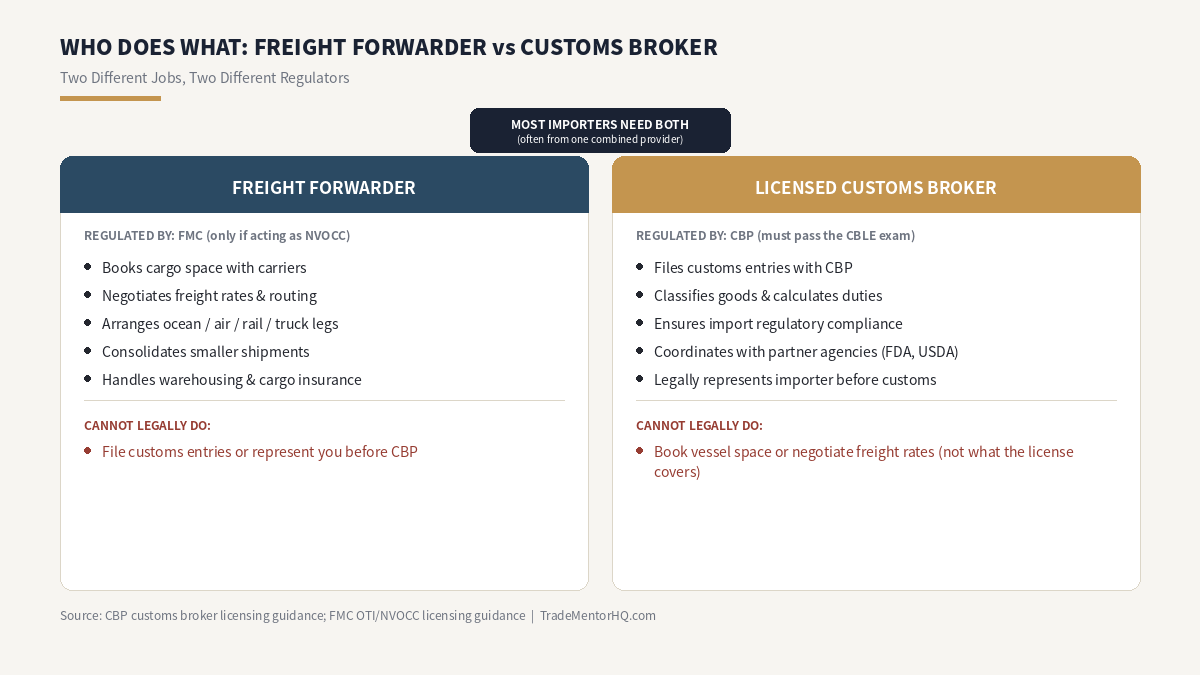
Understanding freight forwarder vs customs broker roles clearly is essential for any new importer, since hiring only one when a shipment actually needs both can leave critical steps in the import process completely unhandled.
New importers often assume a freight forwarder and a customs broker are two names for the same job, or that hiring one automatically covers what the other does. Neither is true, and the confusion usually surfaces at the worst possible moment — when a shipment is sitting at port and nobody the importer has hired is actually authorized to file the customs entry that releases it. A freight forwarder moves your cargo; a licensed customs broker clears it through customs — they’re regulated by different agencies, legally permitted to do different things, and most importers who ship internationally on a regular basis end up needing both.
What a Freight Forwarder Actually Does
A freight forwarder is the logistics coordinator: they book cargo space with carriers, negotiate freight rates, arrange the ocean, air, rail, or trucking legs of the journey, consolidate smaller shipments, and often handle warehousing and cargo insurance along the way. A good forwarder is the one juggling schedules and routing when a vessel is delayed or a connection gets missed. S. Customs and Border Protection (CBP) — that authority is legally reserved for someone else.
What a Licensed Customs Broker Actually Does
A customs broker is licensed, trained, and regulated directly by CBP — brokers have to pass the federal Customs Broker License Examination (CBLE) to earn that license. Their job is regulatory, not logistical: they submit import documentation to CBP and any partnering government agencies (FDA, USDA, and similar), classify goods and calculate duties, ensure compliance with import regulations, and are legally authorized to represent the importer in front of customs. A broker doesn’t book vessel space or negotiate freight rates — that’s not what the license covers, and it’s not what they’re set up to do.
Where the Confusion Comes From
In practice, a lot of freight forwarders also hold a customs broker license, or work in-house with licensed brokers, and market themselves as a single “one-stop” logistics provider. That’s a legitimate and common business model, and it’s exactly why the two roles blur together in most importers’ minds. But the license and the logistics coordination remain two legally distinct functions underneath — a company can offer both services under one roof without either service actually being the same thing, and knowing that distinction matters the moment something goes wrong with either half.
A Concrete Illustration
An importer hires a freight forwarder to move a container from Shenzhen to Los Angeles. The forwarder books the vessel, tracks the shipment, and gets it to the port on schedule — exactly what they’re supposed to do. But when the container arrives, it can’t legally clear customs until a licensed broker files the entry, pays the estimated duties, and gets CBP’s release (as covered in our guide to customs clearance delays).
How to Actually Decide What You Need
If you’re only arranging transportation — say, a domestic move or a shipment where someone else on the other end is already handling customs — a forwarder alone may be enough. S. yourself, you need a licensed customs broker in the picture somewhere, whether that’s a standalone broker or a forwarder that also holds the license in-house. For most regular importers, the practical answer is simpler than it sounds: hire a provider that offers both services, confirm explicitly which entity is filing your customs entries and holds the CBP license to do it, and don’t assume “freight forwarder” on a company’s website means customs clearance is automatically included — ask.
Check our FCL vs LCL comparison if you’re still sorting out how your cargo will actually move.
The Bottom Line
A freight forwarder and a customs broker solve two different problems: one gets your cargo physically from origin to destination, the other gets it legally released once it arrives. They’re regulated by different bodies, licensed under different rules, and while plenty of companies offer both under one name, the underlying functions never merge into one job. Know which one you’ve actually hired — and whether you need the other one too — before your shipment is the one sitting at the port finding out the hard way.
Source: U.S. Customs and Border Protection (CBP) guidance on customs broker licensing; Federal Maritime Commission (FMC) guidance on NVOCC/OTI licensing; standard freight forwarding and customs brokerage industry practice.
What a freight forwarder actually does
A freight forwarder arranges the physical movement of cargo — booking ocean or air carrier space, coordinating trucking to and from ports, consolidating shipments, and handling logistics documentation like bills of lading. In the freight forwarder vs customs broker comparison, the forwarder’s job is fundamentally about moving goods efficiently from origin to destination, not about clearing them through customs.
Freight forwarders are not required to hold the same government licensing that customs brokers do, since their role centers on logistics coordination rather than legal representation before customs authorities. Many forwarders partner with or employ licensed customs brokers, which is part of why the freight forwarder vs customs broker distinction gets blurred in practice.
What a customs broker actually does
A customs broker is a licensed professional authorized to prepare and submit customs entries, calculate and pay duties on the importer’s behalf, and represent the importer in dealings with customs authorities. This licensing requirement is the clearest dividing line in the freight forwarder vs customs broker comparison — customs brokers must pass a government exam and maintain their license, while freight forwarders generally do not.
Customs brokers focus specifically on compliance: correct tariff classification, valuation, and ensuring all required documentation and duties are properly filed so cargo can legally clear customs. This compliance-focused, licensed role is what separates a customs broker from a freight forwarder in every jurisdiction that regulates the profession.
Why the confusion between the two happens so often
The freight forwarder vs customs broker confusion is understandable because many logistics companies offer both services under one roof, employing licensed customs brokers alongside their forwarding operations. From an importer’s perspective, working with a single point of contact who handles both makes the distinction feel academic — until something goes wrong specifically in the customs clearance step.
The confusion also stems from overlapping marketing language, where companies advertise “full-service” logistics without clearly distinguishing which parts of the service are performed under freight forwarding authority versus customs broker licensing. Importers should ask directly whether customs clearance is handled by a licensed broker, in-house or via a partner, rather than assuming.
Do you need both a freight forwarder and a customs broker?
For most international shipments, yes — the freight forwarder vs customs broker roles are complementary rather than substitutes. The forwarder gets the cargo physically to the border, and the customs broker gets it legally cleared through. Skipping the broker role, or assuming a forwarder without brokerage licensing can handle customs entries, can result in delayed or improperly cleared shipments.
Some importers work with a single company that provides both freight forwarder vs customs broker services under one contract, which simplifies coordination, while others deliberately use separate specialized providers for each role, valuing deeper expertise in each function over the convenience of a single point of contact.
Licensing and regulation: the clearest legal difference
In the United States, customs brokers are licensed by Customs and Border Protection after passing a rigorous exam, and this licensing requirement is the single clearest legal distinction in the freight forwarder vs customs broker comparison — freight forwarders are not licensed the same way and cannot legally file customs entries or represent importers before customs on their own authority.
Similar licensing regimes exist in most countries with meaningful import volumes, though the specific exam, regulator, and title vary. Importers operating across multiple countries should confirm the freight forwarder vs customs broker licensing requirements in each specific destination market rather than assuming the same structure applies everywhere.
Cost differences between the two services
Freight forwarding fees are typically based on shipment size, weight, and routing complexity, while customs brokerage fees are usually charged per entry, sometimes with an additional percentage tied to the declared value of the goods. Understanding this freight forwarder vs customs broker cost structure helps importers budget accurately, since the two fee types respond to different variables and don’t scale together predictably.
Bundled full-service providers sometimes present a single combined quote, which can make it harder to see the freight forwarder vs customs broker cost breakdown clearly — importers who want to compare pricing across providers should ask for an itemized quote separating forwarding fees from brokerage fees specifically.
Choosing the right provider for your shipment
When selecting providers, consider shipment complexity: routine, low-risk goods on established lanes may not need much beyond standard forwarding and brokerage service, while complex, regulated, or high-value goods benefit from providers with specific freight forwarder vs customs broker expertise in that product category or destination market.
Ask potential providers directly about their license status, years of experience with your specific product category, and whether customs brokerage is handled in-house or outsourced to a partner — these questions cut through marketing language and reveal the actual freight forwarder vs customs broker capability being offered.
Common mistakes importers make
The most common mistake is assuming that hiring a freight forwarder alone covers customs clearance, only to discover at the border that no licensed broker was actually engaged for the entry. This freight forwarder vs customs broker gap can cause real delays, demurrage charges, and compliance risk on a shipment that otherwise moved smoothly through transport.
Another common mistake is failing to verify a broker’s license is current and valid for the specific port or country of entry, since licensing can be jurisdiction-specific. Confirming this detail as part of vetting any freight forwarder vs customs broker relationship prevents an unpleasant surprise when an entry is rejected on a technicality.
Frequently asked questions about freight forwarder vs customs broker
Can one company be both a freight forwarder and a customs broker? Yes — many companies hold both capabilities, employing licensed brokers alongside forwarding operations, offering a combined service under one contract.
Is a customs broker legally required for every import? Requirements vary by country and shipment value, but many jurisdictions require a licensed broker or the importer’s own customs bond and direct filing for formal entries above a certain value threshold.
Which one should a first-time importer contact first? Either can typically point you toward the other if needed, but confirming customs brokerage coverage early avoids the freight forwarder vs customs broker gap discussed above.
How the two roles interact during a typical shipment
On a typical import, the freight forwarder vs customs broker relationship plays out sequentially: the forwarder books space, coordinates the carrier, and tracks the shipment in transit, while the broker prepares the customs entry in parallel so clearance can happen as soon as the cargo arrives, minimizing dwell time at the port or airport.
Good communication between the two roles matters — a forwarder who doesn’t share updated arrival estimates with the broker, or a broker who isn’t looped in on documentation changes, can create delays even when each party individually does their job well. This is another reason many importers prefer providers who coordinate freight forwarder vs customs broker functions under one roof.
International variations worth knowing
Outside the United States, the freight forwarder vs customs broker distinction persists but under different names and regulatory structures — some countries use “customs agent” instead of “customs broker,” and licensing exam requirements, bonding rules, and liability structures all vary by jurisdiction. Importers operating across multiple countries should not assume identical rules apply everywhere.
The European Union, for instance, has its own customs representative framework distinct from the US model, and importers working across both US and EU markets need separate freight forwarder vs customs broker relationships (or providers with capability in both regions) rather than assuming one relationship covers every market.
What to ask before signing a service agreement
Before committing to any provider, ask specifically: is customs brokerage handled in-house or outsourced, what is the broker’s license number and status, what is the fee structure for both forwarding and brokerage separately, and what happens if a shipment is delayed at customs. Clear answers to these freight forwarder vs customs broker questions upfront prevent finger-pointing between providers if something goes wrong later.
Building a long-term logistics partnership
For businesses that import regularly, moving beyond a transactional freight forwarder vs customs broker relationship toward a longer-term partnership pays off over time — a provider familiar with your specific product categories, recurring suppliers, and typical shipment patterns can spot potential compliance issues before they become costly delays, something a new provider handling a one-off shipment is less likely to catch.
Regularly reviewing performance with your logistics providers, whether combined or separate, keeps the freight forwarder vs customs broker relationship accountable and ensures service quality doesn’t quietly decline once the initial contract is signed and the relationship becomes routine.
Red flags when evaluating a provider
Be cautious of any provider unwilling to share a broker’s license number or verifiable credentials, unusually vague answers about fee structure, or reluctance to explain how the freight forwarder vs customs broker functions are actually divided within their organization. Legitimate providers are typically transparent about these details since they reflect standard industry practice, not proprietary information.
A provider that pressures you to skip standard documentation steps or suggests shortcuts around normal customs procedures is also a red flag — proper freight forwarder vs customs broker practice never requires cutting corners on compliance, and any provider suggesting otherwise is taking on risk on your behalf that could ultimately land back on you as the importer of record.
Taking the time to properly understand the freight forwarder vs customs broker distinction, and vetting providers on both sides accordingly, is a small upfront investment that pays for itself the first time it prevents a shipment from getting stuck at the border over a preventable documentation or licensing gap.
Final takeaway
Whether you end up with one combined provider or two specialized ones, make sure both the physical movement and the legal customs clearance of every shipment are explicitly accounted for by someone qualified to handle them, so nothing falls into a gap between the two roles.
For official customs broker licensing information, see U.S. Customs and Border Protection’s broker resources. For more import logistics guidance, see our TradeMentorHQ homepage.
Knowing Who to Call and When
Freight forwarders move cargo; customs brokers legally clear it through customs. Most international shipments need both, whether bundled under one provider or sourced separately, and understanding this freight forwarder vs customs broker distinction upfront prevents costly gaps in an import shipment’s compliance and logistics chain.
One structural fact that explains a lot of the confusion between these two roles: customs brokers in the U.S. must pass the CBP-administered Customs Broker License Exam, a notoriously difficult test with a historical pass rate often cited around 10–20%, which is why brokerage is a licensed, regulated function while freight forwarding is not.
On fees, brokers typically charge $75–150 per customs entry regardless of shipment size, while forwarder fees scale more with shipment complexity (consolidation, multiple legs, warehousing). Many companies that call themselves “freight forwarders” also hold a broker license and offer both services under one roof, which is convenient but worth confirming explicitly — not every forwarder is licensed to file your customs entries themselves.
Related Reading
- A Beginner’s Guide to Customs Clearance Delays (and How to Prevent Them)
- FCL vs LCL Shipping: A Cost and Timing Comparison for First-Time Exporters
Written by the TradeMentorHQ editorial team. We research primary sources — CBP and FMC licensing guidance and standard logistics industry practice — before every article, and we’re upfront about how the site is produced on our About page. Spotted something that needs a correction? Let us know.

About the Author: TradeMentorHQ Team
The TradeMentorHQ team researches and writes practical, plain-language guides on Incoterms, customs clearance, trade finance, and shipping logistics for small business owners, first-time importers/exporters, and side-hustle sellers. Our articles are grounded in publicly available regulations and guidance from bodies like U.S. Customs and Border Protection (CBP), the International Chamber of Commerce (Incoterms 2020), and established industry practice, and we link to primary sources wherever a number or rule could change. We are not customs brokers, freight forwarders, or licensed trade attorneys, and nothing here is a substitute for advice from one on your specific shipment.