
Trade credit insurance turns the abstract risk of a non-paying overseas buyer into a manageable, budgeted cost, and understanding how it works is one of the most valuable protections an exporter extending payment terms can put in place.
Extending payment terms to a new buyer overseas is, in practice, extending them a short-term loan — and most exporters never frame it that way until the buyer actually defaults. Trade credit insurance exists for exactly that moment: it doesn’t prevent a buyer from going under or refusing to pay, but it means the loss doesn’t land entirely on your balance sheet.
What Trade Credit Insurance Actually Covers
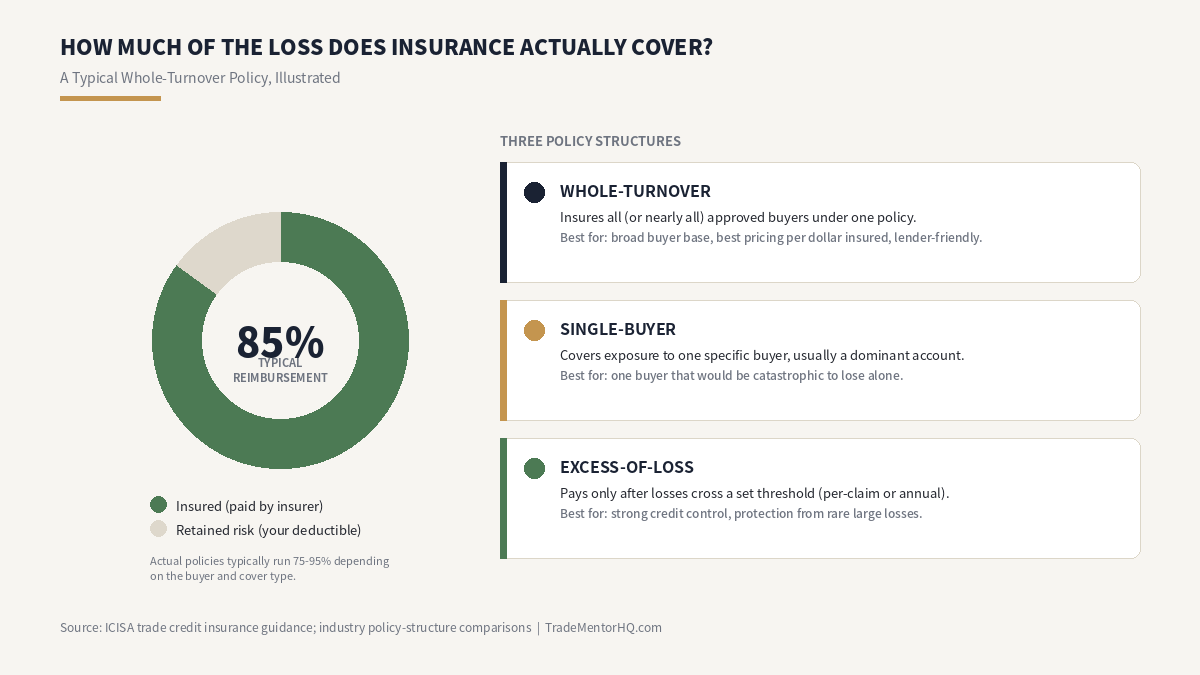
This is a different product from marine cargo insurance (see our guide to marine cargo insurance). Trade credit insurance covers two distinct triggers: buyer insolvency (bankruptcy, liquidation, formal insolvency proceedings) and protracted default (the buyer simply hasn’t paid within a defined window past the due date, even without a formal insolvency filing). Insurers don’t reimburse 100% of the loss — the reimbursement percentage usually falls between 75% and 95% of the outstanding invoice, with the remainder left as your own retained risk, which is a deliberate design choice: it keeps the policyholder financially motivated to vet buyers carefully and chase payment rather than treating every sale as fully backstopped.
The Three Main Policy Structures
Not every policy insures your entire customer base the same way, and picking the wrong structure either leaves gaps or means overpaying for coverage you don’t need.
Whole-turnover policies insure all or nearly all of your approved buyers under a single policy. Because the insurer is spreading risk across your entire sales ledger rather than concentrating it on a handful of accounts, whole-turnover coverage typically comes with the best per-dollar pricing, and it’s also the structure lenders prefer to see when your receivables are backing a financing facility. Single-buyer policies go the opposite direction — they cover exposure to one specific buyer, usually a large account that represents an outsized share of revenue.
These are faster to arrange and make sense when one customer’s payment failure would be catastrophic on its own, but the concentrated risk means higher rates per dollar insured. Excess-of-loss policies sit somewhere else entirely: instead of insuring a portfolio of buyers, they only pay out once losses cross a defined threshold (a “retention” or deductible), either per claim or as an annual aggregate. A company with strong in-house credit control and a $50,000 per-loss retention wouldn’t get paid on a $40,000 bad debt at all, but would collect $100,000 on a $150,000 loss.
This structure suits larger, more sophisticated exporters who want protection against rare, high-impact losses without paying premiums on routine, small write-offs they can already absorb.
How Premiums and Claims Actually Work
Premiums aren’t a flat fee — insurers calculate them as a percentage of your insured turnover, weighted by your company’s bad-debt history, the buyer countries and industries in your portfolio, and broader economic conditions in those sectors. Most policies carry a minimum premium regardless of actual sales volume, since the insurer is underwriting a forward-looking estimate of your turnover, not a known figure. On the claims side, timing depends heavily on which trigger applies: an insolvency claim — where the buyer has formally entered bankruptcy or liquidation proceedings — is typically the faster path, often resolving within about a month once documentation is submitted.
A protracted-default claim, where the buyer simply hasn’t paid but hasn’t filed for insolvency either, usually requires a waiting period of up to six months before the insurer will pay out, partly because many “slow payers” do eventually settle on their own. Most insurers also run debt collection services in parallel with the claims process, attempting recovery before a claim is finalized — which, in a meaningful share of cases, reduces or eliminates the loss entirely before it reaches the insurer’s books.
A Concrete Illustration
An exporter ships $500,000 worth of goods over a year to a mid-sized distributor on 60-day open-account terms, insured under a whole-turnover policy with an 85% reimbursement rate. Midway through the year, the distributor files for insolvency owing $120,000 on unpaid invoices. Under the policy, the exporter files an insolvency claim, and — once the insurer verifies the debt and the buyer’s formal insolvency status — recovers 85% of that amount, or $102,000, typically within a matter of weeks rather than months.
The remaining $18,000 is the exporter’s retained risk, but that’s a materially different outcome than absorbing the full $120,000 loss with no safety net, which is the position an uninsured exporter extending the same terms would have been in.
Is It Worth It for a Smaller Exporter?
Smaller exporters sometimes assume trade credit insurance is built for large multinational sellers with sprawling buyer portfolios, but the calculus often favors smaller companies even more. A single buyer default that a large company absorbs as a rounding error can be existential for a business with a handful of major accounts — which is also exactly the profile that benefits most from single-buyer or key-accounts coverage rather than paying for a full whole-turnover policy.
Trade credit insurance is also distinct from other trade finance tools (see our guide to trade finance instruments like factoring and export credit) — trade credit insurance earns its premium specifically when you’re extending unsecured payment terms and taking on buyer risk directly, not when a bank or ECA is already standing between you and the buyer’s creditworthiness.
The Bottom Line
Trade credit insurance doesn’t eliminate buyer risk — it caps it, typically leaving you covered for 75-95% of an insured loss while keeping some skin in the game on the rest. The right policy structure depends entirely on how concentrated your buyer risk is: whole-turnover for broad, spread-out portfolios; single-buyer for one dominant account; excess-of-loss for companies that can absorb small losses but want protection against the rare, large one. For any exporter extending open-account terms to buyers they can’t fully vet themselves, it’s worth pricing out before the first default happens, not after.
Source: International Credit Insurance & Surety Association (ICISA) guidance on trade credit insurance; industry policy-structure comparisons from trade credit insurance brokers and providers.
How trade credit insurance policies are structured
Trade credit insurance typically comes in three main structures: whole-turnover policies covering all or most of a company’s buyers, single-buyer policies covering one specific high-value relationship, and excess-of-loss policies that only kick in after losses exceed a self-insured threshold. Choosing the right trade credit insurance structure depends on how concentrated a business’s buyer risk is and how much of that risk it wants to self-insure versus transfer.
Whole-turnover trade credit insurance tends to suit businesses with many buyers of moderate size, spreading premium cost across the full portfolio. Single-buyer trade credit insurance fits businesses with one or two large, concentrated buyer relationships where a single default would be disproportionately damaging.
What trade credit insurance actually covers
Trade credit insurance reimburses a percentage of an unpaid invoice — commonly around 85-90% — when a covered buyer fails to pay due to insolvency or protracted default. It typically does not cover disputes over product quality or delivery, since trade credit insurance is designed specifically for buyer credit risk, not commercial disputes between the parties.
Most trade credit insurance policies also require the insured exporter to have performed reasonable due diligence on the buyer before extending credit, and many insurers provide buyer credit limit recommendations as part of the policy, which the exporter should follow closely to keep coverage valid.
How much trade credit insurance costs
Premiums for trade credit insurance are typically calculated as a percentage of insured sales volume, often ranging from a fraction of a percent to a few percent depending on buyer risk profiles, industry, and destination markets. Businesses selling into higher-risk countries or industries with historically higher default rates should expect higher premiums accordingly.
Many insurers also offer a deductible or self-insured retention as part of the policy structure, lowering premium cost in exchange for the exporter absorbing a small initial portion of any loss before coverage kicks in — a common way businesses balance cost against protection.
Benefits beyond the insurance payout itself
Trade credit insurance often provides value beyond the direct reimbursement: insurers maintain credit information and monitoring on buyers across many countries, giving policyholders an early warning system if a buyer’s financial health deteriorates, sometimes before the exporter’s own visibility would catch it.
Having a trade credit insurance policy in place can also make it easier to secure financing, since banks are often more willing to advance against insured receivables, treating the insurer’s backing as additional security when assessing a working capital loan or receivables financing facility.
Filing a claim under a trade credit insurance policy
When a covered buyer defaults, the exporter typically must notify the insurer promptly, provide documentation of the underlying sale and non-payment, and cooperate with any collection efforts the insurer pursues before or alongside the claim payout. Missing notification deadlines can jeopardize an otherwise valid claim.
Most policies pay claims after a defined waiting period following formal insolvency proceedings or a set number of days of protracted default, giving the insurer time to pursue recovery options before finalizing the payout to the policyholder.
Who should consider trade credit insurance
Trade credit insurance is worth considering for any exporter extending open account or unsecured payment terms to buyers, particularly those selling into new or higher-risk markets, those with concentrated exposure to a small number of large buyers, or those seeking financing secured against their receivables. Smaller exporters sometimes assume this coverage is only for large corporations, but many insurers offer policies scaled to smaller trade volumes as well.
Businesses that already use letters of credit or documentary collections for higher-risk transactions may find trade credit insurance most valuable specifically for the open-account portion of their sales — the segment carrying the most unmanaged buyer risk without any other protective structure in place.
Comparing providers and choosing a policy
Several major insurers specialize in trade credit insurance globally, and coverage terms, buyer monitoring quality, and claims-handling reputation can vary meaningfully between them. Getting quotes from multiple providers and asking about their specific buyer database coverage in your target markets helps ensure the policy actually protects the buyers you care most about insuring.
It is also worth asking providers directly how quickly they typically process claims and how much flexibility exists to adjust buyer credit limits as a relationship develops, since a policy that is too rigid can end up under-protecting a growing, increasingly important buyer relationship.
Common misconceptions about this coverage
A common misconception is assuming this type of coverage guarantees full reimbursement for any unpaid invoice — in reality, most policies reimburse a percentage, not the full amount, and require the underlying due diligence and credit limit compliance discussed earlier. Treating the coverage as a complete substitute for buyer vetting is a mistake that can leave gaps in actual protection.
Another misconception is that this coverage is prohibitively expensive for smaller businesses. In practice, premiums scale with insured sales volume, and many smaller exporters find the cost modest relative to the protection gained, particularly once financing benefits and buyer monitoring value are factored in alongside the direct claims protection.
Frequently asked questions
Does this coverage replace the need to vet buyers? No — insurers still expect reasonable due diligence, and skipping it can affect claim eligibility even when a policy is in place.
Can coverage be added mid-year for a specific large new order? Many insurers can add single-buyer endorsements or adjust coverage for a specific large transaction, though lead time varies by provider and the buyer’s risk profile.
Is this the same as export credit insurance offered by government agencies? They are related but distinct — private trade credit insurance and government export credit agency programs both cover buyer default risk, but eligibility, pricing, and country coverage can differ meaningfully between them.
Working with a broker to find the right policy
An insurance broker specializing in this coverage type can help compare structures, pricing, and buyer coverage across multiple insurers without requiring a business to independently research every provider in the market. Brokers also often have insight into which insurers are strongest in specific regions or industries, which can meaningfully affect actual claims experience down the line.
How this coverage fits into a broader risk management program
This kind of coverage works best as one layer of a broader risk management approach — combined with buyer vetting, appropriate payment terms based on relationship maturity, and diversification across enough buyers that no single default is catastrophic. Relying on any one protection alone, including insurance, leaves gaps that a layered approach closes more effectively.
Businesses that integrate buyer screening, tiered payment terms, and this insurance coverage together typically find each layer catches different failure modes — screening catches known bad actors before a sale happens, payment terms manage exposure during the relationship, and insurance absorbs the residual risk that inevitably remains even after careful screening and reasonable terms.
Getting started: what to prepare before requesting quotes
Before contacting insurers or brokers, gather basic information: annual export sales volume, a list of major buyers and their countries, any existing credit losses over recent years, and current payment terms offered. Having this ready speeds up the quoting process considerably and helps insurers provide accurate, comparable pricing across the buyers and markets that matter most to your business.
Reviewing and adjusting coverage over time
A policy purchased at one point in a company’s growth may no longer fit well a few years later as buyer mix, sales volume, and risk appetite change. Reviewing coverage annually, alongside renewal, ensures credit limits on major buyers still reflect current sales volume and that the overall policy structure still matches the business’s actual risk profile rather than an outdated snapshot from years earlier.
Businesses expanding into new markets should specifically flag this during renewal conversations, since a policy that worked well for existing markets may need adjusted terms or additional endorsements to properly cover buyers in a newly entered country with a different risk profile than the business has dealt with before.
In short, treat this coverage as a living part of the business’s financial risk management, not a policy purchased once and forgotten — the cost of a brief annual review is small compared to discovering a coverage gap only after a major buyer has already defaulted.
A quick self-assessment
If your business regularly ships to buyers on open account terms, has never formally screened its aggregate buyer credit exposure, or has experienced even one meaningful unpaid invoice from an overseas buyer in the past few years, it is a strong candidate for exploring this coverage seriously rather than continuing to absorb that risk informally.
For background on export credit programs, see the Export-Import Bank of the United States. For more risk management guidance, see our TradeMentorHQ homepage.
Deciding Whether Trade Credit Insurance Is Worth It
Trade credit insurance is one of the more underused tools available to exporters extending payment terms internationally, converting an otherwise unmanaged buyer-default risk into a predictable, budgeted premium cost. For any business with meaningful open-account exposure to overseas buyers, it is worth getting at least one quote to see whether the coverage and cost make sense for the current risk profile.
On pricing, trade credit insurance premiums typically run around 0.1–0.6% of insured sales volume depending on the buyer’s risk profile and country, and most policies cover roughly 90% of the invoice value if a covered default occurs — meaning you’re still absorbing that remaining 10% as a built-in deductible, not getting made fully whole.
Coverage is also typically buyer-specific: insurers set individual credit limits per buyer after reviewing their financials, so a large order to a buyer whose limit hasn’t been pre-approved may not be covered at all until you request a limit increase. That approval step can take days to weeks depending on the insurer, so it’s worth building it into your sales timeline rather than assuming coverage is automatic the moment you sign the policy.
Related Reading
- Marine Cargo Insurance 101: What It Covers and What It Doesn’t
- Understanding Trade Finance: Invoice Factoring, Forfaiting, and Export Credit
Written by the TradeMentorHQ editorial team. We research primary sources — ICISA guidance and standard trade credit insurance industry practice — before every article, and we’re upfront about how the site is produced on our About page. Spotted something that needs a correction? Let us know.

About the Author: TradeMentorHQ Team
The TradeMentorHQ team researches and writes practical, plain-language guides on Incoterms, customs clearance, trade finance, and shipping logistics for small business owners, first-time importers/exporters, and side-hustle sellers. Our articles are grounded in publicly available regulations and guidance from bodies like U.S. Customs and Border Protection (CBP), the International Chamber of Commerce (Incoterms 2020), and established industry practice, and we link to primary sources wherever a number or rule could change. We are not customs brokers, freight forwarders, or licensed trade attorneys, and nothing here is a substitute for advice from one on your specific shipment.