
Understanding free trade agreement qualification is one of the most valuable skills an exporter can develop, since qualifying correctly can eliminate duty entirely, while getting it wrong can trigger penalties, denied preferential treatment, and unexpected costs long after a shipment has already cleared.
A lot of exporters assume that if their country has a free trade agreement with the destination country, their product automatically ships duty-free.
Why “Made in an FTA Country” Isn’t the Same as “Qualifies Under the FTA”
The confusion usually starts with country-of-origin marking, which is a separate concept from FTA qualification. A product can pass the substantial transformation standard — it underwent a fundamental change in form, appearance, or character there — while still failing to qualify for USMCA preferential tariff treatment, because the FTA’s rules of origin are stricter and more specific than the general marking rule. Substantial transformation asks a fairly open-ended question: did this become a genuinely new product? FTA rules of origin ask a narrower, product-specific question: does this particular good, under this particular agreement’s rule for its HS classification, contain enough originating content or undergo the right kind of processing?
A product can pass one test and fail the other, which is exactly why assuming FTA eligibility from country-of-origin marking alone is a common and costly mistake.
The Three Core Rules of Origin Tests
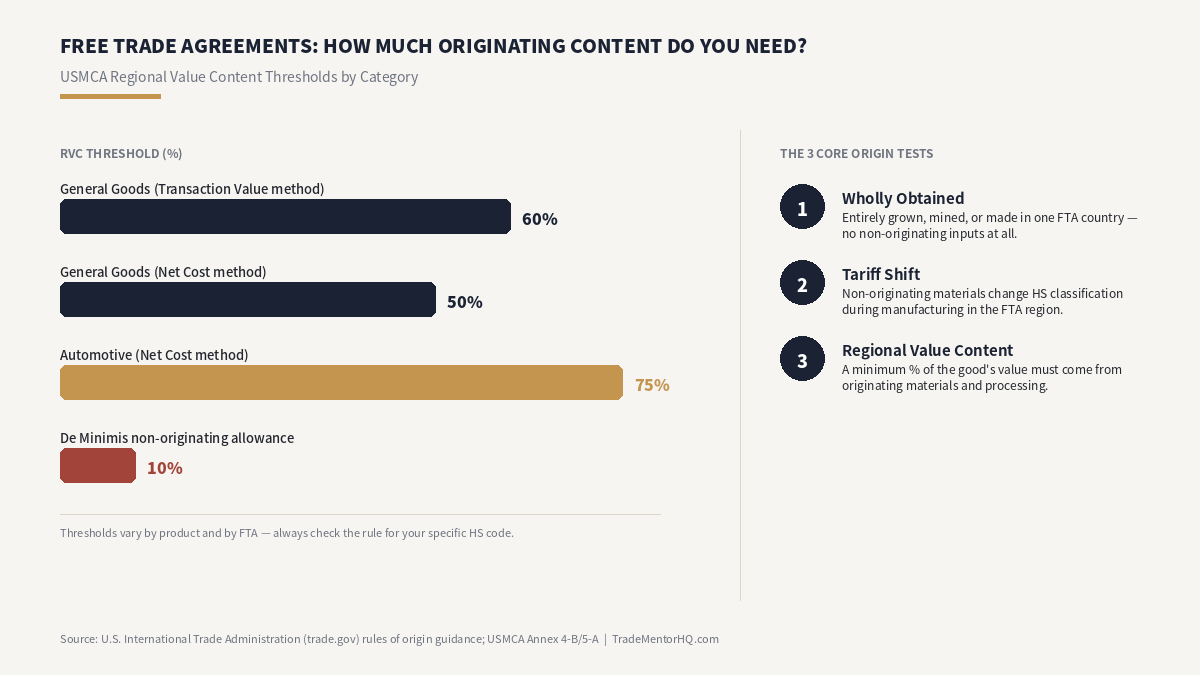
Nearly every FTA relies on some combination of three tests, applied at the product level based on its HS code. Wholly obtained or produced is the simplest: the good is entirely grown, harvested, mined, or manufactured in one FTA country with no non-originating inputs at all — raw agricultural products and minerals are the typical examples. Tariff shift requires that non-originating materials used in production undergo a specified change in HS classification during manufacturing in the FTA territory — for example, non-originating fabric (one HS heading) being cut and sewn into a finished garment (a different HS heading) inside the FTA region.
Regional value content (RVC) requires that a minimum percentage of the good’s value come from originating materials and processing within the FTA territory, calculated using a transaction value, net cost, build-up, or build-down formula depending on the agreement. Many product-specific rules combine two of these — a tariff shift plus an RVC floor — and the exact rule that applies depends entirely on the product’s HS classification, which is why getting the HS code right is the prerequisite step before checking origin at all.
A Concrete Illustration: USMCA’s Numbers
USMCA is a useful worked example because its thresholds are public and specific. For most general manufactured goods, the regional value content requirement is 60% under the transaction value method or 50% under the net cost method — meaning at least half to three-fifths of the good’s value must originate in the US, Mexico, or Canada. 5% under the old NAFTA), and a separate labor value content rule requires 40% of a passenger vehicle’s content (45% for trucks) to be produced by workers earning at least $16 per hour.
USMCA also allows a de minimis tolerance: up to 10% of a good’s value can consist of non-originating materials that fail the applicable tariff shift rule and the good still qualifies overall, which gives manufacturers some flexibility for minor non-originating inputs that would otherwise disqualify an entire shipment.
How to Actually Check Your Product
In practice, checking qualification starts with confirming the correct HS classification for the finished good, then looking up that specific HS code’s rule of origin in the FTA’s product-specific rules annex, available through the official FTA text on the USTR website or an equivalent government trade portal for the agreement in question. S. Commercial Service’s free Rules of Origin Facilitator tool consolidates this lookup across multiple agreements and is generally the fastest starting point rather than reading full treaty text line by line.
For a company sourcing components from multiple countries, this usually means mapping out the HS code and country of origin of every material in the bill of materials before running the applicable test — tariff shift, RVC, or both — against the finished good’s specific rule.
Documenting the Claim: The Certificate of Origin
Meeting the rule of origin is only half the requirement — the claim also has to be documented. Under USMCA, this is a self-certification process rather than a government-issued form: the certifier (which can be the importer, exporter, or producer) completes a document containing nine required data elements specified in USMCA Annex 5-A, states which origin criterion (A, B, or C) the good qualifies under, and keeps supporting records available for CBP verification. A single certification can cover a blanket period of up to 12 months for recurring shipments of the same good, which saves significant paperwork for exporters shipping the same product repeatedly.
Other FTAs use their own certificate formats and, in some cases, still require a government or chamber-of-commerce-issued certificate rather than self-certification — the exact process depends on the specific agreement, which is one more reason a blanket assumption about “how FTAs work” based on one agreement can lead an exporter astray on another.
The Bottom Line
Free trade agreements don’t grant duty-free treatment automatically to anything shipped between member countries — they grant it to goods that pass a specific, product-level rule of origin test and are backed by a properly documented certificate of origin. Before assuming a shipment qualifies, confirm the HS classification, check that code’s specific rule under the agreement in question, and run the numbers on tariff shift or regional value content rather than relying on where the product happens to be labeled as made.
Source: U.S. International Trade Administration (trade.gov) guidance on identifying and applying rules of origin and substantial transformation; industry analysis of USMCA regional value content, de minimis, and certification requirements.
What free trade agreement qualification actually requires
Free trade agreement qualification is not automatic just because both countries are signatories to the same agreement — a product must satisfy specific rules of origin proving it was substantially produced or transformed within the free trade area, not merely shipped through or lightly processed there. Free trade agreement qualification typically hinges on one of three tests: a tariff shift test, a regional value content test, or a specific manufacturing process requirement, depending on the product category and the agreement.
Getting free trade agreement qualification wrong is a common and costly mistake. Many exporters assume any product made in a member country automatically qualifies, only to discover during a customs audit that imported components pushed the product below the required regional value content threshold, invalidating the preferential tariff treatment and triggering back duties, interest, and sometimes penalties.
Tariff shift rules explained
Under a tariff shift approach to free trade agreement qualification, a product qualifies if its non-originating (foreign) materials are classified under a different tariff heading than the finished product after processing in the member country. This test focuses on whether meaningful transformation occurred, rather than directly measuring cost or value added.
Tariff shift rules for free trade agreement qualification vary by product category and specific agreement — some require only a change at the broader HS chapter level, while others require a more specific change at the heading or subheading level, making it essential to check the exact rule for your product’s HS code rather than assuming a general standard applies.
Regional value content: the other major test
Regional value content is the second common approach to free trade agreement qualification, requiring that a specified percentage of a product’s value originate within the free trade area. This percentage varies by agreement and product category — USMCA, for instance, sets different regional value content thresholds for automotive products than for most other manufactured goods.
Calculating regional value content for free trade agreement qualification purposes requires careful documentation of every input’s origin and cost, since a single miscounted imported component can push a product below the required threshold. Exporters relying on regional value content should maintain detailed bills of materials specifically to support free trade agreement qualification claims if audited.
Documentation needed to support your claim
Beyond meeting the underlying rule, free trade agreement qualification also requires proper documentation — typically a certificate of origin, either issued by an authority or self-certified depending on the specific agreement, along with supporting records proving how the product met the applicable rule of origin test.
Many agreements now allow exporter or producer self-certification of free trade agreement qualification rather than requiring a government-issued certificate, but self-certification shifts more of the compliance burden and audit risk onto the exporter, making thorough internal documentation even more important.
Common mistakes exporters make with free trade agreement qualification
The most frequent mistake is assuming qualification based on where final assembly happened, without checking whether enough of the actual value or transformation occurred within the trade area to satisfy the specific rule. Free trade agreement qualification depends on the precise rule for your product’s HS code, not on a general sense that “mostly made here” should be good enough.
A second common mistake is failing to update free trade agreement qualification analysis when a supply chain changes. Switching a component supplier to a country outside the trade area can silently invalidate a qualification that was previously valid, and many businesses do not re-check qualification status after routine sourcing changes, leading to inadvertent misdeclaration on customs paperwork.
A third mistake is confusing rules of origin under different agreements. A product’s free trade agreement qualification under one agreement, such as USMCA, does not automatically transfer to a different agreement your country has with another partner, since rules of origin, thresholds, and documentation requirements can differ substantially between agreements even for the same product.
How to check qualification for your specific product
Start free trade agreement qualification analysis by identifying your product’s correct HS code, then look up the specific rule of origin for that code under the relevant agreement — most trade agreement texts publish these rules by chapter and heading, and many customs authorities also publish searchable rules-of-origin databases online.
For complex products with multiple foreign-sourced components, working with a customs broker or trade compliance specialist to verify free trade agreement qualification before shipping is usually worth the cost, since the potential savings from correctly claimed preferential duty treatment — and the penalties for incorrectly claimed treatment — can both be substantial.
What happens if qualification is claimed incorrectly
Incorrectly claiming free trade agreement qualification carries real consequences: customs authorities can retroactively assess unpaid duties, add interest for the period the goods moved without proper duty payment, and in cases of repeated or willful misdeclaration, impose additional penalties or increase future audit scrutiny on the exporter or importer.
Even honest mistakes in free trade agreement qualification analysis are not automatically excused — customs authorities generally expect exporters and importers to exercise reasonable care in verifying qualification before claiming preferential treatment, which is why maintaining clear documentation of the qualification analysis itself, not just the final certificate, matters so much if a claim is ever questioned.
How free trade agreement qualification affects pricing and competitiveness
Correctly claimed free trade agreement qualification can be a genuine competitive advantage, since eliminating or sharply reducing duty allows a lower landed cost than a competitor shipping the same product without qualifying preferential treatment. This makes free trade agreement qualification not just a compliance exercise but a real pricing lever worth actively managing rather than treating as an afterthought.
Conversely, businesses that fail to pursue available free trade agreement qualification — perhaps because they assume the analysis is too complicated — leave real money on the table every single shipment, paying full duty rates on products that could legitimately qualify for preferential or duty-free treatment with proper documentation.
Put a dollar figure on it: a $50,000 shipment of qualifying goods facing a 6.5% most-favored-nation duty rate would owe $3,250 in duty without a free trade agreement claim. If that same shipment genuinely qualifies for 0% preferential treatment under an applicable FTA, that $3,250 either becomes pure margin or a price advantage the exporter can pass on to stay competitive against suppliers who aren’t claiming the benefit.
Multiply that across a year of monthly shipments at similar volume, and the gap between claiming and not claiming qualification is closer to $39,000 than a single line item — which is why the paperwork burden of a certificate of origin is rarely the real obstacle; not knowing the rule exists is.
Frequently asked questions about free trade agreement qualification
Does free trade agreement qualification apply automatically once a trade deal is signed? No — qualification must be verified product by product against the specific rules of origin in the agreement; simply operating within a member country does not guarantee qualification.
Who is responsible for verifying qualification? Typically the exporter or producer, though importers relying on preferential treatment should also confirm the supporting documentation is accurate and available if requested by customs.
Can qualification status change over time? Yes — supply chain changes, updated rules of origin, or agreement renegotiations can all affect whether a previously qualifying product still qualifies, making periodic re-verification worthwhile.
Working with a customs broker on qualification analysis
For businesses without in-house trade compliance expertise, a licensed customs broker can perform the free trade agreement qualification analysis directly, cross-referencing bills of materials against the applicable rules of origin and flagging any component that puts qualification at risk before a shipment leaves the factory.
Brokers experienced in free trade agreement qualification can also help set up ongoing monitoring, so that a future supplier change automatically triggers a re-check of qualification status rather than relying on someone remembering to revisit the analysis manually months or years later.
Building qualification checks into new product launches
The best time to run free trade agreement qualification analysis is before a product launches, not after it has already been shipping under an assumed qualification status for months. Building a qualification check into the standard new-product or new-supplier onboarding checklist catches issues while sourcing decisions are still flexible, rather than after contracts and pricing are already locked in.
This proactive approach to free trade agreement qualification also gives sourcing teams a chance to weigh a marginally more expensive but qualifying component against a cheaper non-qualifying one, factoring the duty savings into the total cost comparison rather than discovering the tradeoff only after the fact.
Keeping records for a customs audit
Customs authorities can request supporting documentation for a free trade agreement qualification claim years after a shipment clears, so records — bills of materials, supplier certifications, cost calculations — should be retained well beyond the shipment date, typically for the retention period specified under the relevant agreement or the importing country’s customs regulations.
Well-organized qualification records also make responding to an audit request far less stressful, since the underlying analysis supporting each free trade agreement qualification claim can be produced quickly rather than reconstructed under time pressure after an audit notice arrives.
In short, treat free trade agreement qualification the same way you would treat any other recurring compliance obligation: build it into standard processes, document it consistently, and revisit it whenever the underlying facts — suppliers, components, or agreements themselves — change, rather than assuming a one-time determination holds forever.
For official rules of origin guidance, see the USTR’s free trade agreements resources. For more export compliance guidance, see our TradeMentorHQ homepage.
Making Sure You Actually Qualify
Free trade agreement qualification is genuinely worth the upfront effort: correctly qualifying a product for preferential tariff treatment can meaningfully lower landed cost and improve competitiveness, while incorrectly claiming it can trigger costly retroactive duties and penalties. Treating qualification analysis as a routine, ongoing part of export operations — not a one-time checkbox — is the safest and most profitable approach.
Related Reading
- How to Classify Your Product with the Correct HS Code (and Avoid Costly Mistakes)
- A Beginner’s Guide to Customs Clearance Delays (and How to Prevent Them)
Written by the TradeMentorHQ editorial team. We research primary sources — U.S. International Trade Administration guidance and official USMCA text and annexes — before every article, and we’re upfront about how the site is produced on our About page. Spotted something that needs a correction? Let us know.

About the Author: TradeMentorHQ Team
The TradeMentorHQ team researches and writes practical, plain-language guides on Incoterms, customs clearance, trade finance, and shipping logistics for small business owners, first-time importers/exporters, and side-hustle sellers. Our articles are grounded in publicly available regulations and guidance from bodies like U.S. Customs and Border Protection (CBP), the International Chamber of Commerce (Incoterms 2020), and established industry practice, and we link to primary sources wherever a number or rule could change. We are not customs brokers, freight forwarders, or licensed trade attorneys, and nothing here is a substitute for advice from one on your specific shipment.