For the full legal background on this doctrine, see the general average entry and our related guide on marine cargo insurance basics.
General average cargo damage is a maritime law principle that can leave a cargo owner responsible for a share of losses even when their own shipment arrived completely undamaged.
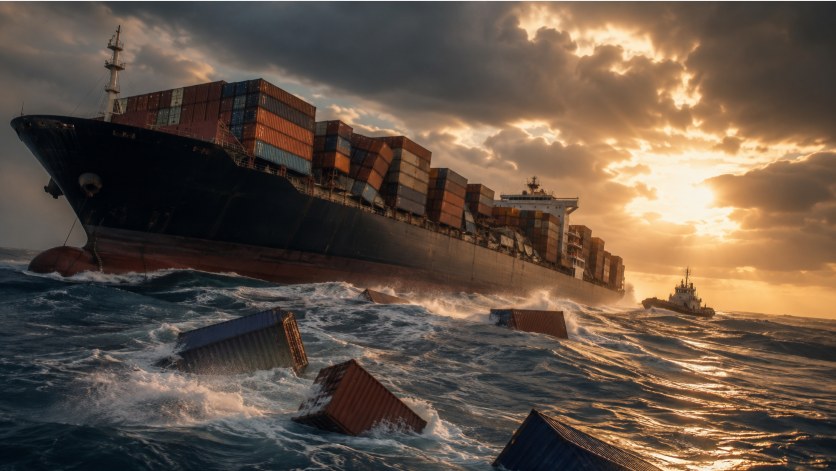
General Average is one of the oldest rules in commercial shipping, and it catches first-time importers off guard almost every time it shows up: if a ship’s crew makes an emergency sacrifice to save the vessel and everyone’s cargo from a real danger — jettisoning containers in a storm, fighting an engine-room fire, paying for emergency towage after a grounding — every cargo owner aboard has to help pay for it afterward, in proportion to what their goods were worth, even if their own boxes came through untouched.
Carriers can hold your cargo at the port of discharge until you post security for that unknown future bill, which is why a General Average declaration turns a routine shipment into a months-long financial and legal process almost overnight.
What Actually Counts as a “General Average” Event
General Average isn’t triggered by ordinary cargo damage — a container that got wet from a leaking roof or a pallet crushed by bad stowage is a regular cargo claim, handled through the carrier’s liability or your own marine cargo insurance. General Average is reserved for a much narrower, more dramatic category: a deliberate, reasonable sacrifice made specifically to save the ship and the whole cargo from a genuine shared peril. Maritime law generally looks for four things to be true before a declaration holds up:
- A real peril threatened the vessel and cargo together — not a hypothetical or minor risk
- The action taken was voluntary — a deliberate decision by the master, not an accident
- The response was reasonable — commercially and nautically defensible given the situation
- The action actually worked — property was successfully preserved as a result
In practice, the scenarios that trigger a declaration tend to repeat: cargo jettisoned overboard during severe weather to lighten a struggling ship, emergency towage to prevent a grounding, firefighting costs (including damage caused by the water used to fight the fire, not just the fire itself), diverting to a port of refuge for emergency repairs, or the cost of unloading and reloading cargo to refloat a disabled vessel. None of these are rare edge cases — fires, groundings, machinery failures, and container losses are still a routine part of ocean shipping, which is exactly why this 150-year-old rule hasn’t gone anywhere.
The York-Antwerp Rules — the Playbook Behind Every Declaration
General Average isn’t something a carrier invents on the fly. It’s adjusted according to the York-Antwerp Rules, a standardized international framework that gets written directly into your bill of lading, charter party, or contract of carriage. The current 2016 edition is what’s in use industry-wide today, and it covers everything from how salvage payments are treated (Rule VI) to how a “voluntary sacrifice” is legally defined (Rule A) to documentation and time-limit requirements.
The rules don’t apply automatically just because you shipped cargo on a vessel — they apply because your shipping contract incorporated them, which is worth knowing since it means the fine print you never read is exactly what governs this process.
Why You Pay Even If Your Cargo Was Never Touched
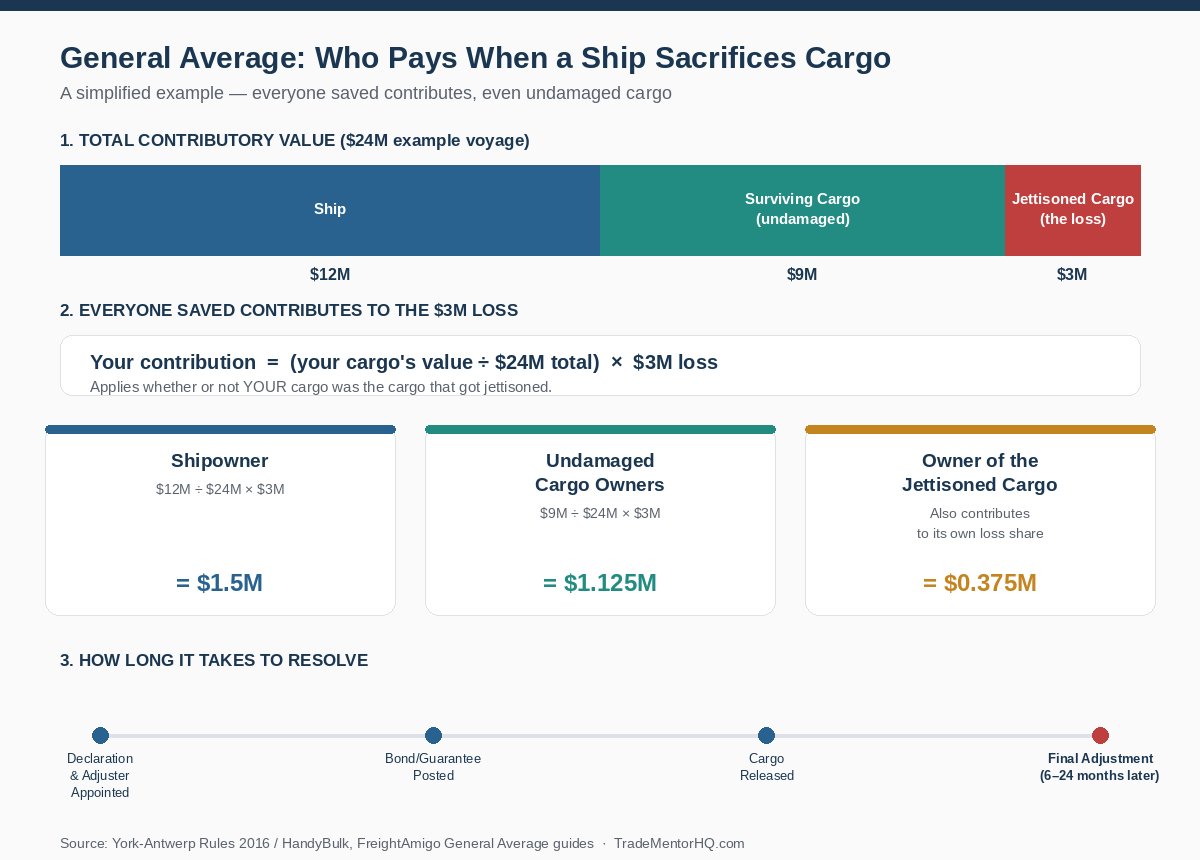
This is the part that trips people up every time: General Average contributions are based on what was saved, not what was damaged. If the crew jettisoned someone else’s containers to keep the ship from capsizing, your untouched cargo was saved by that sacrifice just as much as the ship itself was — so you owe a share too. The math is a straightforward proportion:
Your contribution = (your cargo’s value ÷ total value of everything saved) × total General Average cost
A simplified version of how this plays out: say a vessel worth $12 million is carrying $12 million in total cargo, and $3 million worth of containers gets jettisoned to save the rest. The total contributory value (ship plus surviving cargo plus freight) works out to roughly $24 million, and every interest that was saved — the shipowner included — pays their share of that $3 million loss based on their percentage of the total. The owner of a $500,000 container that arrived in perfect condition might still owe tens of thousands of dollars, simply because their goods were part of what got saved.
The General Average Bond and Guarantee — What Happens at the Dock
Once General Average is declared, the shipowner appoints an independent average adjuster to survey the vessel and cargo values and calculate everyone’s share — a process that, by its nature, can’t be finished quickly. But the ship still needs to unload and cargo owners still need their goods, so carriers won’t release anything until each cargo owner posts security for a contribution amount that isn’t even known yet. Two documents handle this:
- A General Average Bond — your written promise to pay whatever the final adjustment determines you owe, once it’s calculated
- A General Average Guarantee — typically issued by your cargo insurer instead of you personally, promising to cover the contribution when the final number is set
This is exactly why marine cargo insurance matters here in a way people don’t expect: if you’re insured and General Average coverage is included in your policy, your insurer issues the guarantee and your cargo gets released without you tying up cash. If you’re not insured, you’re the one posting a cash deposit or bank guarantee — sometimes a significant one — before you see your goods again.
I’ve seen an importer discover this the hard way on an otherwise uneventful shipment: their container was completely undamaged, but a fire elsewhere on the vessel triggered a General Average declaration, and their goods sat at the terminal for weeks while they scrambled to arrange a bond, simply because nobody had checked whether their cargo insurance actually extended to General Average contributions.
How Long This Actually Takes
Don’t expect a quick resolution. Average adjustment is a genuinely slow process — surveying values, verifying claims, and calculating final contributions across every cargo interest on board a large vessel routinely takes six months to two years, and complex cases can run longer. This is also why the bond/guarantee system exists in the first place: nobody could reasonably keep cargo sitting at a terminal for two years waiting for a final number, so security gets posted upfront and the actual payment gets settled much later, once the adjuster’s report is final.
Large, high-profile incidents are a useful reminder of how routine this actually is in commercial shipping — vessel groundings, onboard fires, and machinery failures that trigger General Average declarations happen on cargo ships every year, not just in rare headline events. If you ship internationally by ocean freight often enough, encountering a General Average declaration eventually is a matter of when, not if.
Does Marine Cargo Insurance Cover This?
Most properly arranged marine cargo insurance policies do include General Average coverage, but “most” isn’t “all,” and coverage details vary by policy terms, conditions, and valuation basis — this isn’t something to assume without checking. Before you ship anything valuable by ocean freight, confirm with your broker or insurer, in writing, that your policy specifically covers General Average contributions and salvage charges, not just physical loss or damage to your own goods. It’s a five-minute question that can save you from an unplanned five- or six-figure cash outlay months down the line.
What to Do If You Get a General Average Notice
- Don’t ignore it or assume it doesn’t apply to you — it applies precisely because your cargo was saved, not because it was damaged
- Check your marine cargo insurance policy immediately for General Average and salvage coverage — if it’s covered, your insurer typically handles the guarantee and adjuster communication for you
- If you’re not insured, contact your freight forwarder or a maritime lawyer promptly about arranging a bond or cash deposit — delays here directly delay your cargo release
- Keep all shipping documents (bill of lading, commercial invoice, packing list) accessible, since the adjuster will need them to verify your cargo’s value
- Expect the process to take months, and don’t expect a final invoice quickly — the bond you post now is a placeholder, not the final bill
General Average is one of those maritime rules that feels almost unfair the first time you run into it — paying for damage to cargo that was never yours, on a ship you don’t own, over an incident you had no part in. But it’s also one of the oldest and most consistently applied principles in shipping precisely because the alternative is worse: without it, a captain facing an emergency would have every incentive to save their own liability exposure over the ship and cargo as a whole.
Understanding it before it happens — and making sure your insurance actually covers it — is the difference between a paperwork inconvenience and a genuine cash-flow crisis.
Related Reading
- Marine Cargo Insurance 101: What It Covers and What It Doesn’t
- All Risk vs Named Perils: Choosing the Right Cargo Insurance Coverage
Written by the TradeMentorHQ editorial team. We research primary sources — the York-Antwerp Rules 2016 and marine insurance industry guidance (HandyBulk, FreightAmigo) — before every article, and we’re upfront about how the site is produced on our About page. Spotted something that needs a correction? Let us know.
How general average cargo damage claims actually arise
General average cargo damage is declared under a legal doctrine dating back centuries in maritime law, codified today primarily through the York-Antwerp Rules, which most bills of lading incorporate by reference. Under this principle, when a ship’s master makes a deliberate sacrifice to save the voyage as a whole — jettisoning cargo, extinguishing a fire with seawater, or grounding the vessel intentionally to prevent a total loss — every party with cargo or interest on board shares the resulting cost proportionally, even those whose cargo was never physically touched.
This is precisely why general average cargo damage claims can surprise importers who assume insurance only responds to damage to their own specific shipment.
A general average declaration is typically made by the shipowner shortly after an incident, triggering a formal average adjustment process run by a professional average adjuster. Every cargo owner on the vessel, regardless of whether their cargo was damaged, sacrificed, or untouched, is asked to post a general average bond or guarantee before their cargo is released, precisely because the general average cargo damage contribution amount is not yet known and can take months or years to finalize.
How much a general average cargo damage contribution can cost
The proportional share a cargo owner owes toward a general average cargo damage event is calculated based on the value of their cargo relative to the total value of everything at risk in the voyage — ship, fuel, and all cargo combined. A container of relatively low-value goods can still trigger a meaningful five- or six-figure general average cargo damage contribution demand if it was part of a very high-value voyage, which is exactly the kind of surprise bill that catches first-time importers off guard when they have never budgeted for this specific maritime law exposure.
Why cargo insurance matters for general average cargo damage exposure
Marine cargo insurance, particularly a policy written on an all-risk basis, typically covers a cargo owner’s general average cargo damage contribution as a named benefit, reimbursing the guarantee or bond amount the owner had to post to release their goods. Importers who ship without cargo insurance, assuming their goods are low-risk or the voyage is routine, discover during a general average cargo damage event that they are personally on the hook for a contribution completely unrelated to any damage their own cargo actually suffered.
The general average adjustment process, step by step
A general average cargo damage adjustment typically unfolds over several stages, starting with the shipowner’s formal declaration and appointment of an average adjuster, followed by cargo release conditioned on a general average bond or guarantee, then months of investigation into the exact values and circumstances, and finally a settlement statement allocating the general average cargo damage contribution across every party. This entire general average cargo damage process commonly takes six months to two years to fully resolve, during which importers may have working capital tied up in bond guarantees or letters of undertaking their insurer or bank provided on their behalf.
Cargo owners are usually notified of a general average cargo damage event through their freight forwarder or the carrier directly, often with a deadline to provide a general average bond before cargo will be released from the port. Missing this deadline can result in demurrage charges piling up on top of the underlying general average cargo damage contribution itself, compounding what was already an unexpected cost with additional fees for the delay.
Common triggers for general average cargo damage events
Container ship groundings, engine room fires, and severe weather incidents requiring jettison of deck cargo are the most common real-world triggers for a general average cargo damage declaration. High-profile vessel groundings and fires in major shipping lanes over the past decade have each triggered general average cargo damage events affecting thousands of individual cargo owners simultaneously, some of whom had never even heard of general average as a concept before receiving a contribution demand.
What to do if you receive a general average cargo damage notice
Cargo owners who receive a general average cargo damage notice should immediately check whether their marine cargo insurance policy covers general average contributions, since most all-risk policies do, and contact their insurer or broker right away rather than trying to negotiate directly with the average adjuster alone. Insurers experienced with general average cargo damage claims typically handle the bond or guarantee process directly with the adjuster on the policyholder’s behalf, which removes much of the administrative burden and legal complexity from the cargo owner during an already stressful situation.
Budgeting and contract terms around general average cargo damage risk
Experienced importers who ship high volumes on container vessels increasingly build general average cargo damage risk into their standard supply chain planning, treating cargo insurance as a fixed cost of doing business rather than an optional add-on considered only after a scare. Freight forwarders and customs brokers who regularly handle ocean freight can usually explain a shipper’s specific general average cargo damage exposure based on the trade lane and carrier used, since risk varies meaningfully by route, vessel age, and season.
Reviewing a bill of lading’s general average clause before shipping, rather than after an incident occurs, helps importers understand exactly which rules — York-Antwerp 1994, 2004, or 2016 — will govern any future general average cargo damage adjustment, since the specific rule set in force can affect how contributions are calculated and what expenses qualify. This detail is easy to overlook when a bill of lading is treated as boilerplate, but it becomes directly relevant the moment an actual general average cargo damage event occurs.
The bottom line for importers
Few concepts in maritime law surprise first-time importers as much as this one: a shipment that arrives without a scratch can still generate a real bill, sometimes a substantial one, months after the voyage ends. Building basic awareness of this risk into a shipping and insurance strategy, rather than discovering it for the first time when a bond demand arrives, is a small amount of preparation relative to the disruption an unbudgeted contribution can cause to cash flow. Reviewing whether an existing cargo insurance policy actually names this specific protection, and confirming it with a broker before it is ever needed, is worth the short conversation it takes.
One detail that surprises cargo owners the first time they’re hit with a general average declaration: your bill is based on your cargo’s proportional share of everything on the vessel’s total value (the York-Antwerp Rules’ “contributory value” formula), a calculation that can take average adjusters six months to over a year to finalize.
In the meantime, carriers typically require a general average bond or cash deposit — often 10–30% of your cargo’s declared value — before releasing your container, even if your specific boxes were undamaged. That’s why marine cargo insurance with a general average clause is worth the extra premium: without one, that deposit comes straight out of your working capital for however long the adjustment takes.

About the Author: TradeMentorHQ Team
The TradeMentorHQ team researches and writes practical, plain-language guides on Incoterms, customs clearance, trade finance, and shipping logistics for small business owners, first-time importers/exporters, and side-hustle sellers. Our articles are grounded in publicly available regulations and guidance from bodies like U.S. Customs and Border Protection (CBP), the International Chamber of Commerce (Incoterms 2020), and established industry practice, and we link to primary sources wherever a number or rule could change. We are not customs brokers, freight forwarders, or licensed trade attorneys, and nothing here is a substitute for advice from one on your specific shipment.