
Most first-time exporters find out how marine cargo insurance actually works at the worst possible time — after a container has already been damaged, or after a carrier declares something called “General Average” and suddenly wants money for cargo that was never even touched. Buying a policy is the easy part. Understanding what it actually pays for is where people get caught out.
Short version: marine cargo insurance comes in three standard coverage tiers — Institute Cargo Clauses A, B, and C — ranging from broad “all risks” protection down to a narrow list of named perils, and even a fully insured, undamaged shipment can still owe money under a separate maritime rule called General Average. Which tier you need depends on your cargo, your Incoterm, and how much of a gap you’re willing to carry yourself.
What Marine Cargo Insurance Actually Is
Marine cargo insurance covers physical loss or damage to goods while they’re in transit — by sea, but usually extended to cover the connecting inland legs too, from the seller’s warehouse to the buyer’s dock. Who’s responsible for arranging it comes straight out of the Incoterm on your contract: under CIF and CIP, the seller is contractually required to buy it (at different minimum coverage levels, more on that below); under every other Incoterm, whichever party is carrying the risk at that point in the journey decides for themselves whether to insure it, and how much.
The Three Coverage Levels: ICC A, B, and C
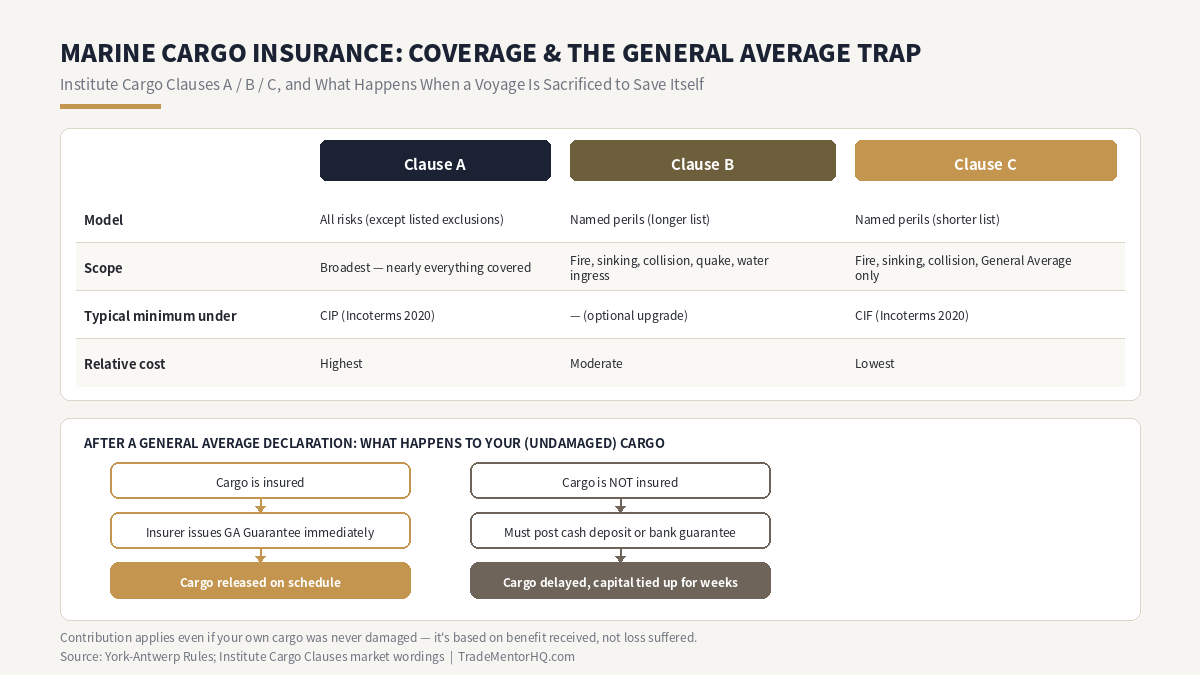
Institute Cargo Clauses are the standard policy wordings the marine insurance market uses worldwide, and they come in three tiers that differ in a fundamental way, not just in degree.
Clause A is “all risks” coverage: it protects against loss or damage from any cause, except for a specific, named list of exclusions (willful misconduct, inherent vice, ordinary wear and leakage, inadequate packing, and war or strikes unless separately added back in). This is the broadest and most expensive tier, and it’s the minimum required under CIP as of the 2020 Incoterms revision.
Clause B and Clause C work the opposite way: instead of covering everything except a list of exclusions, they only cover a specific list of named perils. Clause B’s list is longer — fire, explosion, stranding, sinking, capsizing, collision, jettison, earthquake, and water entering the vessel or container, among others. Clause C strips that down further, dropping natural catastrophe and water-damage perils and leaving mainly fire, explosion, stranding, sinking, collision, and General Average sacrifice.
Clause C is the minimum required under CIF — which means a CIF shipment can legally be insured against a noticeably narrower set of risks than a CIP shipment, even though both terms sound like they’re offering a similar service.
What “All Risks” Doesn’t Actually Mean
Even the broadest tier, Clause A, isn’t unconditional. It won’t pay for damage caused by the cargo’s own inherent nature (produce that spoils on a normal timeline, metal that rusts from ordinary humidity), for ordinary wear and tear or normal leakage, for losses caused by inadequate or unsuitable packing, or for war, strikes, riots, and civil commotion unless those are separately added back into the policy. A shipper who assumes “all risks” means “every possible outcome is covered” is the person most likely to get an unpleasant surprise when a claim is denied on one of these grounds.
The Cost Nobody Budgets For: General Average
This is the part that catches even experienced shippers off guard. General Average is a centuries-old maritime principle, still governed today by the York-Antwerp Rules, that says: if a genuine peril threatens the entire voyage and deliberate action is taken to save it — jettisoning some cargo to keep a ship from sinking, paying for emergency salvage or towage — then every party whose cargo was saved has to share that cost proportionally, whether or not their own cargo was the one sacrificed or damaged.
That means a shipper whose container arrives completely undamaged can still be legally required to pay a General Average contribution, simply because their cargo benefited from the collective rescue. Before the ship line will release any cargo after a General Average declaration, it requires security — a General Average Bond guaranteeing eventual payment. If your cargo is insured, your insurer typically issues this guarantee immediately and your goods move on schedule.
If it isn’t, you’re often looking at posting a cash deposit or bank guarantee before your own undamaged cargo gets released — which can tie up working capital and delay delivery for weeks, over damage that never touched your shipment at all.
👉 Read the CMI’s General Average guidelines (York-Antwerp Rules)
What It Actually Costs
Marine cargo insurance premiums are quoted as a percentage of the insured value, and the range is wide: roughly 0.05%–0.15% for low-risk shipments, 0.10%–0.60% for typical general cargo, and 0.60%–2% or more for higher-risk commodities or lanes. What moves the number: the type of commodity (fragility, theft appeal, temperature sensitivity), the route (theft hotspots, transshipment points, congestion), documented packing quality, how broad a coverage tier you choose, your deductible, and your own claims history. Insured value itself is usually calculated as invoice value plus freight, marked up by roughly 10% to cover the buyer’s expected profit margin and overhead exposure — not just the bare cost of the goods.
How to Actually Get This Right
Check what your Incoterm actually obligates the seller to buy, and don’t assume it’s enough for your situation — CIF’s Clause C minimum is a legal floor, not a recommendation, and plenty of experienced buyers pay the small premium difference to upgrade to Clause A coverage even when they’re not the one contractually required to insure. For genuinely high-value or fragile cargo, treat the coverage tier as a real decision, not a box to check.
And regardless of which tier you carry, keep documented proof of proper packing — it’s frequently the deciding factor in whether a damage claim gets paid or denied under the “inadequate packing” exclusion that exists in every tier, including Clause A.
The Bottom Line
Marine cargo insurance isn’t a single product — it’s a tier of coverage that ranges from a short list of named disasters to nearly everything except a handful of exclusions, and even full coverage doesn’t exempt you from General Average’s oldest rule: you can owe money for damage that never happened to your own cargo. Know which Clause your policy actually is, read the exclusion list once before you need it, and budget for General Average as a real (if rare) possibility rather than a footnote.
Source: Standard Institute Cargo Clauses (A/B/C) market wordings; York-Antwerp Rules on General Average; marine cargo insurance industry pricing practice.
Marine Cargo Insurance: Common Claim Scenarios
Real claims make marine cargo insurance easier to understand than reading policy definitions alone. A container lost overboard during a storm is a textbook marine cargo insurance claim under most all-risk policies, covering the full value of the lost goods. A shipment damaged by seawater intrusion into a container with a compromised seal is another common marine cargo insurance scenario, though coverage can depend on whether the packaging was deemed adequate for ocean transit.
A general average declaration — where cargo is deliberately jettisoned to save the vessel — triggers a different kind of marine cargo insurance claim, since all cargo owners aboard share the loss proportionally regardless of whose goods were actually sacrificed.
- Cargo lost overboard — a standard marine cargo insurance claim under most all-risk policies.
- Water damage from a compromised container seal — marine cargo insurance coverage depends on packaging adequacy.
- General average declarations — marine cargo insurance often covers a business’s proportional share.
Marine Cargo Insurance: Coverage Levels at a Glance
Comparing coverage levels side by side makes it easier to choose the right marine cargo insurance policy for a specific shipment.
| Clause | Marine cargo insurance coverage level |
|---|---|
| ICC (A) | All risks, broadest marine cargo insurance coverage |
| ICC (B) | Named perils, moderate marine cargo insurance coverage |
| ICC (C) | Named perils, narrowest marine cargo insurance coverage |
Frequently Asked Questions: Marine Cargo Insurance
Does marine cargo insurance cover delay? Generally no — most marine cargo insurance policies exclude pure delay losses unless delay directly results from a covered physical loss or damage event.
Is marine cargo insurance required by law? Not universally, but many buyers and financing arrangements require proof of marine cargo insurance before releasing payment or extending credit.
Who typically arranges marine cargo insurance? Depends on the Incoterm used — under CIF and CIP the seller arranges marine cargo insurance, while under most other terms the buyer arranges its own coverage.
Marine Cargo Insurance: Filing a Claim
Filing a marine cargo insurance claim promptly and with complete documentation speeds up the payout process significantly. Photograph any visible damage before goods are moved or repackaged, keep the original bill of lading and packing list on hand, and notify the marine cargo insurance provider within the timeframe specified in the policy — often as little as a few days from discovery. Missing a notification deadline can jeopardize an otherwise valid marine cargo insurance claim, so building claim notification into standard receiving procedures is worth the small extra step.
Understanding General Average in Practice
General average is one of the oldest concepts in maritime law, predating modern insurance by centuries. When a ship’s captain makes a deliberate sacrifice to save the vessel and remaining cargo — jettisoning containers in a storm, for example — every cargo owner aboard shares the resulting loss proportionally, regardless of whether their own goods were the ones sacrificed. This can mean a business whose cargo arrived completely undamaged still owes a share of the loss simply for having been aboard the same vessel.
Adequate coverage protects against this surprisingly common scenario, since general average contributions can arrive as an unexpected bill months after a shipment has already been delivered and sold.
Choosing Between Named Perils and All-Risk Coverage
Named-perils policies only pay out for specifically listed causes of loss, while all-risk policies cover any loss not explicitly excluded — a meaningful practical difference when an unusual or unanticipated cause of damage occurs. Businesses shipping high-value or fragile goods generally lean toward broader coverage, accepting a higher premium in exchange for fewer gaps. Businesses shipping durable, low-value bulk commodities sometimes accept narrower named-perils coverage to keep costs down, on the reasoning that the goods are unlikely to be damaged by anything beyond the listed perils anyway. Neither approach is universally correct — the right choice depends on the specific cargo, trade lane, and the buyer’s own risk tolerance.
Marine Cargo Insurance: Warehouse-to-Warehouse Coverage
Many marine cargo insurance policies extend beyond the ocean voyage itself, covering goods from the moment they leave the shipper’s warehouse until they arrive at the buyer’s warehouse — often called warehouse-to-warehouse coverage. This matters because a meaningful share of cargo damage actually occurs during inland trucking or rail transport before goods even reach the port, not during the ocean leg itself. Confirming that a marine cargo insurance policy includes this extended coverage, rather than only covering the vessel voyage, closes a gap that surprises many first-time buyers of this type of coverage.
Some policies price warehouse-to-warehouse coverage as a standard inclusion, while others treat it as an optional add-on worth specifically requesting.
Marine Cargo Insurance Premiums and What Drives Them
Premiums for marine cargo insurance are typically calculated as a percentage of the insured cargo value, adjusted for the specific trade route, the type of goods, and the packaging quality. High-value electronics or fragile goods generally carry higher marine cargo insurance rates than durable bulk commodities like grain or steel. Routes through waters with elevated piracy risk or severe weather patterns also carry a premium loading, reflecting the insurer’s higher expected claims frequency on those lanes.
Businesses shipping the same type of goods repeatedly on the same route often qualify for an annual open-cover policy, which can meaningfully reduce the administrative burden and sometimes the overall cost compared to insuring each shipment individually.
Marine Cargo Insurance: Documentation Needed for a Claim
Filing a marine cargo insurance claim smoothly depends on having the right documentation ready before damage is even discovered. The original bill of lading, the commercial invoice showing insured value, the packing list, and photographs of the cargo condition at both origin and destination all matter. For a marine cargo insurance claim involving visible damage, a surveyor’s report is often required before the insurer will process payment, and arranging that survey promptly — ideally before goods are moved from the point of discovery — preserves the evidence an insurer needs.
Businesses that establish a standard claims procedure in advance, rather than improvising after damage is first noticed, generally see marine cargo insurance claims resolved faster and with fewer disputes over documentation completeness.
Marine Cargo Insurance for Different Cargo Types
Coverage needs vary considerably by cargo type, and a one-size-fits-all marine cargo insurance policy rarely fits every shipment a business makes. Perishable goods often require specialized temperature-monitoring provisions and tighter claim notification windows, since spoilage can be difficult to attribute to a specific covered cause after the fact. Machinery and heavy equipment typically carry higher insured values and may require specific rigging and handling certifications to maintain full marine cargo insurance coverage. Bulk commodities like grain or ore usually carry lower per-unit value but higher total shipment value, making the choice between named-perils and all-risk coverage a meaningful cost consideration across an entire shipping season rather than a single voyage.
Reviewing coverage terms annually, particularly as shipment values or trade lanes change, remains the simplest way to make sure a policy purchased years ago still matches what is actually being shipped today rather than quietly leaving new gaps unaddressed.
Marine Cargo Insurance: Working With a Broker
Most businesses arrange marine cargo insurance through a specialist broker rather than directly with an underwriter, since brokers can compare coverage across multiple insurers and negotiate terms that fit a specific trade lane and cargo type. A good broker will ask detailed questions about packaging, prior loss history, and typical shipment routes before recommending a coverage level, rather than defaulting to a generic policy.
For businesses shipping infrequently, a broker who understands marine cargo insurance well enough to explain trade-offs clearly is often worth the modest commission built into the premium, since the alternative — an underinsured or improperly structured policy — can cost far more than any commission saved by going direct.
For background on cargo insurance clauses, see the Wikipedia overview of marine insurance, and for a related comparison on this site see our guide to customs clearance delays.
Final Takeaway: Making Marine Cargo Insurance Work for You
Marine cargo insurance exists to cover the gap that ocean and air carriers’ own limited liability leaves wide open, and understanding exactly which coverage level and exclusions apply before a shipment leaves port is what keeps a single damaged container from becoming an uninsured loss. Reviewing marine cargo insurance coverage against actual shipment values periodically, rather than assuming an old policy still fits current cargo values, is the simplest habit that keeps this coverage doing its job.
One coverage gap that surprises a lot of first-time shippers: standard marine cargo policies generally exclude delay-related losses (a missed sales window, a spoiled perishable shipment sitting in port) and “inherent vice” (damage caused by the nature of the goods themselves, like fruit ripening too fast) even under a broad All Risk policy — these require separate riders or aren’t insurable at all.
War and strikes coverage is also typically excluded by default and needs to be added as a separate War Risk / SRCC (Strikes, Riots, Civil Commotions) endorsement, which matters more than it sounds for cargo transiting certain regions. Reading the actual exclusions list on your policy, not just the “All Risk” label on the cover page, is the only way to know what you’re genuinely covered for.
Related Reading
- Incoterms 2020 Explained: A Practical Guide for Importers and Exporters
- FCL vs LCL Shipping: A Cost and Timing Comparison for First-Time Exporters
Written by the TradeMentorHQ editorial team. We research primary sources — ICC rules, WCO and customs-authority guidance, and standard freight/insurance industry practice — before every article, and we’re upfront about how the site is produced on our About page. Spotted something that needs a correction? Let us know.

About the Author: TradeMentorHQ Team
The TradeMentorHQ team researches and writes practical, plain-language guides on Incoterms, customs clearance, trade finance, and shipping logistics for small business owners, first-time importers/exporters, and side-hustle sellers. Our articles are grounded in publicly available regulations and guidance from bodies like U.S. Customs and Border Protection (CBP), the International Chamber of Commerce (Incoterms 2020), and established industry practice, and we link to primary sources wherever a number or rule could change. We are not customs brokers, freight forwarders, or licensed trade attorneys, and nothing here is a substitute for advice from one on your specific shipment.