
For the official rules, see the Bureau of Industry and Security website, and our related guide on trade compliance basics.
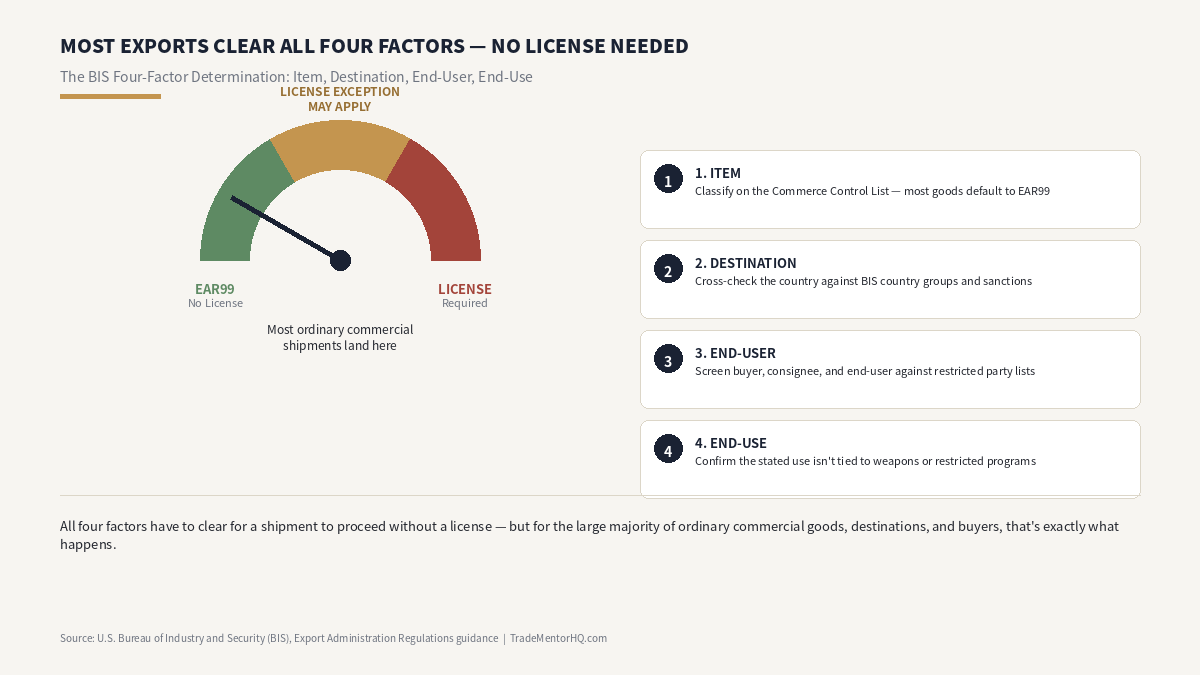
Export license requirements catch many first-time exporters off guard, since most products can ship freely while a specific subset requires government authorization before they ever leave the country.
Most first-time exporters assume export licenses are something only defense contractors or semiconductor makers deal with — until a freight forwarder asks for an ECCN and the shipment stalls. S.
Step One: Classify the Item
Every export determination starts with classification. Products controlled specifically under the Export Administration Regulations (EAR) are assigned an Export Control Classification Number (ECCN) — a five-character code identifying the category and the specific controls that apply, found by checking the Commerce Control List (CCL) or by requesting an official classification from BIS. Products that aren’t specifically listed on the CCL default to EAR99, a catch-all designation covering the vast majority of ordinary commercial goods. Most consumer products, off-the-shelf electronics, and general commercial equipment end up as EAR99, which is the best-case starting point for the rest of the analysis.
Step Two: Check the Destination
Even an EAR99 item can require a license depending on where it’s going. BIS maintains country groups with different levels of export restriction, and certain destinations — comprehensively sanctioned or embargoed countries in particular — trigger license requirements regardless of how benign the product is. For ECCN-classified items, the Commerce Country Chart cross-references the ECCN’s specific reasons for control (national security, missile technology, chemical/biological weapons, and so on) against the destination country to determine whether a license is required for that specific combination.
Step Three: Screen the End-User
Regardless of what the item is or where it’s headed, the transaction can still require a license — or be prohibited outright — if the end-user is a problem. BIS maintains restricted party lists (the Denied Persons List, Entity List, and others) identifying individuals and organizations barred or restricted from receiving U.S.-origin exports, often tied to national security or proliferation concerns. Screening every counterparty in a transaction — the buyer, any intermediate consignee, and the ultimate end-user — against these lists is a standard compliance step precisely because a legitimate-looking destination country doesn’t guarantee a legitimate end-user.
Step Four: Confirm the End-Use
The final factor is what the item will actually be used for. Certain end-uses trigger license requirements even for otherwise unrestricted items and destinations — most notably use in nuclear, chemical, biological, or missile weapons programs. This is why export documentation often requires an end-use statement, and why red flags (a buyer vague about the item’s application, an unusual shipping route, a request to obscure the item’s true end-user) are taken seriously even when the paperwork otherwise looks clean.
A Concrete Illustration
S. trade restrictions. The pump isn’t listed on the Commerce Control List, so it classifies as EAR99 (item: clear). The destination has no comprehensive embargo (destination: clear). The buyer isn’t on any restricted party list after screening (end-user: clear). The stated end-use is routine industrial water processing (end-use: clear). All four factors clear, and the shipment proceeds with no license required — this is the outcome for the substantial majority of ordinary commercial exports. Change any one factor — say the same pump is destined for a chemical weapons production facility — and the end-use factor alone could trigger a license requirement despite the item and destination otherwise being unrestricted.
The Bottom Line
An export license isn’t a special hurdle reserved for obviously sensitive goods — it’s the outcome of a four-factor screening process that most ordinary commercial shipments pass through cleanly. Knowing the four factors, and running through them before every new product or new market, is what turns export compliance from a source of shipment delays into a five-minute check.
Source: U.S. Bureau of Industry and Security (BIS) Export Administration Regulations guidance on classification, licensing, and restricted party screening.
In practice, most exporters don’t need to memorize the entire Commerce Control List — the faster path is running your product through the BIS Commerce Country Chart in reverse: start with the destination country and check for red flags across the control-reason columns (NS, RS, AT, etc.), then confirm the exact ECCN only if a flag appears.
If your product isn’t listed on the CCL at all, it defaults to EAR99, which covers the vast majority of consumer goods and needs no license for most destinations outside of embargoed countries (currently Cuba, Iran, North Korea, Syria, and Russia/Belarus-related restrictions). When a license is required, SNAP-R applications through BIS typically take 30–60 days for a standard review, though this can stretch past 90 days if your case gets referred to other agencies — budget accordingly rather than assuming a quick turnaround.
Related Reading
- How to Classify Your Product with the Correct HS Code (and Avoid Costly Mistakes)
- 7 Documents Every First-Time Exporter Needs Before the First Shipment
Written by the TradeMentorHQ editorial team. We research primary sources — U.S. Bureau of Industry and Security guidance and the Export Administration Regulations — before every article, and we’re upfront about how the site is produced on our About page. Spotted something that needs a correction? Let us know.
How to determine your export license requirements
Figuring out export license requirements starts with classifying the product using an Export Control Classification Number, or ECCN, under the Commerce Control List maintained by the Bureau of Industry and Security. Most consumer goods fall under the classification “EAR99,” meaning no specific export license requirements apply for most destinations, but products with military, dual-use, or advanced technology applications often carry a specific ECCN that triggers export license requirements depending on the destination country, end user, and end use.
Export license requirements are also driven by the destination country itself. Shipping the exact same product to one country might require no license at all, while shipping it to a country under U.S. sanctions or export restrictions can trigger a full license application regardless of how mundane the product seems. Checking the destination against current sanctioned-country and denied-party lists is a required step in determining export license requirements for any international shipment, not just those involving obviously sensitive technology.
Who enforces export license requirements
The Bureau of Industry and Security within the U.S. Department of Commerce administers export license requirements for most commercial and dual-use goods, while the State Department’s Directorate of Defense Trade Controls handles export license requirements for defense articles and services under the International Traffic in Arms Regulations. Exporters dealing with agricultural products, certain chemicals, or nuclear materials may also encounter export license requirements enforced by other agencies, including the Department of Agriculture, the Environmental Protection Agency, or the Nuclear Regulatory Commission, depending on the specific product category involved.
Penalties for ignoring export license requirements
Violating export license requirements carries serious consequences, including civil fines that can reach hundreds of thousands of dollars per violation, criminal penalties for willful violations, and the loss of export privileges entirely, which can be a company-ending outcome for a business that depends on international sales. Even unintentional violations of export license requirements, caused by simple ignorance of the rules rather than deliberate evasion, can still result in significant fines, which is why compliance programs exist specifically to catch these issues before a shipment leaves the warehouse.
The four questions that determine export license requirements
Trade compliance professionals typically boil export license requirements down to four questions: what is the item, where is it going, who will receive it, and what will it be used for. A product with no obvious military application can still trigger export license requirements if the buyer is on a restricted party list, or if the stated end use involves something like weapons development, even in a country with no general export restrictions. Answering all four questions correctly, rather than only checking the product classification, is essential to accurately determining export license requirements for any specific shipment.
Screening customers and business partners against the U.S. government’s consolidated denied party lists is a standard part of managing export license requirements, since selling to a restricted individual or entity can trigger violations even when the product itself carries no restrictions at all. Many exporters use automated screening software specifically to check every new customer against these lists before finalizing a sale, treating this check as a routine part of order processing rather than an occasional compliance exercise.
License exceptions and when they apply
Not every situation triggering a review of export license requirements actually results in needing to file a full license application. The Bureau of Industry and Security publishes numerous license exceptions that allow specific ECCN and destination combinations to ship without a formal license, provided the exporter meets the conditions attached to that exception. Understanding which license exceptions might apply to a specific export license requirements situation can save significant time compared to filing a full license application, but misapplying an exception incorrectly carries the same penalties as shipping without any authorization at all.
How long the export license requirements process takes
Filing for an export license, when export license requirements actually apply, typically takes several weeks to a few months for a standard commercial license, though sensitive destinations or end uses can extend this considerably. Building this timeline into a sales and shipping schedule matters, since promising a customer delivery before confirming whether export license requirements apply, and before securing any needed authorization, risks a costly and reputation-damaging delay if a license turns out to be required and takes longer than expected to obtain.
Building an internal compliance program around export license requirements
Companies that export regularly, rather than occasionally, typically benefit from a documented internal compliance program addressing export license requirements systematically — assigning responsibility for classification, screening, and license applications to a specific person or team rather than handling each shipment ad hoc. A written compliance program addressing export license requirements also matters if a violation does occur, since regulators consider the presence and quality of a compliance program when determining penalties, and a documented good-faith effort to comply can meaningfully reduce fines compared to a company with no compliance process at all.
Export license requirements for software and technology transfers
Export license requirements do not only apply to physical goods shipped across a border — transferring technology, source code, or technical data to a foreign national, even one working inside the United States, can itself count as a “deemed export” subject to the same export license requirements as physically shipping the item abroad. Companies that hire foreign national engineers or share technical specifications with overseas contractors need to evaluate export license requirements around these deemed export scenarios specifically, since this is one of the most commonly overlooked categories of violation among technology and manufacturing companies.
Cloud storage and email introduce their own wrinkle into export license requirements compliance: uploading controlled technical data to a server located outside the country, or emailing it to a recipient abroad, can itself constitute an export subject to the same license requirements as a physical shipment. Companies handling ECCN-controlled technical data should confirm with IT and legal teams exactly where that data is stored and who can access it, since export license requirements apply regardless of whether the transfer happens by ship, plane, or internet connection.
Working with a customs broker or trade compliance consultant
Many exporters, particularly smaller companies without a dedicated compliance department, work with a customs broker or trade compliance consultant specifically to navigate export license requirements correctly. A good consultant can classify products, screen customers, identify applicable license exceptions, and file license applications when export license requirements genuinely apply, which is often more cost-effective than building this expertise entirely in-house for a company that only exports occasionally. Choosing a consultant with specific experience in the exporter’s product category matters, since export license requirements vary significantly between industries like electronics, agriculture, and industrial equipment.
Common mistakes exporters make around export license requirements
The most common mistake is assuming that because a product seems harmless, no export license requirements could possibly apply — many controlled items are dual-use technologies that look identical to their uncontrolled commercial counterparts, and the controlling factor is often the specific technical specification rather than anything visible to a layperson. Another common mistake is classifying a product once and never revisiting that classification, even though export license requirements can change as a company’s products are updated, as the Commerce Control List itself is revised, or as sanctions on specific countries change over time.
Exporters also sometimes assume that because a freight forwarder or customs broker handled the shipment, someone else is responsible for confirming export license requirements were met. In most cases, the actual legal responsibility for export license requirements compliance rests with the exporter of record, not the logistics provider moving the shipment, regardless of who physically prepared the paperwork.
Record-keeping obligations for exporters
Federal regulations require exporters to retain records related to their shipments, classifications, and any license determinations for a set number of years after the transaction. These records include the classification analysis performed, screening results against denied party lists, and copies of any license applications or exception justifications used to ship without a formal license. Keeping this documentation organized and easily retrievable matters enormously if a regulator ever audits a company’s export history, since being unable to produce records supporting a past decision is treated similarly to having made no determination at all, regardless of whether the original decision was actually correct.
Smaller companies sometimes underestimate how much documentation this involves, assuming a simple email confirming a classification is sufficient, when in practice a defensible compliance file typically includes the technical specification sheet used for classification, the specific regulation or exception relied upon, and a dated record of the screening performed against current government lists at the time of the transaction. Building a simple standardized template for this file, used consistently across every shipment, saves considerable time compared to reconstructing the reasoning behind a decision months or years after the fact.
Staying current as rules change
The regulations governing international trade compliance are revised regularly, with new items added to control lists, sanctions programs updated, and denied party lists refreshed on an ongoing basis. Companies that export as a meaningful part of their business typically subscribe to updates from the relevant government agencies or a trade compliance publication, rather than relying on knowledge that may have been accurate at the time a product was first classified but has since become outdated. Treating trade compliance as a static, one-time exercise rather than an ongoing responsibility is one of the more subtle but consequential mistakes a growing exporting business can make.
The bottom line for new exporters
Getting this right does not require becoming a full-time trade lawyer, but it does require treating the classification and screening steps as a genuine part of the sales process rather than paperwork to handle after a deal is already agreed. A short conversation with a customs broker or compliance consultant before the first international shipment, a simple written process for classifying and screening every new product and customer, and a habit of revisiting old classifications as products change are usually enough to keep a growing exporter well within the rules.
The businesses that run into serious trouble are rarely the ones that tried and got a judgment call wrong — they are the ones that never asked the question at all.
Building this habit early, while shipment volume is still manageable, makes it far easier to scale later without compliance becoming an afterthought bolted onto a growing operation. A company that treats classification and screening as a normal, five-minute part of onboarding each new product or customer rarely finds itself scrambling to reconstruct a compliance history after the fact — and that habit, more than any single piece of software or any one consultant, is what actually keeps a growing exporter out of trouble over the long run.
None of this needs to feel overwhelming for a small or mid-size business just beginning to sell internationally. A short initial audit of current products and top export markets, done once with the help of a knowledgeable broker or consultant, usually surfaces the handful of situations that genuinely need ongoing attention, while confirming that the bulk of the catalog ships freely without further review. From there, maintaining the habit is a matter of routine rather than heavy lifting.

About the Author: TradeMentorHQ Team
The TradeMentorHQ team researches and writes practical, plain-language guides on Incoterms, customs clearance, trade finance, and shipping logistics for small business owners, first-time importers/exporters, and side-hustle sellers. Our articles are grounded in publicly available regulations and guidance from bodies like U.S. Customs and Border Protection (CBP), the International Chamber of Commerce (Incoterms 2020), and established industry practice, and we link to primary sources wherever a number or rule could change. We are not customs brokers, freight forwarders, or licensed trade attorneys, and nothing here is a substitute for advice from one on your specific shipment.