
FCL vs LCL shipping is one of the first real decisions a new exporter has to make, and the wrong choice can quietly add days to transit time or hundreds of dollars to a shipment’s total cost. This guide walks through FCL vs LCL shipping trade-offs with concrete numbers, so you can pick the right option for a specific shipment size rather than defaulting to whatever a forwarder suggests first.
Somewhere around the second or third shipment, almost every new exporter asks a freight forwarder the same question: “should I just fill my own container, or is it cheaper to share one?” The honest answer depends entirely on how much cargo you actually have — and getting this one wrong either wastes money on empty container space or adds days of delay you didn’t budget for.
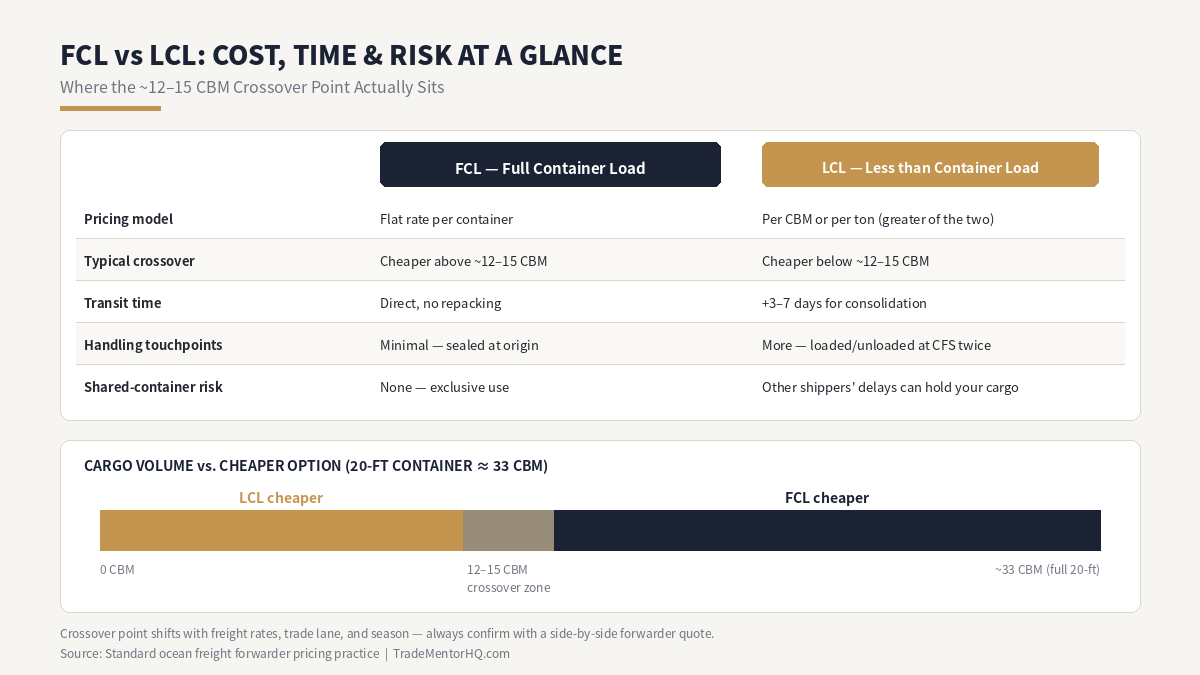
Short version: FCL (Full Container Load) means you pay a flat rate for exclusive use of an entire container, while LCL (Less than Container Load) means you pay by volume to share a container with other shippers’ cargo — and the crossover point where FCL becomes the cheaper option is usually around 12–15 CBM, not “whenever you can afford a full container.” Below that volume, LCL almost always wins on cost. Above it, FCL usually wins on both cost and speed.
FCL vs LCL Shipping: What Each Term Actually Means
FCL means your cargo — however much or little of it there is — has an entire container to itself, moving under a single bill of lading from origin to destination without being opened or repacked along the way. You pay one flat rate per container (commonly a 20-foot, holding roughly 33 CBM, or a 40-foot, holding roughly 67 CBM), regardless of whether you fill it completely.
LCL means your cargo shares a container with shipments from other exporters, consolidated at an origin Container Freight Station (CFS) and deconsolidated at a destination CFS. You’re charged by volume — per cubic meter (CBM) or per ton, whichever number is greater — so you only pay for the space your goods actually occupy.
FCL vs LCL Shipping: Where the Real Cost Crossover Sits
This is the number worth remembering: freight forwarders commonly treat roughly 12–15 CBM as the practical point to start evaluating FCL instead of LCL. Below that volume, LCL’s per-CBM pricing beats paying for a mostly-empty container. Above it, the flat FCL rate starts working out cheaper per unit of cargo — and the gap widens the closer you get to a container’s full capacity.
The catch is that this crossover point isn’t fixed. It shifts with prevailing freight rates, the trade lane, and the season — during peak shipping periods, container rates can spike enough to push the crossover point higher, meaning LCL stays the cheaper option at a larger cargo volume than usual. A forwarder quoting both options for your actual volume and trade lane will always beat a rule of thumb.
The Trade-Off Nobody Mentions Upfront: Time and Handling
Cost isn’t the only variable, and it’s often not the deciding one. FCL cargo moves directly from origin port to destination port without being opened. LCL cargo has to wait for consolidation with other shipments before it even departs, then goes through deconsolidation on arrival — a process that commonly adds 3 to 7 days to total transit time compared to an equivalent FCL shipment on the same route.
LCL also carries more handling risk, simply by virtue of more touchpoints. Your cargo gets loaded, unloaded, and reloaded more times during consolidation and deconsolidation than an FCL shipment ever does, which raises the odds of damage. There’s also a documentation layer FCL doesn’t have: LCL shipments typically move under both a House Bill of Lading (issued by your freight forwarder to you) and a Master Bill of Lading (issued by the ocean carrier to the consolidator), which adds a step of paperwork reconciliation that occasionally causes delays on its own.
Perhaps the least obvious risk: because LCL containers hold multiple shippers’ cargo, a customs hold or documentation problem on someone else’s shipment in the same container can delay the release of your cargo too, even if your own paperwork is perfect. This is rare, but it’s a real exposure that simply doesn’t exist with FCL.
So Which One Should You Actually Use?
A few practical signals worth weighing, beyond just the CBM math:
If your shipment is comfortably under 12 CBM, LCL is very likely the right call — you’d be paying for a lot of empty container space otherwise. If you’re consistently shipping close to or above 15 CBM per order, get an FCL quote before defaulting to LCL out of habit; the savings usually justify it, and you get faster, lower-risk transit as a bonus.
If your cargo is time-sensitive, fragile, or high-value, lean toward FCL even below the typical cost crossover point — the reduced handling and single-shipment routing can be worth paying a premium for, especially early in a buyer relationship where a damaged or late shipment costs you more in trust than the freight savings are worth.
And if you’re genuinely unsure where your volume lands relative to the crossover, ask your forwarder for both quotes side by side on your actual lane. Rules of thumb are a starting point for the conversation, not a substitute for it — rates move enough by lane and season that the “right” answer can flip within the same year.
👉 Learn more about ocean shipping regulation from the U.S. Federal Maritime Commission
The Bottom Line
FCL and LCL aren’t just “big shipment vs. small shipment” — they’re genuinely different cost structures, transit timelines, and risk profiles. The rough 12–15 CBM crossover point is a useful starting heuristic, but transit time, handling risk, and the possibility of a container-mate’s paperwork problem holding up your cargo are just as much a part of the decision as the per-CBM math. Get an actual quote for both before you assume you already know which one is cheaper this time.
Source: Industry freight forwarder guidance and standard ocean freight practice on FCL/LCL cost structures, container capacities, and consolidation processes.
FCL vs LCL Shipping: Common Scenarios Where the Choice Matters
Real examples make the FCL vs LCL shipping decision clearer than definitions alone. A first-time exporter shipping a small pallet of samples almost always benefits from LCL, since paying for a full container when the cargo fills a fraction of it wastes money outright. A growing business shipping enough product to fill 60-70% of a container often crosses the FCL vs LCL shipping breakeven point, where paying for the full container costs about the same as LCL but arrives faster and with less handling risk.
A business shipping fragile or high-value goods often prefers FCL vs LCL shipping decisions that favor the full container specifically to avoid the extra handling and consolidation risk that comes with LCL’s shared-container model.
- Small sample shipments — FCL vs LCL shipping analysis usually favors LCL here.
- Shipments filling 60%+ of a container — often past the FCL vs LCL shipping cost crossover point.
- Fragile or high-value goods — FCL vs LCL shipping considerations often favor FCL to avoid extra handling.
FCL vs LCL Shipping: A Quick Comparison Table
Comparing the two side by side highlights the practical FCL vs LCL shipping trade-offs at a glance.
| Factor | FCL | LCL |
|---|---|---|
| Best for | Larger shipments, fragile/high-value goods | Small shipments, samples |
| Handling risk | Lower — single container, single handler | Higher — shared container, more handling |
| Typical transit time | Faster | Slower — consolidation and deconsolidation add days |
| Cost structure | Flat container rate | Priced by volume/weight |
Frequently Asked Questions: FCL vs LCL Shipping
Is FCL vs LCL shipping always about cost? Not entirely — while cost matters, FCL vs LCL shipping decisions should also weigh transit time and handling risk, not price alone.
Can a shipment switch from LCL to FCL mid-transit? No — the FCL vs LCL shipping decision has to be made at booking, since consolidation and container loading happen well before the vessel departs.
Does LCL always cost less than FCL? Only below the cost crossover point — beyond that, FCL vs LCL shipping economics actually favor the full container, since LCL’s per-unit pricing keeps climbing with volume.
FCL vs LCL Shipping: Handling and Damage Risk
Handling risk is an underrated factor in the FCL vs LCL shipping decision. LCL cargo gets consolidated with other shippers’ goods at an origin warehouse, then deconsolidated at destination — two extra handling touchpoints that FCL cargo skips entirely by staying sealed in one container from origin to destination. For fragile goods, this difference in FCL vs LCL shipping handling can matter more than the cost difference itself, since damage claims and the delays they cause often outweigh any savings from choosing the cheaper option.
FCL vs LCL Shipping: Insurance and Liability Considerations
Insurance considerations differ meaningfully in the FCL vs LCL shipping decision, since LCL cargo shares a container with other shippers’ goods, raising the risk of cross-contamination or damage from a neighboring shipment’s poorly secured cargo. Standard marine cargo insurance covers both FCL and LCL shipments, but claims involving LCL cargo can take longer to resolve since determining fault when damage occurs inside a shared, consolidated container is often more complex than a single-shipper FCL claim.
Businesses making frequent LCL shipments sometimes negotiate specific liability terms with their consolidator to clarify responsibility in the FCL vs LCL shipping arrangement before damage ever occurs, rather than discovering ambiguous liability terms only after filing a claim.
FCL vs LCL Shipping: Booking Lead Times
Booking lead times differ between the two options as well, adding another dimension to the FCL vs LCL shipping decision beyond pure cost. FCL bookings can often be confirmed closer to the actual ship date, since the carrier only needs a single container slot. LCL bookings typically require earlier commitment, since the consolidator needs enough lead time to gather multiple shippers’ cargo before the container departs — missing an LCL consolidation window can mean waiting for the next scheduled sailing, sometimes a week or more later. For time-sensitive shipments, this lead-time difference can make FCL the more reliable FCL vs LCL shipping choice even when LCL would otherwise be cheaper.
FCL vs LCL Shipping: Customs Clearance Differences
Customs clearance also plays into the FCL vs LCL shipping decision in ways first-time exporters often overlook. An FCL shipment typically clears customs as a single unit tied to one importer of record, while an LCL shipment shares a container with multiple importers, meaning a customs hold on one shipper’s goods within that container can sometimes delay deconsolidation for everyone else sharing the box. This shared-risk dynamic is one of the less obvious factors in the FCL vs LCL shipping comparison, and it matters most at ports known for slower or less predictable customs processing, where a single flagged shipment can add days to an entire container’s release.
FCL vs LCL Shipping: A Decision Checklist
Before booking, running through a short checklist helps settle the FCL vs LCL shipping question for a specific shipment. First, calculate the shipment’s volume as a percentage of a standard container — above roughly 60-70%, FCL usually wins on cost alone. Second, weigh how time-sensitive the shipment is, since LCL’s longer consolidation lead time can matter more than any cost savings for urgent orders. Third, consider the cargo’s fragility and value, since FCL vs LCL shipping decisions involving high-value or delicate goods often favor the reduced handling risk of a sealed, single-shipper container.
Running through this checklist before every booking, rather than defaulting to habit, tends to save meaningful money and time across a full shipping year.
FCL vs LCL Shipping: Negotiating Rates With Forwarders
Forwarders sometimes default to whichever option is easier for their own operations rather than what best serves a specific shipper, so it’s worth asking directly why a particular option is recommended for a given shipment. Requesting rate quotes for both FCL and LCL, even when a forwarder recommends one outright, lets a shipper compare the FCL vs LCL shipping economics directly rather than taking a single recommendation at face value. Shippers who book regularly can also negotiate volume-based rates that shift the cost crossover point in their favor, sometimes making FCL economical at a lower fill percentage than the standard 60-70% guideline suggests.
Building a direct relationship with a forwarder who explains FCL vs LCL shipping trade-offs transparently, rather than simply booking whatever is quoted first, tends to produce better rates over a long shipping relationship.
FCL vs LCL Shipping: Scaling as a Business Grows
Many businesses start with LCL shipments as import or export volume ramps up slowly, then transition to FCL as order sizes grow large enough to fill a meaningful share of a container. Tracking shipment volume trends over several months helps identify exactly when this FCL vs LCL shipping transition point arrives, rather than continuing with LCL out of habit long after FCL would be more economical. Some businesses settle into a hybrid approach, using FCL for larger recurring orders and LCL for smaller supplemental or rush shipments, treating the FCL vs LCL shipping decision as a per-shipment calculation rather than a fixed company policy.
Revisiting this decision every time order volume changes meaningfully, rather than treating an early choice as permanent, keeps freight costs aligned with actual shipment size as a business scales over time.
FCL vs LCL Shipping: A Word on Packaging Requirements
Packaging standards differ subtly between the two options as well. LCL cargo, since it travels alongside other shippers’ goods and gets handled more times during consolidation and deconsolidation, generally needs more robust export packaging to survive the extra handling without damage. FCL cargo, sealed in a single container from origin to destination, can sometimes use lighter packaging since it isn’t jostled against unrelated shipments along the way — though this shouldn’t be taken as license to skimp on packaging for valuable or fragile goods regardless of which option is chosen.
Reviewing packaging standards against whichever option is selected, rather than assuming one packaging approach fits both, helps avoid damage claims that could otherwise be prevented with a small upfront packaging investment.
FCL vs LCL Shipping: Environmental and Sustainability Considerations
Consolidated LCL shipments can sometimes carry a lower per-unit carbon footprint than a partially-filled FCL container, since sharing a container’s capacity across multiple shippers uses vessel space more efficiently overall. Businesses increasingly factoring sustainability into logistics decisions sometimes weigh this alongside cost and timing when working through the FCL vs LCL shipping choice, particularly for lower-urgency shipments where the extra consolidation time is an acceptable trade-off for a smaller environmental footprint per unit shipped. This isn’t typically the deciding factor for most shippers, but it’s an increasingly common secondary consideration layered on top of the core cost and timing analysis that drives most FCL vs LCL shipping decisions.
For background on container shipping, see the Wikipedia overview of containerization, and for a related comparison on this site see our guide to customs clearance delays.
Choosing the Right Container Strategy
FCL vs LCL shipping ultimately comes down to shipment size relative to the cost crossover point, plus how much handling risk and transit-time flexibility a specific cargo can tolerate. Running the numbers for a specific shipment, rather than defaulting to whichever option was used last time, is what actually optimizes the FCL vs LCL shipping decision shipment by shipment.
On cost and timing specifically: LCL (less than container load) shipping is typically priced per cubic meter, often in the $50–150/CBM range depending on the trade lane, which is cost-effective for small shipments but adds real time — consolidation and deconsolidation at origin and destination warehouses commonly add 5–10 days to the total transit compared to a direct FCL move.
FCL is priced as a flat container rate regardless of how full it is, so the crossover point where FCL becomes cheaper than LCL is usually somewhere around 12–15 CBM of cargo, though that threshold shifts with current freight rates. If your shipment is hovering near that volume, it’s worth pricing both options directly rather than defaulting to LCL just because the shipment feels “small.”
Related Reading
- Incoterms 2020 Explained: A Practical Guide for Importers and Exporters
- Letter of Credit (LC) vs T/T: Which Payment Method Should You Choose?
Written by the TradeMentorHQ editorial team. We research primary sources — ICC rules, WCO and customs-authority guidance, and standard freight industry practice — before every article, and we’re upfront about how the site is produced on our About page. Spotted something that needs a correction? Let us know.

About the Author: TradeMentorHQ Team
The TradeMentorHQ team researches and writes practical, plain-language guides on Incoterms, customs clearance, trade finance, and shipping logistics for small business owners, first-time importers/exporters, and side-hustle sellers. Our articles are grounded in publicly available regulations and guidance from bodies like U.S. Customs and Border Protection (CBP), the International Chamber of Commerce (Incoterms 2020), and established industry practice, and we link to primary sources wherever a number or rule could change. We are not customs brokers, freight forwarders, or licensed trade attorneys, and nothing here is a substitute for advice from one on your specific shipment.