Short answer: the sea freight vs air freight decision is a tradeoff between cost and speed. Choose air freight when speed matters more than cost — new inventory drops, high-value or time-sensitive goods, or a supplier delay you need to make up for — and choose sea freight for everything else, since ocean shipping typically costs three to five times less than air for the same cargo, even though it takes weeks instead of days.
New importers often default to whichever mode their supplier suggests, without realizing how much the choice between sea freight and air freight actually swings total landed cost. On a container-sized order the difference can run into thousands of dollars, while on a small, urgent restock the extra air freight cost can be smaller than a single day of an empty shelf.
This guide breaks down the real cost and time gap between sea freight and air freight, when each one actually makes sense for a small business, the hybrid options in between, and the mistakes that lead new importers to pick the wrong mode.
Sea Freight vs Air Freight: The Real Cost Gap
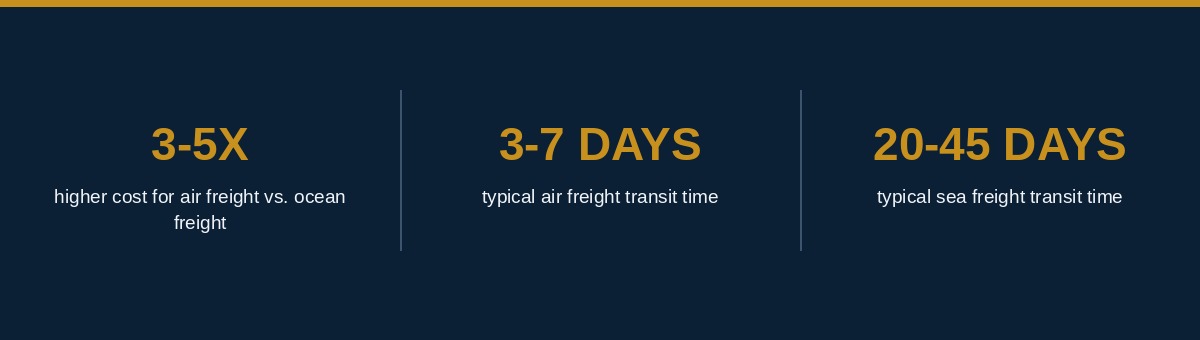
Air freight commonly runs three to five times more expensive than sea freight for the same shipment, and on small or light cargo the gap can be even wider once minimum charges are factored in. A shipment that costs a few hundred dollars by ocean can easily run over a thousand dollars by air — the exact multiple depends on weight, volume, and how far the cargo has to travel, but the direction is consistent: air is the premium option, not the default.
A useful rule of thumb some freight forwarders use is that air freight starts to make financial sense once shipping cost would otherwise eat up more than 15 to 20% of the value of the goods relative to how urgently you need them — below that threshold, the cost premium rarely pays for itself.
How Much Longer Does Sea Freight Take?
Ocean freight transit time typically runs 20 to 45 days port-to-port depending on origin, destination, and whether the route requires transshipment, plus several more days on each end for trucking, customs clearance, and last-mile delivery. Air freight, by comparison, usually moves in three to seven days door-to-door, including customs processing — a difference measured in weeks, not days.
That gap matters most when you’re planning inventory around it. A sea freight order placed too close to a launch date, a seasonal peak, or a restock deadline can arrive weeks late even when nothing goes wrong — building in buffer time for customs delays and peak-season port congestion is part of planning a sea freight shipment realistically. For official data on global shipping and port congestion trends, see UNCTAD’s trade logistics resources.
When Sea Freight Is the Right Choice
Sea freight makes sense for the large majority of small business inventory: standard restocks, bulky or heavy goods, and any order where you can plan a few weeks ahead. If your product isn’t time-sensitive and you can forecast demand with reasonable confidence, the cost savings from ocean shipping usually outweigh the extra weeks in transit by a wide margin, especially on container-scale orders where the per-unit shipping cost drops further with volume.
When Air Freight Is Worth the Premium
Air freight earns its cost premium in a narrower set of situations: a genuine stockout risk where lost sales would exceed the extra shipping cost, high-value or compact goods like electronics or jewelry where the shipping cost is small relative to product value, perishable or time-sensitive items, or a one-time rush order to cover a sea freight shipment that’s running late. Retail categories with fast turnover, and goods that benefit from air freight’s tighter security and handling, are the clearest fits.
Hybrid Options: Splitting Between Air and Sea
Many small businesses don’t have to choose one mode for an entire order. A common hybrid approach is shipping the bulk of an order by sea for cost efficiency, then air-freighting a smaller portion of the same order to cover the gap until the sea shipment arrives — useful around a launch date or seasonal peak where running out of stock for even a week or two is costly.
Expedited LCL (less-than-container-load) ocean services have also narrowed the gap somewhat in recent years, moving faster than traditional ocean freight while staying well below air freight pricing, which is worth asking your freight forwarder about if pure sea freight feels too slow but full air freight feels too expensive.
Getting the sea freight vs air freight math right on each order is what keeps landed costs predictable.
Common Sea Freight vs Air Freight Mistakes to Avoid
The most common mistake is defaulting to whichever mode a supplier recommends without comparing an actual quote for both — suppliers sometimes default to air freight because it’s simpler to arrange, not because it’s the better economic choice for your order.
A second common mistake is ordering sea freight without building in buffer time for customs clearance and port congestion, which can turn a 30-day estimate into 40 or more days during peak shipping season. A third is treating the shipping mode decision as fixed for every order, rather than reevaluating it each time based on how urgent that specific shipment actually is.
Sea Freight vs Air Freight: A Quick Decision Checklist
Before booking a shipment, run through a short checklist: how many weeks of lead time do you actually have, how much would a stockout cost in lost sales, and how does the air freight premium compare to that potential loss? If lead time is comfortable and the order isn’t time-sensitive, sea almost always wins on cost alone. If a launch date, restock deadline, or high-value shipment is on the line, the premium is usually cheap insurance against running out of stock.
On a recent 500-unit reorder sized up this way, the air premium worked out to roughly $1.80 per unit — trivial next to the margin lost on even a few days of empty shelves, but not worth paying on a routine restock with six weeks of runway to spare. Running that math on every order, instead of defaulting to habit, is what keeps shipping costs predictable over time.
Bottom Line
The sea freight vs air freight decision isn’t really about competing options — they’re tools for different situations, and the right choice comes down to how much a few weeks of extra transit time actually costs you versus how much the air freight premium costs in dollars. For most routine restocking, sea freight’s cost advantage wins; for genuine urgency, air freight’s speed is worth paying for. Running the real numbers on a specific shipment, rather than defaulting to habit, is what separates a reasoned shipping decision from an expensive guess.
This sea freight vs air freight math shows up clearly in the numbers: on a typical 500-unit reorder of a small consumer product, air freight’s per-unit premium usually lands somewhere around $1.50–$2.50 more than sea freight once you account for door-to-door costs — but that gap shrinks fast for anything under about 100kg, where air’s minimum billing weight and simpler documentation can make it the cheaper option once you factor in warehousing and the working capital tied up while a container sits on the water for 30–40 days.
The other detail worth remembering when running the sea freight vs air freight comparison: air cargo is billed on whichever is greater, actual weight or volumetric weight (length × width × height in cm ÷ 6000 for most carriers), so bulky-but-light products like inflatable or foam-based goods often cost far more to fly than their actual weight would suggest.
Related Reading
FCL vs LCL Shipping: Comparing Costs and Transit Times
Container Shipping Rates 2026: The Best Guide to Volatility
Freight Forwarder vs Customs Broker: What’s the Difference?

About the Author: TradeMentorHQ Team
The TradeMentorHQ team researches and writes practical, plain-language guides on Incoterms, customs clearance, trade finance, and shipping logistics for small business owners, first-time importers/exporters, and side-hustle sellers. Our articles are grounded in publicly available regulations and guidance from bodies like U.S. Customs and Border Protection (CBP), the International Chamber of Commerce (Incoterms 2020), and established industry practice, and we link to primary sources wherever a number or rule could change. We are not customs brokers, freight forwarders, or licensed trade attorneys, and nothing here is a substitute for advice from one on your specific shipment.