
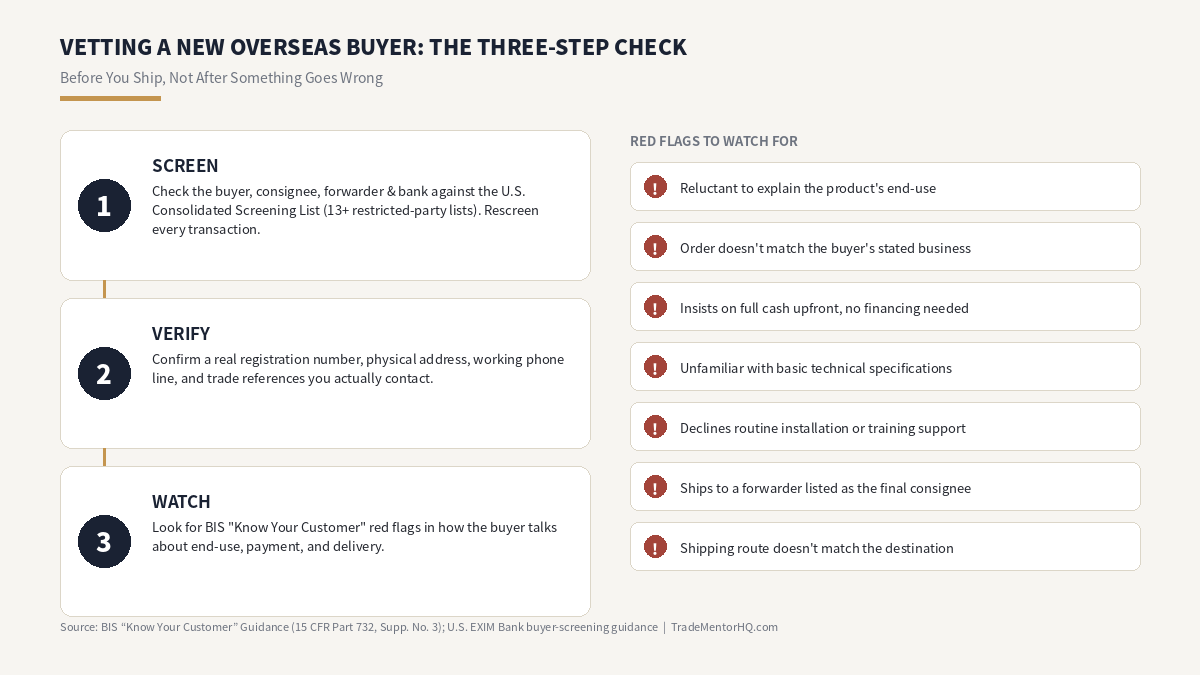
Learning how to vet overseas buyer prospects properly before shipping is one of the cheapest forms of risk protection an exporter can build, since a few minutes of screening upfront can prevent a non-paying or fraudulent order from ever reaching the shipping dock.
A new international order can feel like validation — someone overseas wants what you’re selling, and it’s tempting to just ship it. But the exporters who get burned almost never get burned by a buyer who was obviously a scammer from the first email; they get burned by someone who looked plausible enough that nobody stopped to check. Vetting an overseas buyer means confirming they’re a real, legally operating business, screening them against U.S. government restricted-party lists, and watching for a specific, well-documented set of behavioral red flags — and doing all three before you ship, not after a payment bounces or a shipment gets seized.
Start with the Legal Baseline: Denied Party Screening
S. government’s Consolidated Screening List (CSL), which combines more than a dozen restricted- and denied-party lists from the Commerce, State, Treasury, Justice, Homeland Security, and Defense departments into a single free, searchable database — including the Treasury’s OFAC Specially Designated Nationals list and Commerce’s BIS Entity List. This isn’t optional due diligence; it’s the exporter’s legal responsibility, and it applies to more than just the buyer — screen the buyer, the consignee, the freight forwarder, and any bank involved in the transaction.
Critically, screening isn’t a one-time check: rescreen before every new transaction, even with a buyer you’ve shipped to before, since a company or individual can be added to a restricted list at any time. A match doesn’t automatically mean the deal is dead, but it does mean you need to pause and work through the specific agency’s guidance before moving forward.
Confirm the Business Actually Exists
Once the legal screening is clear, verify the buyer is a real, operating company — not just a name on an email signature. A legitimate business has a verifiable registration number, a physical address that isn’t a mail drop, a working phone line answered by someone who knows the company, and a website or public presence consistent with its claimed size and industry. Ask for trade references — other suppliers or banks the buyer has worked with — and actually contact them rather than treating the names as decoration.
A trade credit report (see our guide to trade credit insurance) gives you a data-backed read on payment history rather than relying on the buyer’s own word for it.
The Behavioral Red Flags Worth Knowing
S. Bureau of Industry and Security publishes a formal list of “Know Your Customer” red flags, and while it’s written for export-control compliance, most of it doubles as plain good business sense. Watch for a buyer who is reluctant to explain what they’ll actually use the product for, or whose order doesn’t match their stated business (a small bakery ordering industrial-grade lasers, for instance).
Be wary of a buyer with little to no verifiable business history, one who’s oddly insistent on paying full cash upfront for an expensive order when financing would be the norm, or one who doesn’t seem to understand basic technical specifications of the product they’re urgently trying to buy. Declining routine installation, training, or after-sales support that would normally come with the sale is another signal worth noting.
On the logistics side, be cautious of vague or shifting delivery instructions, a final destination that’s actually a freight forwarder rather than the real end user, a shipping route that makes no geographic sense for the stated destination, or packaging that doesn’t match how the buyer says the goods will be shipped or used.
A Concrete Illustration
A first-time buyer contacts an exporter wanting to purchase a large quantity of specialized industrial equipment, offers to pay the full invoice in cash before shipment despite the exporter’s standard 30-day terms, and asks for the goods to be shipped to a freight-forwarding company’s address rather than their own business address, with the freight forwarder listed as the final consignee. Individually, cash-upfront and using a forwarder aren’t automatically disqualifying — plenty of legitimate buyers do both.
But stacked together, plus a buyer who can’t clearly explain what the equipment will be used for, that combination lines up with several BIS red flags at once, and it’s exactly the kind of order that warrants a phone call and some verification before it ships, not after.
What to Actually Do When Something Doesn’t Add Up
A red flag isn’t an automatic rejection — it’s a prompt to ask more questions. Get the end-use and end-user in writing, ideally on a signed end-use statement. Call the company at an independently verified phone number rather than one supplied only in the order email. Cross-check the shipping address against public business registries. If something still doesn’t resolve cleanly after reasonable diligence, it’s better to walk away from one deal than to end up shipping controlled goods to a sanctioned party or absorbing a total loss from a buyer who was never going to pay.
And for the buyer risk that no amount of vetting fully eliminates — a legitimate company that later goes insolvent, for instance — that’s precisely the gap trade credit insurance is built to cover.
The Bottom Line
Vetting an overseas buyer isn’t a single check, it’s three: confirm they’re not on a restricted-party list, confirm they’re a real operating business with a verifiable track record, and watch for the specific behavioral patterns that experienced compliance officers have flagged for decades. None of these steps takes more than a day or two, and every one of them is faster and cheaper than unwinding a bad shipment after the fact.
Source: U.S. Bureau of Industry and Security (BIS) “Know Your Customer” Guidance and Red Flags (15 CFR Part 732, Supplement No. 3); U.S. EXIM Bank guidance on screening foreign buyers.
Why you need to vet overseas buyer prospects before every new order
Every exporter should vet overseas buyer prospects the same way a bank vets a loan applicant — not because most buyers are dishonest, but because the cost of skipping this step on the rare bad actor is high enough to justify checking every time. A new overseas buyer with no track record represents unknown risk until basic verification confirms otherwise.
To vet overseas buyer prospects properly, start with the basics: confirm the company actually exists through a business registry lookup in its home country, verify the contact person’s role at the company, and check whether the company’s stated address matches publicly available records rather than just a generic mailbox or shared office space.
Screening against restricted party lists
Beyond basic company verification, exporters must vet overseas buyer prospects against government restricted and denied party lists — the US Bureau of Industry and Security’s Entity List, the Treasury’s OFAC Specially Designated Nationals list, and similar lists maintained by other jurisdictions. Shipping to a listed party, even unknowingly, can expose an exporter to significant civil or criminal penalties.
Free and paid screening tools exist specifically to vet overseas buyer prospects against these lists automatically, and larger exporters often integrate this check directly into their order intake process so that no shipment proceeds without a documented screening result on file.
Red flags to watch for when you vet overseas buyer inquiries
Certain patterns should immediately raise suspicion when you vet overseas buyer inquiries: unusual urgency to ship before payment terms are finalized, a buyer requesting shipment to a freight forwarder or address unrelated to their stated business address, or a buyer overpaying and asking for a refund of the difference — a classic overpayment scam.
Other red flags worth checking for as you vet overseas buyer prospects include a buyer refusing standard payment methods in favor of unusual arrangements, vague or evasive answers about the intended end-use of the product (especially for dual-use or sensitive goods), and email domains that don’t match the company’s stated website.
Ongoing monitoring, not just a one-time check
Vetting is not a one-time event — exporters should vet overseas buyer relationships periodically even after the first successful order, since a previously legitimate buyer’s ownership, financial health, or end-use patterns can change over time. Restricted party list screening in particular should be re-run before every shipment, not just at the start of a relationship, since lists are updated frequently.
Building a simple internal checklist to vet overseas buyer prospects consistently — rather than relying on gut feeling or memory — ensures screening happens every time regardless of how busy the sales team is or how eager everyone is to close a promising new deal.
Using trade credit reports and references
A commercial trade credit report is one of the most useful tools to vet overseas buyer creditworthiness, providing payment history, financial stability indicators, and legal filings that a company’s own claims cannot substitute for. For larger orders, the modest cost of a credit report is small compared to the exposure of an unpaid invoice on a significant shipment.
Trade references from the buyer’s other suppliers offer another practical way to vet overseas buyer payment behavior — a buyer with a genuine track record of paying other exporters on time provides real evidence, whereas a buyer who cannot or will not provide any references is itself a signal worth taking seriously.
Payment method as a vetting tool
The payment method requested can itself help vet overseas buyer risk: a new, unverified buyer insisting on open account terms with no security is a materially different risk profile than one willing to work with a letter of credit, documentary collection, or partial upfront deposit — payment structure and buyer trustworthiness tend to move together in practice.
Exporters who vet overseas buyer risk carefully often tier their payment terms accordingly: safer, more secured payment structures for new or unverified buyers, graduating toward open account terms only once a buyer has built a track record of reliable, on-time payment across several transactions.
Frequently asked questions about vetting overseas buyers
Is it necessary to vet overseas buyer prospects for small orders too? Yes — restricted party screening in particular applies regardless of order size, and small orders can still expose a business to compliance violations even if the financial risk is modest.
How long does it typically take to vet overseas buyer prospects? Basic screening against restricted party lists takes minutes with the right tools; deeper credit and reference checks can take a few days depending on how responsive the buyer and their references are.
What’s the single most important step? Restricted party list screening is the single non-negotiable step, since it carries direct legal compliance consequences beyond ordinary commercial risk.
Common mistakes exporters make when vetting buyers
A common mistake is treating a professional-looking website and prompt email replies as sufficient evidence of legitimacy. Sophisticated fraud schemes invest in polished websites and fast communication precisely to bypass casual due diligence, which is why exporters need to vet overseas buyer claims against independent, verifiable sources rather than relying only on what the buyer presents directly.
Another mistake is only screening the named buyer company without checking the individuals signing documents or the ultimate parent company, if one exists. A restricted or sanctioned entity can sometimes operate through an affiliated company that passes a surface-level check, which is why deeper vetting sometimes needs to trace ownership structure, not just the immediate counterparty name.
A third mistake is treating vetting as a compliance-department-only responsibility disconnected from sales. Sales teams eager to close a deal can unintentionally skip or rush screening steps, so building buyer vetting into the standard order workflow — rather than as an optional extra step sales can bypass under deadline pressure — closes this gap.
Tools and services that make vetting easier
Several commercial services now specialize in helping exporters vet overseas buyer prospects efficiently, combining restricted party list screening, business registry verification, and credit reporting into a single check. For smaller exporters without dedicated compliance staff, these consolidated tools can make thorough vetting practical without requiring specialized in-house expertise.
Government resources also help exporters vet overseas buyer prospects at no cost — the Commerce Department’s Consolidated Screening List tool checks against multiple restricted party lists simultaneously, and many countries’ export promotion agencies offer buyer verification services specifically to help smaller exporters manage this risk affordably.
Building a vetting checklist into your sales process
The most reliable way to consistently vet overseas buyer prospects is to embed the check directly into whatever system your sales and operations teams already use — a CRM field that must be completed before an order can proceed, or a simple shared checklist attached to every new international inquiry. Making the step visible and mandatory, rather than something a busy salesperson remembers to do informally, is what actually makes it stick over time.
How much time should vetting actually take
For most transactions, a basic effort to vet overseas buyer prospects — business registry lookup, restricted party screening, and a quick sanity check on contact details — takes well under an hour. A deeper credit report and reference check for a larger or first-time order adds a few more days, but this is time well spent relative to the size of the potential loss being avoided.
Exporters who worry that thorough vetting will slow down sales too much often find the opposite is true once the process is built into a standard workflow: buyers with nothing to hide rarely object to reasonable verification requests, and the deals that fall apart under light scrutiny were often the ones carrying the most risk to begin with.
Whatever level of vetting a specific transaction warrants, treat it as a permanent part of doing international business rather than an occasional precaution reserved for deals that already feel suspicious — by the time a deal feels suspicious enough to prompt scrutiny, the most useful window for catching a problem early has often already closed.
When to walk away from a deal entirely
Sometimes the right outcome of vetting is simply declining the order. If a buyer appears on a restricted party list, refuses reasonable verification requests, or shows multiple red flags simultaneously, the safest choice is to walk away regardless of how attractive the order size looks. No single sale is worth the legal, financial, or reputational risk of proceeding with a buyer that fails basic screening.
To summarize the core discipline: vet overseas buyer prospects before every shipment, vet overseas buyer prospects again periodically for repeat customers, and never let deal size or sales pressure be a reason to skip the step of screening a buyer properly.
For official restricted party screening, see the BIS Lists of Parties of Concern. For more export risk guidance, see our TradeMentorHQ homepage.
Protecting Yourself Before You Ship
The businesses that avoid costly fraud and compliance violations are not the ones with the most sophisticated screening technology — they are the ones that consistently vet overseas buyer prospects every single time, regardless of deal size or how legitimate a new inquiry seems on the surface. Consistency matters more than sophistication here.
Build a simple, repeatable process to vet overseas buyer prospects, document every screening result, and treat restricted party list checks as a non-negotiable step before any shipment leaves the dock. This modest, routine investment of time is far cheaper than the alternative of an unpaid invoice, a fraud loss, or a compliance violation discovered after the fact.
A practical, low-cost first step before extending open account terms: a business credit report from Dun & Bradstreet or a similar agency typically costs $60–150 and can surface payment history red flags — chronic late payments, recent bankruptcies, or a very short operating history — well before you ship anything.
One pattern worth treating as a genuine red flag rather than just an inconvenience: a brand-new buyer with zero trading history who immediately pushes for open account or long payment terms (60+ days) instead of accepting a letter of credit or partial deposit. Legitimate new buyers with nothing to hide are usually willing to start with more secure terms and earn open-account status over a few completed orders — a buyer who resists that entirely is worth a second look before you commit inventory.
Related Reading
- 7 Documents Every First-Time Exporter Needs Before the First Shipment
- Trade Credit Insurance Explained: Protecting Your Business from Buyer Default
Written by the TradeMentorHQ editorial team. We research primary sources — BIS export compliance guidance and EXIM Bank buyer-screening resources — before every article, and we’re upfront about how the site is produced on our About page. Spotted something that needs a correction? Let us know.

About the Author: TradeMentorHQ Team
The TradeMentorHQ team researches and writes practical, plain-language guides on Incoterms, customs clearance, trade finance, and shipping logistics for small business owners, first-time importers/exporters, and side-hustle sellers. Our articles are grounded in publicly available regulations and guidance from bodies like U.S. Customs and Border Protection (CBP), the International Chamber of Commerce (Incoterms 2020), and established industry practice, and we link to primary sources wherever a number or rule could change. We are not customs brokers, freight forwarders, or licensed trade attorneys, and nothing here is a substitute for advice from one on your specific shipment.