
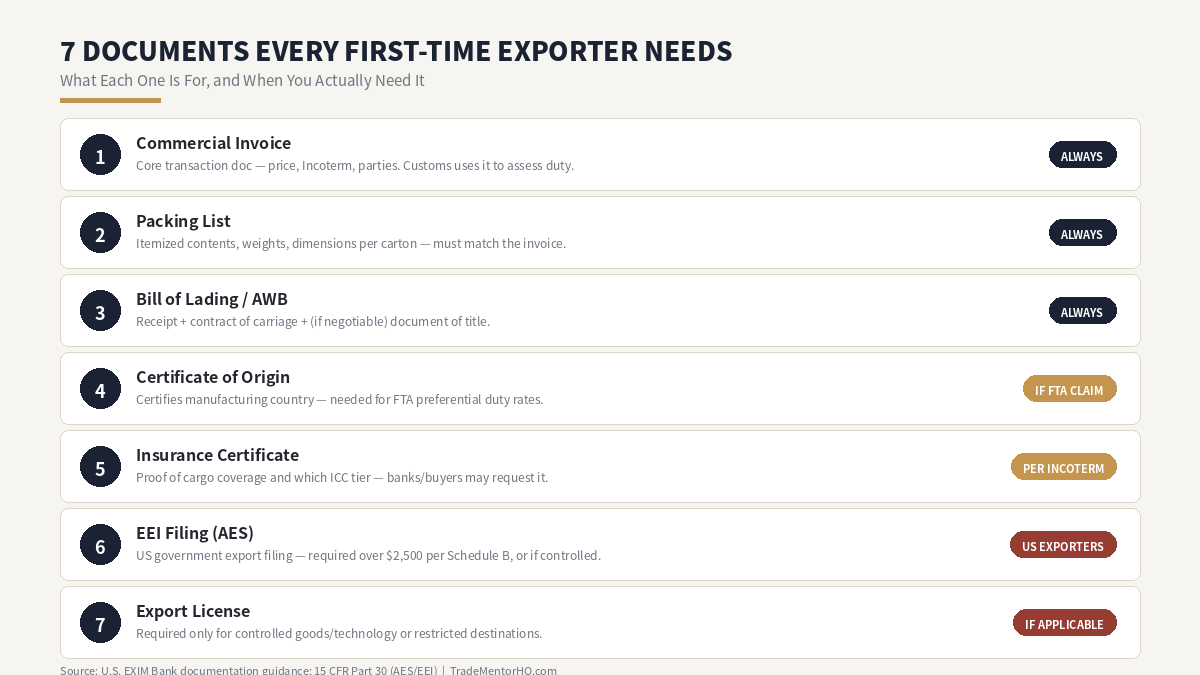
Export documents first shipment checklists exist for a reason: missing even one required paper can hold your cargo at the port for days. This guide walks through the export documents first shipment preparation actually requires, so a first-time exporter can move goods without a costly customs delay.
The first time you actually ship something internationally, the paperwork tends to be more intimidating than the shipping itself. Nobody hands new exporters a single checklist — you find out what you needed after a bank rejects a document, or customs holds a shipment because one form is missing. Here’s the list that would have saved most first-time exporters a phone call to their freight forwarder at 5pm the day before a container closes.
Short version: nearly every international shipment needs a commercial invoice, a packing list, and a bill of lading at minimum — plus a certificate of origin, insurance certificate, and (for U.S. exporters) an Electronic Export Information filing depending on value and destination. Which additional documents you need depends on your product, your buyer’s country, and how you’re getting paid.
1. Commercial Invoice
This is the core transaction document, and nearly everyone downstream needs it: your buyer, the freight forwarder, both countries’ customs authorities, the import broker, and any bank involved in payment. It states what’s being sold, the agreed price, the Incoterm governing the shipment, and the parties involved. Customs uses it to assess duties, so accuracy here isn’t optional — a commercial invoice that undervalues goods (even accidentally) is exactly the kind of error that triggers the customs misclassification penalties covered in our HS code article.
2. Packing List
Technically not always legally required, but functionally indispensable. This itemizes exactly what’s in each carton or pallet — piece counts, weights, dimensions, carton numbers — so your freight forwarder can book the right space and customs can verify the shipment matches the invoice without opening every box. Mismatches between the packing list and the commercial invoice are a common, entirely avoidable cause of inspection holds.
3. Bill of Lading (or Air Waybill)
The bill of lading is three things at once: a receipt confirming the carrier took custody of your goods, a contract of carriage, and — if issued as a negotiable “order” bill rather than a “straight” one — a document of title that can be bought, sold, or used as loan collateral while the goods are still at sea. This last point matters enormously if you’re getting paid under a Letter of Credit: the bank won’t release payment until it has the correct bill of lading in hand, which is exactly the mechanism described in our LC vs T/T comparison.
Air shipments use an Air Waybill instead, which functions similarly but is never negotiable.
4. Certificate of Origin
This document certifies which country your goods were actually manufactured in — not where they shipped from, which can be a different country entirely. It’s typically prepared by the exporter and certified by a chamber of commerce or government body. Destination customs authorities use it for two things: general import processing, and — more importantly for your bottom line — determining whether your shipment qualifies for preferential tariff rates under a free trade agreement. Getting this wrong doesn’t just risk a delay; it can mean your buyer pays full duty on a shipment that should have qualified for a reduced or zero rate.
5. Insurance Certificate
Proof that cargo insurance is in place, and under which Institute Cargo Clause tier — this is the document your bank or buyer may ask to see, and it’s what your insurer references if a claim needs to be filed. As covered in our marine cargo insurance guide, whether you’re the one required to provide this depends entirely on your Incoterm.
6. Electronic Export Information (EEI) — U.S. Exporters
If you’re exporting from the United States, shipments valued over $2,500 per Schedule B commodity classification, per exporter, per destination, generally require an EEI filing through the Automated Export System (AES) — and certain controlled goods require it regardless of value. This one gets skipped by first-timers more than any other document on this list, mostly because it’s a government filing rather than something a bank or buyer asks for directly, which makes it easy to forget until a freight forwarder asks for the confirmation number.
7. Export License (When Applicable)
Most ordinary commercial goods ship under “No License Required” status and don’t need this at all. But some products — dual-use technology, certain chemicals, goods bound for sanctioned or embargoed destinations — do require an export license before they can legally leave the country. The only safe approach is to actually check your product’s classification against your government’s control list before you assume you’re exempt; “I didn’t know I needed one” is not a defense that limits the penalty.
Export Documents First Shipment: How to Actually Stay on Top of This
Build a standard document checklist once, specific to your typical product and lanes, rather than starting from scratch on every shipment. Cross-check your commercial invoice and packing list against each other before they go out — the two documents disagreeing is one of the most common, entirely preventable causes of a customs hold. And when a shipment involves a country, product, or payment method you haven’t used before, confirm document requirements with your freight forwarder before cargo is booked, not after.
The Bottom Line
Export documentation isn’t one form — it’s a small stack of documents, each serving a different party in the transaction (your buyer, your bank, two customs authorities, your insurer), and missing even one can hold up an entire shipment. Commercial invoice, packing list, and bill of lading cover nearly every shipment; certificate of origin, insurance certificate, and EEI filing depend on your specific goods, destination, and origin country’s rules. Build the checklist once, and the paperwork stops being the scariest part of exporting.
Source: U.S. Export-Import Bank (EXIM) documentation guidance; 15 CFR Part 30 (Electronic Export Information / AES filing requirements); standard international trade documentation practice.
Export Documents First Shipment: Common Mistakes New Exporters Make
Getting export documents first shipment ready is where most new exporters stumble, usually on a handful of predictable mistakes. The most common is submitting a commercial invoice with a mismatched value compared to the packing list, which customs officials flag immediately and can hold a shipment for days. Another frequent export documents first shipment mistake is waiting until the goods are packed and ready to ship before requesting a certificate of origin, when many chambers of commerce take several business days to process one.
A third mistake: assuming an export license isn’t needed without actually checking the destination country and product classification, when export documents first shipment preparation should always include that check early, not as an afterthought.
- Mismatched values between invoice and packing list — a common export documents first shipment error.
- Requesting a certificate of origin too late in the process.
- Skipping the export license classification check entirely.
Export Documents First Shipment: A Quick Reference Table
Keeping a quick reference nearby makes assembling export documents first shipment paperwork faster on every subsequent shipment.
| Document | Why it matters for export documents first shipment |
|---|---|
| Commercial invoice | Establishes value for customs and payment |
| Packing list | Details contents, weights, and dimensions |
| Certificate of origin | Confirms manufacturing country for duty purposes |
| Bill of lading / air waybill | Serves as the contract of carriage and title document |
Frequently Asked Questions: Export Documents First Shipment
How far in advance should export documents first shipment paperwork be prepared? At least one to two weeks before the planned ship date, since some documents like a certificate of origin can take several business days to obtain.
Do all shipments need an export license? No — export documents first shipment preparation should include a classification check, since most consumer goods don’t require a license, but certain technology and dual-use products do.
What happens if a document is missing at the port? Export documents first shipment paperwork gaps typically cause the shipment to be held until the missing document is provided, which can mean demurrage charges accumulating daily.
Export Documents First Shipment: Working With a Freight Forwarder
Many first-time exporters lean on a freight forwarder to help assemble export documents first shipment paperwork correctly, and this is often money well spent for a first transaction. A good forwarder can flag missing documents, confirm HS code classifications, and catch value mismatches before they become a customs hold. Export documents first shipment preparation done in partnership with an experienced forwarder tends to go far more smoothly than a first-time exporter attempting the full document set alone, particularly for destinations with unfamiliar customs requirements.
Export Documents First Shipment: Digital Tools That Help
A growing number of platforms now streamline export documents first shipment preparation, generating commercial invoices, packing lists, and even certificates of origin from a single data entry pass rather than filling out each form separately. These tools reduce the value-mismatch errors that are the single most common cause of customs holds, since the invoice and packing list are generated from the same underlying data rather than typed twice by hand. Export documents first shipment software also often integrates directly with freight forwarders and customs brokers, letting documents flow electronically rather than requiring a physical or scanned handoff.
For exporters shipping more than occasionally, investing in this kind of tooling for export documents first shipment preparation typically pays for itself within the first few shipments through reduced delays alone.
Export Documents First Shipment: Country-Specific Variations
While the core document set stays largely consistent, export documents first shipment requirements do vary meaningfully by destination country. Some countries require a legalized or notarized certificate of origin rather than a standard chamber-of-commerce version, adding processing time that first-time exporters often don’t anticipate. Others require additional certificates specific to the product category — phytosanitary certificates for agricultural goods, or specific safety certifications for electronics and machinery. Export documents first shipment preparation should always include a check of destination-specific requirements well before the planned ship date, since discovering an unusual requirement at the port is far more expensive to resolve than catching it during initial planning.
Export Documents First Shipment: Retention and Recordkeeping
Once a shipment clears customs, export documents first shipment paperwork doesn’t simply get discarded — most countries require exporters to retain copies for several years in case of an audit. In the United States, for example, export records typically need to be kept for five years from the date of export, covering everything from the commercial invoice to any export license documentation used. Building a simple filing system for export documents first shipment records from the very first shipment saves significant time later, since retrieving a specific shipment’s paperwork during an audit request is far easier from an organized digital archive than from scattered email attachments and paper folders.
Many exporters underestimate this recordkeeping obligation until they face their first audit request, at which point assembling export documents first shipment history from years back can become a genuinely time-consuming task.
Export Documents First Shipment: Insurance Documentation
An insurance certificate is often the most overlooked item in export documents first shipment preparation, particularly when a freight forwarder or logistics provider handles most of the shipping arrangement. Depending on the Incoterm used, either the buyer or seller may be responsible for arranging cargo insurance, but whoever holds that responsibility needs the certificate ready in case of a claim. Export documents first shipment checklists should explicitly confirm who is responsible for insurance under the agreed shipping term, since assuming the other party has it covered — without confirming in writing — is a common and expensive gap that only becomes visible after cargo is damaged or lost in transit.
Export Documents First Shipment: A Pre-Shipment Checklist
Running through a structured checklist before a shipment leaves the warehouse catches most export documents first shipment errors before they become customs holds. Confirm the commercial invoice value matches the packing list exactly, line by line. Confirm the certificate of origin has been requested with enough lead time, typically at least a week before the ship date. Confirm any required export license has been checked against both the product’s classification and the destination country. Confirm the bill of lading or air waybill lists the correct consignee and notify party. Confirm insurance responsibility has been explicitly agreed and documented, not just assumed.
Running through this export documents first shipment checklist every time, even after dozens of shipments, remains one of the simplest ways to avoid a customs delay that can cost far more in demurrage fees than the few minutes the checklist takes to complete.
Export Documents First Shipment: When Something Goes Wrong
Even with careful preparation, export documents first shipment paperwork occasionally has an error that surfaces only once cargo reaches the port. When this happens, the fastest resolution usually comes from contacting the freight forwarder or customs broker immediately with a corrected document, rather than waiting to see if customs notices on their own. Many export documents first shipment corrections can be handled within a day or two if flagged promptly, while delays in addressing the issue compound demurrage and storage charges daily.
Keeping a direct line of communication with whoever handles customs clearance, and responding quickly when a document discrepancy is flagged, keeps an isolated export documents first shipment mistake from turning into a multi-week delay.
Building a habit of reviewing export documents first shipment paperwork the same way, shipment after shipment, is ultimately what turns a stressful first export into a routine, repeatable process — one where documents come together on schedule instead of scrambling at the last minute before a container closes.
Getting Comfortable With the Process Over Time
The first shipment always takes the longest to prepare, simply because every document is unfamiliar and every requirement has to be looked up rather than recalled from memory. By the third or fourth shipment, most exporters find the same checklist takes a fraction of the time, since the documents required rarely change for a given product and destination combination. Keeping templates for the commercial invoice and packing list, updated only for the specific shipment’s values and quantities, is one of the simplest ways to speed up preparation once the initial learning curve is behind you.
Export Documents First Shipment: Working With a Customs Broker
A licensed customs broker can review export documents first shipment paperwork before it’s submitted, catching classification errors or missing certifications that a first-time exporter might not recognize. Brokers are particularly valuable for products subject to specific regulatory requirements — agricultural goods, chemicals, or anything requiring an export license — since they stay current on classification rules that change more often than most exporters track on their own.
While a broker adds a cost per shipment, that cost is usually far smaller than the demurrage and storage fees a documentation error at the port can generate, making a broker relationship worthwhile for most new exporters handling anything beyond the simplest low-risk goods.
For official U.S. export documentation requirements, see the Wikipedia overview of exporting, and for a related comparison on this site see our guide to customs clearance delays.
Getting Your Paperwork Right the First Time
Export documents first shipment preparation comes down to starting early, double-checking that every value and description matches across documents, and confirming licensing requirements before goods are packed. Getting export documents first shipment paperwork right the first time avoids the most common — and most expensive — mistakes new exporters make.
A detail that catches a surprising number of first-time exporters: the Electronic Export Information (EEI) filing through AESDirect isn’t optional once a single Schedule B commodity in the shipment exceeds $2,500 in value, or if a license is required regardless of value — skipping it isn’t just a paperwork gap, it can trigger penalties from the Census Bureau.
On the commercial invoice and packing list, the numbers need to match exactly — same item descriptions, same quantities, same total value — because customs officials on both ends cross-reference these documents, and mismatches are one of the most common reasons a shipment gets pulled for manual review rather than cleared automatically. If you’re using a certificate of origin issued by a local chamber of commerce, budget $25–75 per certificate and a few business days of lead time rather than assuming it can be produced same-day.
Related Reading
- Letter of Credit (LC) vs T/T: Which Payment Method Should You Choose?
- How to Classify Your Product with the Correct HS Code (and Avoid Costly Mistakes)
Written by the TradeMentorHQ editorial team. We research primary sources — ICC rules, WCO and customs-authority guidance, and U.S. EXIM Bank documentation practice — before every article, and we’re upfront about how the site is produced on our About page. Spotted something that needs a correction? Let us know.

About the Author: TradeMentorHQ Team
The TradeMentorHQ team researches and writes practical, plain-language guides on Incoterms, customs clearance, trade finance, and shipping logistics for small business owners, first-time importers/exporters, and side-hustle sellers. Our articles are grounded in publicly available regulations and guidance from bodies like U.S. Customs and Border Protection (CBP), the International Chamber of Commerce (Incoterms 2020), and established industry practice, and we link to primary sources wherever a number or rule could change. We are not customs brokers, freight forwarders, or licensed trade attorneys, and nothing here is a substitute for advice from one on your specific shipment.