
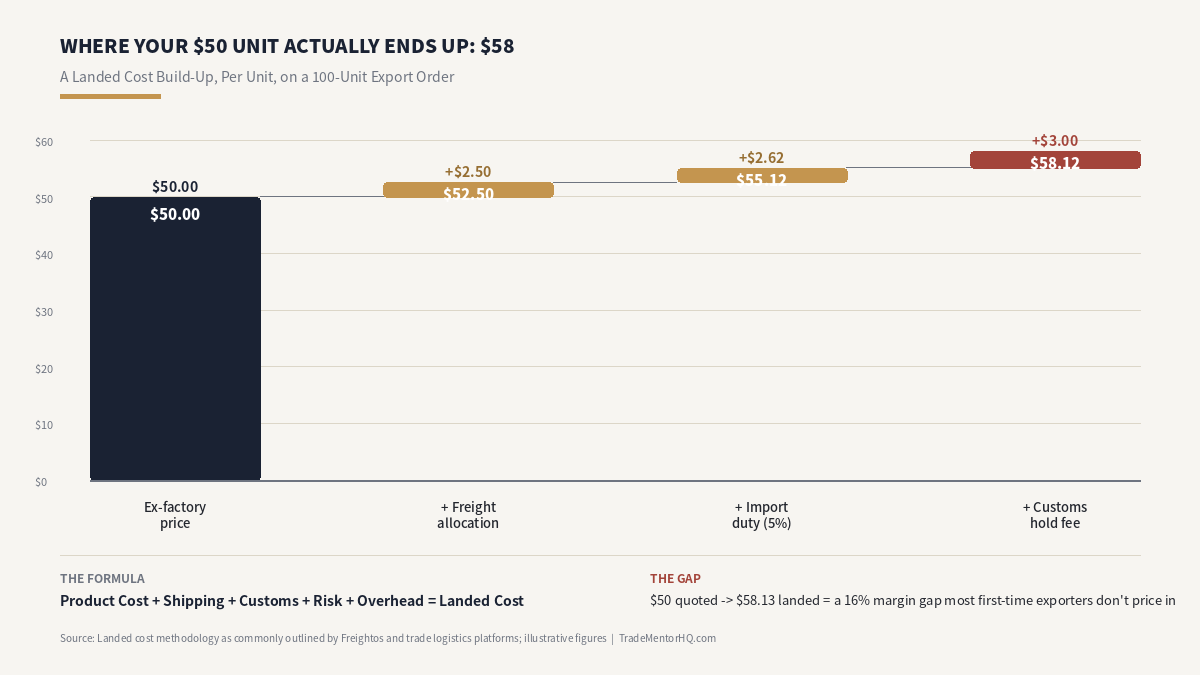
Building a reliable landed cost calculator is the single most important pricing habit a first-time exporter can develop, since quoting off the ex-factory price alone almost always leads to underpricing and shrinking margins once freight, duty, and hidden fees are added.
Most first-time exporters price a product off a single number — the ex-factory or FOB cost per unit — and then wonder why the margin they modeled on paper never quite shows up in the bank account. It’s rarely because the ex-factory price was wrong. Landed cost — ex-factory price plus your allocated share of freight, insurance, customs duty, and the handling/financing overhead that comes with moving goods across a border — is what actually determines your margin, and on a real shipment it can run 15-20% higher than the number on the factory quote.
Try it yourself: we built a free interactive Landed Cost Calculator based on the walkthrough below — plug in your own product cost, freight, duty rate, and overhead to get an instant per-unit landed cost estimate.
What “Landed Cost” Actually Includes
The formula freight forwarders and trade finance platforms use is simple to state and easy to underestimate in practice: Product Cost + Shipping + Customs + Risk + Overhead = Landed Cost. Product cost is the ex-factory or FOB price per unit. Shipping is your shipment’s allocated share of freight — not the full container rate, but the portion of it your order actually consumes. Customs covers import duty and any tariff-classification-driven fees, calculated against your product’s HS code. Risk covers cargo insurance premiums.
Overhead is the catch-all for everything else that shows up on the invoice after the goods clear: terminal handling charges, customs brokerage fees, demurrage or storage if the shipment sits, and the financing cost of capital tied up in transit. Skip any one of these categories when pricing an export order and the gap between quoted cost and landed cost is exactly the margin that quietly disappears.
Walking Through a Real Calculation
Take an order of 100 units at $50 per unit ex-factory — $5,000 in product cost. 50 per unit. 50 per unit, before customs even enters the picture. 63 per unit — pushing the landed cost to about $55 per unit. If the pricing model stopped there, most exporters would call the exercise finished. It shouldn’t.
The Hidden Cost Most First-Time Exporters Miss
Real shipments don’t always move in a straight line, and the overhead category is where landed cost calculations most often go wrong — not because the math is hard, but because the cost doesn’t exist until it does. Say this shipment gets flagged for a documentation check at the port and sits for four extra days, generating $300 in demurrage and expedited customs brokerage fees. That’s $3 per unit, on top of everything else — bringing the true landed cost to roughly $58 per unit, a 16% gap from the $50 ex-factory price that appeared on the original quote.
None of this is unusual or worst-case; it’s a normal, unremarkable customs hold. A landed cost model that doesn’t budget some contingency for exactly this kind of overhead will look accurate right up until the first shipment that doesn’t go perfectly.
How the Incoterm You Choose Changes This Calculation
Which of these cost categories you’re even responsible for depends entirely on the Incoterm in the sales contract. Under EXW, the buyer absorbs freight, insurance, customs, and overhead in their own landed cost calculation — the seller’s price is just the ex-factory number. Under FOB, the seller’s cost stops at loading the vessel, so freight and everything after becomes the buyer’s landed cost problem. Under DDP, the seller is quoting a price that’s already supposed to be the landed cost, duties and all, which means getting this calculation right isn’t optional — it’s the difference between a profitable DDP quote and one that erodes margin on every unit shipped.
Keeping the Incoterm and the landed cost calculation aligned is one of the more common gaps between a contract that looks fine on paper and one that actually protects margin.
Building Your Own Landed Cost Calculator
A working version doesn’t need to be complicated — a spreadsheet with five inputs (unit product cost, total freight cost and your shipment’s allocated share of it, insurance premium, duty rate, and an overhead line with a reasonable contingency buffer) covers most of what a first shipment needs. Deciding whether the cargo moves as a full container or shares space with other shippers’ freight changes both the cost and how predictably it can be estimated in advance.
Once the calculator exists, the real value isn’t the one-time answer — it’s being able to re-run the numbers whenever freight rates, duty rates, or the allocation share change, instead of re-deriving the math from scratch every time a quote is due.
The Bottom Line
Ex-factory price is the number on the invoice; landed cost is the number that determines whether an export order is actually profitable. Building a simple, repeatable calculator that adds allocated freight, customs duty, insurance, and a realistic overhead buffer to the product cost turns pricing from a guess into a model — and it’s usually the difference between a margin that holds up and one that quietly evaporates somewhere between the factory and the buyer’s warehouse.
Source: Landed cost methodology as commonly outlined by Freightos and other trade logistics platforms; generalized customs duty and demurrage cost structures for illustration.
A quick sanity-check formula worth keeping on hand: landed cost roughly equals FOB unit cost + freight per unit + insurance + duty (unit cost × applicable duty rate) + customs broker/clearance fees + any last-mile delivery cost. For a mid-size shipment, brokerage fees commonly run $75–150 per entry regardless of shipment size, which is why consolidating smaller, frequent shipments into fewer, larger ones often improves your per-unit landed cost more than negotiating freight rates does.
It’s also worth double-checking your HTS duty rate directly against the USITC’s HTS search tool rather than trusting a supplier’s estimate — misclassified duty rates are one of the most common reasons a landed-cost estimate ends up wrong by several percentage points.
Related Reading
- Incoterms 2020 Explained: A Practical Guide for Importers and Exporters
- FCL vs LCL Shipping: A Cost and Timing Comparison for First-Time Exporters
Written by the TradeMentorHQ editorial team. We research primary sources — trade logistics platform methodology and standard customs cost structures — before every article, and we’re upfront about how the site is produced on our About page. Spotted something that needs a correction? Let us know.
What a landed cost calculator actually needs to include
A proper landed cost calculator starts with the ex-factory or FOB price and then layers in every cost that accrues before the product reaches the customer: international freight, marine or air cargo insurance, import duty, customs broker fees, port handling charges, and inland delivery to the final destination. Skipping any one of these categories in a landed cost calculator produces a price that looks profitable on paper but quietly erodes margin in practice.
Many exporters build their first landed cost calculator in a simple spreadsheet, listing each cost category as its own line item and expressing it either as a flat fee or a percentage of goods value. The key discipline is treating a landed cost calculator as a living document — duty rates, freight rates, and fees change often enough that a calculator built once and never updated quickly becomes unreliable.
Duties, tariffs, and how they change the calculation
Import duty is usually the largest variable in a landed cost calculator, and it depends entirely on the product’s HS code and the destination country’s tariff schedule. A landed cost calculator that uses a generic duty estimate instead of the correct HS-code-specific rate can be off by several percentage points, which matters enormously on thin-margin products shipped at volume.
Trade agreements and preferential tariff programs also belong in a well-built landed cost calculator. If a shipment qualifies for a free trade agreement rate, duty can drop from double digits to zero, and failing to reflect that correctly in the landed cost calculator can make a genuinely profitable export deal look unattractive on paper.
Freight, insurance, and handling fees a landed cost calculator must capture
Ocean or air freight rates fluctuate with fuel surcharges, seasonal demand, and container availability, so a landed cost calculator that uses a stale freight quote from months ago can understate costs significantly during peak shipping season. Building in a buffer, or refreshing freight inputs before every major pricing decision, keeps a landed cost calculator honest.
Cargo insurance, port handling fees, terminal charges, and any customs broker commission are smaller individual line items, but together they can add several percent to total landed cost — a landed cost calculator that lumps these into a rough “miscellaneous” bucket instead of itemizing them tends to underestimate true cost by a meaningful margin over many shipments.
Using a landed cost calculator to set a defensible export price
Once every cost category is captured, a landed cost calculator becomes the foundation for setting a defensible export price: add the desired margin on top of total landed cost, rather than on top of the ex-factory price alone, and the resulting quote actually protects profitability once every real-world cost is accounted for.
Exporters who skip a landed cost calculator and instead price intuitively off ex-factory cost plus a flat markup frequently discover, only after several shipments, that the margin they thought they had was consumed entirely by freight and duty — a mistake a properly built landed cost calculator prevents from the very first quote.
Common mistakes when building a landed cost calculator
The most common mistake is treating a landed cost calculator as a one-time exercise instead of an ongoing tool. Duty rates change with trade policy shifts, freight rates swing with fuel prices and demand, and currency fluctuations affect every foreign-denominated cost line. A landed cost calculator built once at the start of a business relationship and never revisited will drift further from reality with every passing month.
A second mistake is ignoring currency exchange risk inside the landed cost calculator. If costs are quoted in a foreign currency but the sale price is fixed in the exporter’s home currency, exchange-rate movement between quoting and payment can erode margin even when every other input in the landed cost calculator was accurate. Building in a small currency buffer, or hedging larger transactions, protects against this.
A third mistake is forgetting one-time or occasional fees — customs exam fees, demurrage on a delayed shipment, or a one-off compliance certification cost — that a landed cost calculator built purely around routine categories can miss entirely. Even infrequent fees should have a small allocated buffer inside the landed cost calculator so a single unlucky shipment does not wipe out that batch’s margin.
Tools and templates for building a landed cost calculator
Many exporters start with a simple spreadsheet-based landed cost calculator, which works well for low shipment volumes and gives full visibility into every assumption. As volume grows, dedicated trade-management software or ERP modules can automate a landed cost calculator by pulling live freight quotes and current duty rates automatically, reducing the manual updating burden.
Whichever tool is used, the core structure of a landed cost calculator should stay consistent: ex-factory price, freight, insurance, duty, broker and handling fees, and a contingency buffer, all rolled up into one true per-unit landed cost figure that the sales team can price against with confidence.
Worked example: a walkthrough of a landed cost calculator in action
Consider an exporter shipping a container of consumer electronics with an ex-factory price of $10 per unit. Ocean freight and insurance add roughly $0.80 per unit, import duty at 6% adds another $0.65, and customs brokerage plus port handling fees add $0.35 more. The landed cost calculator totals these to a true per-unit cost of about $11.80 — nearly 18% above the ex-factory starting point.
Without running this calculation, a seller quoting off the $10 ex-factory price alone and adding a flat 20% markup would price at $12, leaving only about 20 cents of actual margin instead of the intended two dollars. This gap is exactly the kind of quiet margin erosion a landed cost calculator is designed to catch before a contract is signed, not after the shipment has already sailed.
How buyers can use the same calculation to negotiate
Buyers benefit from understanding this same cost structure too. A sophisticated buyer who knows roughly what freight, duty, and handling should cost on a given lane can push back on a seller’s quoted price with specific, informed questions, rather than simply accepting or rejecting a number. Both sides working from a shared, transparent cost breakdown tend to reach fairer pricing faster than negotiating from opposite, opaque assumptions.
For repeat trading relationships, some buyers and sellers even agree to review the underlying cost assumptions together on a quarterly basis, updating freight and duty figures jointly so pricing stays fair to both sides as market conditions shift — a practice that works especially well once both parties trust the same base calculation methodology.
Bottom line on pricing exports correctly
Exporters who skip this exercise entirely tend to discover their true margins only after several shipments have already gone out the door — often too late to adjust a signed contract. Building the habit early, even with a simple spreadsheet, is one of the highest-leverage steps a new exporter can take, and it pays for itself on the very first quote that would otherwise have been underpriced.
Frequently asked questions about landed cost
What is the difference between landed cost and ex-factory price? Ex-factory price covers only the product itself at the seller’s facility, while landed cost adds every expense incurred getting that product to its final destination, including freight, insurance, duty, and handling fees.
How often should landed cost assumptions be updated? At minimum quarterly, and always before quoting a new large order, since freight rates and duty schedules can shift meaningfully within just a few months.
Does landed cost include domestic delivery to the end customer? It can, depending on how far “delivered” the quote needs to be — some businesses stop at the port of entry, while others extend the calculation all the way to the buyer’s warehouse door.
What happens if duty rates change after a contract is signed? This is exactly the kind of risk a buffer line item is meant to absorb; contracts covering longer periods should specify who bears the cost of a tariff change that occurs after signing.
Building a landed cost calculator into your quoting workflow
The final step is making a landed cost calculator part of the standard quoting process rather than a one-off analysis pulled out for special cases. Sales teams should have the calculator open and populated with current freight and duty figures before quoting any new international order, not just for large or unusual shipments.
Integrating a landed cost calculator into the CRM or quoting software, even as a simple linked spreadsheet, ensures every quote reflects real costs consistently, regardless of which team member is preparing it. This consistency is what ultimately protects margin across an entire export operation, not just on the shipments someone happened to double-check.
Over time, as more shipments run through the landed cost calculator, the historical data itself becomes valuable — actual freight and duty costs by lane and product category can be compared against the calculator’s estimates, and the assumptions refined so future quotes get progressively more accurate rather than relying on rough estimates indefinitely.
When to bring in outside help
For exporters shipping high volumes across many product categories or destination countries, manually maintaining a landed cost calculator can become unwieldy. At that point, a customs broker, trade compliance consultant, or dedicated trade-finance software provider can help build a more robust version that automatically pulls current tariff schedules and freight benchmarks, saving significant manual effort while improving accuracy.
Even with outside help, it is worth understanding the underlying mechanics covered here, since the exporter — not the software or the consultant — is ultimately the one who has to live with the pricing decisions the landed cost calculator informs.
Whatever level of sophistication your process reaches, treat the output of your landed cost calculator as a floor for pricing decisions, not a ceiling — build in margin above the calculated landed cost to absorb the inevitable surprises that even the most careful calculation cannot fully predict, from port congestion fees to sudden currency swings.
For official duty and tariff schedule lookups, see the U.S. Harmonized Tariff Schedule. For more export pricing guidance, see our TradeMentorHQ homepage.

About the Author: TradeMentorHQ Team
The TradeMentorHQ team researches and writes practical, plain-language guides on Incoterms, customs clearance, trade finance, and shipping logistics for small business owners, first-time importers/exporters, and side-hustle sellers. Our articles are grounded in publicly available regulations and guidance from bodies like U.S. Customs and Border Protection (CBP), the International Chamber of Commerce (Incoterms 2020), and established industry practice, and we link to primary sources wherever a number or rule could change. We are not customs brokers, freight forwarders, or licensed trade attorneys, and nothing here is a substitute for advice from one on your specific shipment.