Getting EXW vs FCA incoterms right matters far more for container shipments than most exporters realize, since choosing the wrong one can leave the seller legally responsible for export customs clearance and loading risks they never intended to carry.
EXW (“Ex Works”) looks like the simplest Incoterm on paper — the seller’s only job is to make the goods available at their own premises, and everything else is the buyer’s problem. For a domestic sale, that simplicity is fine. For an international container shipment, it creates exactly the kind of liability gap the International Chamber of Commerce has been warning exporters about since the 2020 revision.
What EXW Actually Requires
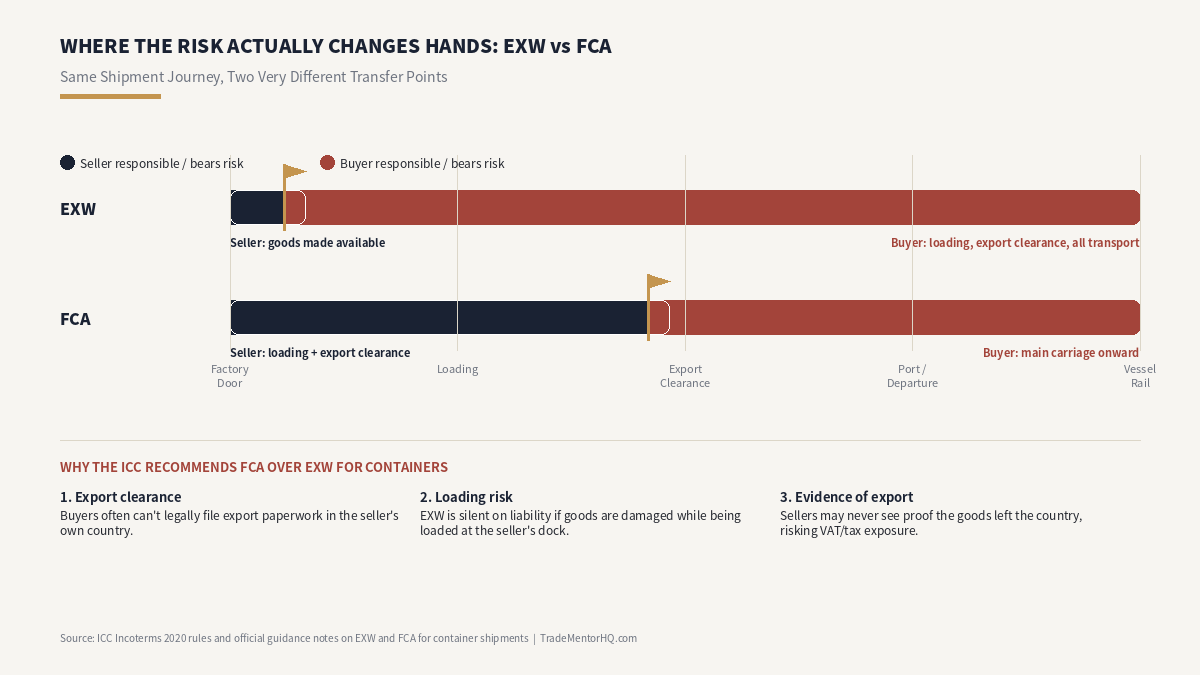
Under EXW, the seller’s obligation ends the moment the goods are placed at the buyer’s disposal at a named place — typically the seller’s own factory or warehouse — not loaded onto anything, just made available. Everything after that point is the buyer’s responsibility: arranging the truck or container pickup, physically loading the goods (a step most people assume is the seller’s job simply because the goods are on the seller’s property), clearing the goods for export out of the seller’s own country, and arranging the entire onward international transport. On paper this looks like maximum simplicity for the seller.
In practice, it means the buyer — a company that may have no legal presence, no customs registration, and no ability to file export paperwork in the seller’s country — is on the hook for tasks only a locally established party can realistically perform.
What FCA Actually Requires (and How It Differs)
FCA shifts two specific obligations back onto the seller while keeping most of EXW’s cost-and-simplicity advantages intact. First, the seller is responsible for loading the goods onto the vehicle arranged by the buyer, if delivery happens at the seller’s own premises — removing the ambiguous loading-risk gap that exists under EXW. Second, and more consequentially, the seller retains responsibility for export customs clearance, since the seller is the party actually established and registered in the country the goods are leaving.
Risk and cost still transfer to the buyer early in the journey — once the goods are loaded onto the buyer’s collecting vehicle, or handed over to the carrier the buyer nominated — so FCA isn’t a return to seller-heavy terms like CIF or DDP. It simply relocates the two tasks that only make practical sense for a locally-present party to handle.
Why the ICC Recommends Against EXW for Containers
The Incoterms 2020 guidance notes give three concrete reasons container shippers specifically should avoid EXW. The first is the export clearance problem described above: a buyer with no legal footprint in the seller’s country often cannot actually complete export formalities there, which can leave a shipment stuck at the port of departure with no party able to legally clear it.
The second is loading risk — EXW is silent on who bears responsibility if goods are damaged during loading, an ambiguity that container shipments (where loading typically means a forklift or crane moving palletized cargo into a container) make more likely to matter than it would for a simple domestic pickup. The third is evidence of export: many countries require documented proof that goods physically left the country in order to zero-rate VAT or sales tax on the export sale, and under EXW the seller may never see that proof, since the buyer controls the entire export process from the seller’s loading dock onward.
A Concrete Illustration
A furniture manufacturer sells a container load to an overseas buyer under EXW terms. The buyer’s appointed trucking company arrives to collect the goods, but the manufacturer’s warehouse staff — reasonably assuming loading is included, since the truck is at their dock — load the container themselves without a clear contractual basis for who’s liable when a forklift damages several pieces during loading.
Separately, the buyer’s freight forwarder, who has no local customs registration in the manufacturer’s country, is unable to file the export declaration, and the shipment sits at the departure port for a week while the manufacturer scrambles to file the clearance itself — a task it never agreed to do and wasn’t paid to perform. Under FCA, both problems disappear: the seller loads the truck as an explicit contractual obligation, and the seller — already registered for customs purposes in its own country — files the export clearance as a matter of course.
The Bill of Lading Fix in FCA (Incoterms 2020)
Incoterms 2020 also addressed a long-standing complaint about FCA specifically for shipments financed by letters of credit: banks issuing an LC frequently require an on-board bill of lading — proof the goods are physically loaded on the vessel — but under FCA, risk transfers to the buyer before the goods reach the ship, at the point of handover to the carrier, so sellers historically couldn’t obtain that on-board notation themselves.
The 2020 revision added an optional mechanism allowing the buyer to instruct the carrier to issue an on-board bill of lading to the seller after loading, resolving the mismatch and making FCA workable for LC-financed trade — one more reason FCA, not EXW, is the Incoterm the ICC steers container shippers toward.
The Bottom Line
EXW looks like the lightest-touch option for a seller, but for an international container shipment it quietly transfers export clearance and loading risk to the party least able to handle either one. FCA keeps almost all of EXW’s simplicity while putting those two specific tasks back where they logically belong — which is exactly why Incoterms 2020’s own guidance recommends it over EXW for anything moving by container.
Source: ICC Incoterms 2020 rules and official guidance notes on EXW and FCA usage for container and multimodal shipments.
What EXW and FCA actually mean
Under EXW (Ex Works), the seller’s only obligation is to make the goods available at their own premises — the buyer arranges and pays for export clearance, loading, and every step of transport from that point forward. Under FCA (Free Carrier), the seller instead delivers the goods, cleared for export, to a carrier or location named by the buyer. This single difference in who handles export clearance and loading is the heart of the EXW vs FCA incoterms comparison, and it has real legal and practical consequences once containers are involved.
Incoterms 2020 explicitly recommends against using EXW for container shipments, and understanding EXW vs FCA incoterms explains exactly why: under EXW, the buyer is technically responsible for loading the container at the seller’s premises and for export customs formalities, even though the buyer often has no local presence to actually do either. FCA fixes this by placing export clearance and loading responsibility on the seller, who is far better positioned to handle both.
EXW vs FCA incoterms: where risk actually transfers
Risk transfer is the most consequential difference in EXW vs FCA incoterms. Under EXW, risk passes to the buyer the moment the goods are made available at the seller’s premises — before loading, before export clearance, before the goods even leave the seller’s property. Under FCA, risk passes only once the goods are handed to the carrier at the named delivery point, after export clearance is complete.
This matters enormously for container shipments specifically. If a container is damaged or lost while being loaded at the seller’s dock under EXW terms, the buyer bears that risk despite having no one on-site to prevent or even witness the incident. EXW vs FCA incoterms diverge sharply here — FCA keeps the seller responsible (and typically insured) through loading, which better matches who is actually present and in control at that stage.
Why Incoterms 2020 recommends FCA over EXW for containers
The Incoterms 2020 rules explicitly flag EXW as poorly suited to container and multimodal shipments, and the EXW vs FCA incoterms guidance reflects this directly: FCA is now the default recommendation for any shipment that requires export clearance and container loading logistics. Sellers who continue defaulting to EXW out of habit are taking on customs and documentation risk that the buyer typically cannot manage from a foreign country.
Freight forwarders and customs brokers increasingly steer clients toward FCA specifically because of these EXW vs FCA incoterms concerns — an EXW shipment that gets stuck at the seller’s local customs office, unable to clear because the buyer’s agent lacks proper local authorization, is a common and entirely avoidable failure mode that FCA eliminates by design.
When EXW might still make sense
Despite the EXW vs FCA incoterms guidance favoring FCA for containers, EXW can still work reasonably well for smaller, non-containerized shipments where the buyer has a reliable local agent already handling pickup and export formalities, or for domestic-adjacent trade where cross-border customs complexity is minimal.
Even in those cases, exporters weighing EXW vs FCA incoterms should confirm the buyer genuinely has export clearance capability in the seller’s country — many buyers assume this is trivial and are surprised to learn they need a local customs representative just to complete an EXW pickup.
Practical impact on cost, insurance, and documentation
Cost allocation is another place EXW vs FCA incoterms diverge meaningfully. Under EXW, the buyer pays for and arranges loading, export customs, and inland transport to the port — costs a foreign buyer often underestimates or mismanages. Under FCA, the seller, who already has local staff, equipment, and customs relationships, handles these steps more efficiently and often at lower total cost.
Insurance coverage also depends on getting EXW vs FCA incoterms right: cargo insurance policies are written around the risk-transfer point defined by the chosen incoterm, so a mismatch between the stated incoterm and the actual physical handling of the goods can create coverage gaps precisely when a claim is filed.
Common mistakes exporters make with EXW vs FCA incoterms
The single most common mistake is defaulting to EXW simply because it appears first alphabetically or seems simplest on paper, without considering that EXW vs FCA incoterms carry very different practical burdens once containers, ports, and cross-border customs enter the picture. Many exporters used EXW for decades under older Incoterms editions and have not updated their contract templates to reflect the 2020 guidance.
A second mistake is agreeing to EXW terms with a buyer who insists on it, without clarifying who will actually be physically present to handle loading and export clearance. Getting EXW vs FCA incoterms wrong in the contract does not just create theoretical risk — it can result in real delays, demurrage charges, or even cargo damage claims being denied because the wrong party was responsible for a step neither side properly executed.
A third mistake, seen often in freight-forwarder-arranged shipments, is mixing incoterm language loosely in commercial invoices and bills of lading. When EXW vs FCA incoterms are stated inconsistently across shipping documents, customs authorities and insurers can interpret the transaction differently than the parties intended, which complicates any dispute that arises later.
Frequently asked questions about EXW vs FCA incoterms
Why does Incoterms 2020 recommend against EXW for containers? Because EXW places export clearance and container loading responsibility on the buyer, who is often not physically present in the seller’s country to handle either task.
Does FCA cost more than EXW? Not necessarily — while the seller takes on more responsibility under FCA, this is often more cost-efficient overall since the seller already has local logistics relationships in place.
Can EXW still be used safely? Yes, for smaller or non-containerized shipments where the buyer has a competent local agent, but EXW vs FCA incoterms guidance still favors FCA whenever container logistics are involved.
How to transition existing contracts from EXW to FCA
Exporters who have relied on EXW for years do not need to overhaul every contract overnight, but transitioning toward FCA where container shipments are involved is worth prioritizing. The practical EXW vs FCA incoterms transition usually starts with updating standard sales-contract templates and pro forma invoices to reference FCA as the default term, with EXW reserved only for the specific smaller-shipment cases discussed above.
It also helps to loop in the freight forwarder early: a forwarder familiar with the EXW vs FCA incoterms distinction can flag, during quoting, whether a particular shipment’s container and customs profile makes FCA clearly preferable, before the sales contract is even finalized. Waiting until loading day to discover an EXW/FCA mismatch is far more expensive than catching it during contract negotiation.
How buyers should evaluate EXW vs FCA incoterms offers
Buyers receiving an EXW quote for a container shipment should ask directly whether the seller is willing to move to FCA instead, since the cost difference is often smaller than buyers assume, while the reduction in operational risk is significant. Framing the EXW vs FCA incoterms conversation around risk allocation, rather than price alone, tends to produce a more balanced agreement for both sides.
Buyers who insist on EXW despite the added complexity should budget for a competent local agent in the seller’s country to manage loading and export clearance — treating this as a real cost of choosing EXW rather than an afterthought is the single biggest factor in avoiding the problems that Incoterms 2020’s EXW vs FCA incoterms guidance was written to prevent.
EXW vs FCA incoterms and multimodal container routing
Container shipments increasingly move through multimodal routes — truck to rail to vessel, or truck to inland port to ocean carrier — and the EXW vs FCA incoterms distinction becomes even more important here, since EXW was never designed with multimodal handoffs in mind. Every additional handoff under EXW terms is another point where responsibility is unclear if something goes wrong before the goods formally leave the seller’s control.
FCA was specifically built to accommodate this complexity: because the seller retains responsibility through export clearance and delivery to the named carrier, all the early handoffs in a multimodal chain stay under the seller’s insurance and operational control. This is arguably the strongest practical argument for choosing FCA in the EXW vs FCA incoterms decision whenever more than one mode of transport is involved before the goods reach the port.
Documenting the choice clearly in the sales contract
Whichever side of EXW vs FCA incoterms a deal lands on, the choice needs to be spelled out precisely in the sales contract, the commercial invoice, and the bill of lading — including the named place of delivery, since both EXW and FCA require a specific location to be effective. Vague or missing location details are a common source of disputes regardless of which incoterm is chosen.
It is also worth noting that Incoterms 2020 introduced a variant of FCA specifically addressing a documentation gap that used to push some exporters toward EXW: sellers can now request an on-board bill of lading notation under FCA terms, which resolves a letter-of-credit compliance issue that previously made EXW seem like the only workable option for some container shipments. Understanding this update is part of making an informed EXW vs FCA incoterms decision in 2026.
For the official rules, see the ICC’s Incoterms 2020 resources. For more incoterms comparisons, see our TradeMentorHQ homepage.
Why the Incoterm You Pick Actually Matters
For container shipments specifically, FCA is now the clear recommendation over EXW, and the EXW vs FCA incoterms decision should default to FCA unless there is a specific, well-understood reason to use EXW instead. The 2020 Incoterms revision made this recommendation explicit precisely because so many EXW container shipments were running into avoidable customs and loading problems.
Exporters who take the time to understand EXW vs FCA incoterms before finalizing a sales contract avoid a meaningful category of shipping delays, disputed insurance claims, and customs holdups — a small amount of upfront diligence on this single incoterm choice pays for itself many times over across a shipping relationship.
The core reason freight forwarders and the ICC itself increasingly steer container shippers toward FCA instead of EXW comes down to loading risk: under EXW, risk technically transfers to the buyer the moment goods are made available at the seller’s premises, meaning if something goes wrong while the truck driver is loading the container (a common flashpoint for cargo damage claims), the buyer is on the hook despite having zero control over how the seller’s staff loaded it.
FCA shifts that same handoff to a point where the goods are already loaded and the carrier has taken charge, which is also why FCA — not EXW — lets the seller more easily handle export customs clearance, since EXW technically leaves that formality to a buyer who often has no legal standing to file export declarations in the seller’s country.
Related Reading
- Incoterms 2020 Explained: A Practical Guide for Importers and Exporters
- FOB vs CIF: The Most Commonly Confused Incoterms, Explained with Examples
Written by the TradeMentorHQ editorial team. We research primary sources — ICC Incoterms 2020 rules and official guidance notes — before every article, and we’re upfront about how the site is produced on our About page. Spotted something that needs a correction? Let us know.

About the Author: TradeMentorHQ Team
The TradeMentorHQ team researches and writes practical, plain-language guides on Incoterms, customs clearance, trade finance, and shipping logistics for small business owners, first-time importers/exporters, and side-hustle sellers. Our articles are grounded in publicly available regulations and guidance from bodies like U.S. Customs and Border Protection (CBP), the International Chamber of Commerce (Incoterms 2020), and established industry practice, and we link to primary sources wherever a number or rule could change. We are not customs brokers, freight forwarders, or licensed trade attorneys, and nothing here is a substitute for advice from one on your specific shipment.