
Choosing a bank guarantee vs standby letter of credit is a decision that trips up even experienced exporters and contractors, since the two instruments look similar on paper but differ in enforceability, cost, and the legal framework that governs a claim.
A construction contractor bidding on an overseas infrastructure project and an exporter shipping machinery on open account terms can end up asking their bank for what sounds like the same thing: a promise that if the other side fails to perform, the bank pays. Depending on which country’s bank issues it, that promise usually comes packaged as one of two different instruments.
What a Bank Guarantee Actually Is
A bank guarantee is a direct undertaking from the issuing bank to pay a specified sum if the applicant fails to meet a contractual obligation — completing construction work, repaying a loan, delivering goods, or whatever the underlying contract requires. Most guarantees used in trade and construction are demand guarantees, governed by the ICC’s Uniform Rules for Demand Guarantees (URDG 758), meaning the beneficiary can typically draw on the guarantee simply by presenting a written demand stating the applicant is in default — the bank generally isn’t required to investigate whether the default actually occurred before paying.
This “pay first, argue later” structure is what makes guarantees fast and reliable for beneficiaries, and it’s also exactly why applicants negotiate carefully over the guarantee’s wording, expiry date, and any conditions attached to a valid demand.
What a Standby Letter of Credit Actually Is
An SBLC is structurally a documentary letter of credit — governed by the same rulebook family as a commercial LC (UCP600) or, more commonly for standbys specifically, the International Standby Practices (ISP98) — but used as a backup instrument rather than the primary payment method. Under normal circumstances, the underlying contract is expected to be paid or performed directly between buyer and seller, with the SBLC sitting in reserve; it’s only drawn if the applicant fails to pay or perform as agreed.
To draw on an SBLC, the beneficiary typically presents a compliant set of documents — often including a signed statement certifying the applicant’s default — to the issuing bank, which then pays according to the credit’s terms. The mechanics look similar to a demand guarantee in practice, but the document-driven, documentary-credit heritage of the SBLC brings UCP600/ISP98-style rules around document examination and discrepancies into play in a way a straightforward demand guarantee often doesn’t.
Why Two Instruments Exist for the Same Job
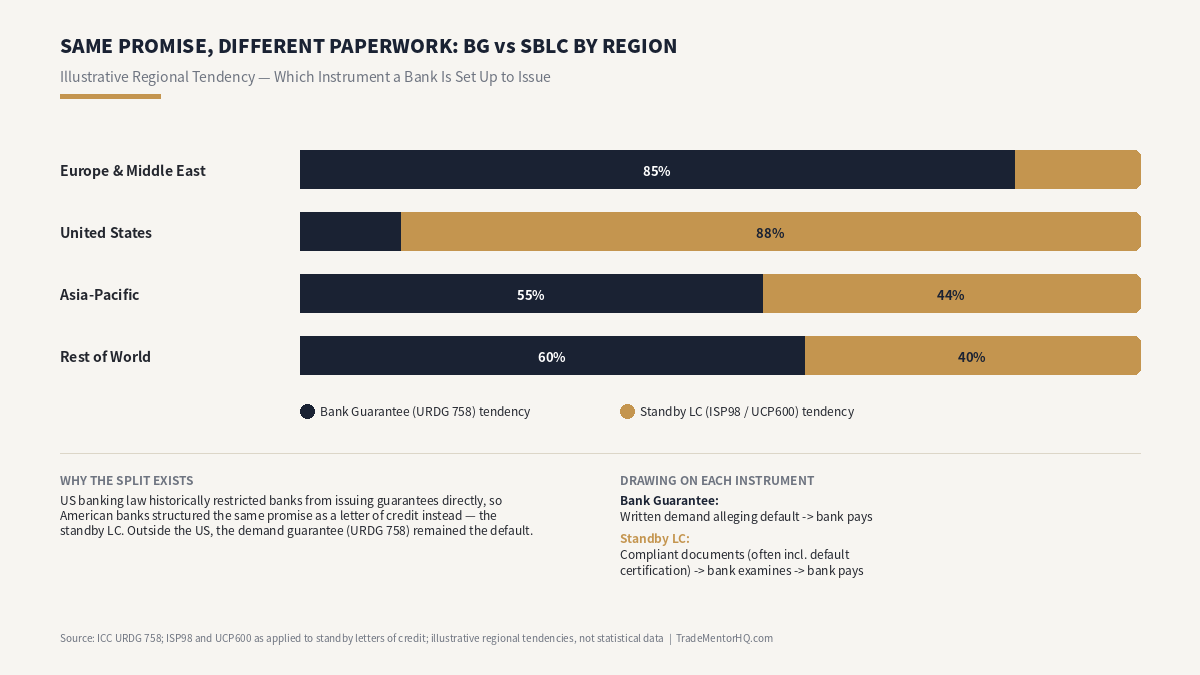
The split is largely a historical and regulatory accident rather than a deliberate design choice. For much of the 20th century, US banking law restricted national banks from issuing guarantees in the traditional sense, since a guarantee was viewed as the bank taking on a form of surety business outside normal banking activity. American banks worked around that restriction by structuring the same economic promise as a letter of credit — a instrument banks were clearly permitted to issue — creating the standby letter of credit as a functional substitute.
That history is why SBLCs remain the dominant instrument for US-issued bank undertakings, while bank guarantees, governed by URDG 758 or the issuing bank’s local law, remain the default in Europe, the Middle East, and much of the rest of the world. A contract between a European seller and a US buyer will often end up negotiating specifically over which instrument each side’s bank can actually issue, rather than which instrument is objectively better suited to the deal.
A Concrete Illustration
An engineering firm wins a contract to supply equipment to a project in the Gulf region and is required to post a 10% performance guarantee. Its bank, operating under regional norms, issues a URDG 758 demand guarantee: if the beneficiary presents a written demand alleging non-performance before the guarantee’s expiry, the bank pays, and any dispute over whether the engineering firm actually defaulted gets resolved separately, after payment.
Now compare a US-based equipment supplier asked for the same kind of backstop by an overseas buyer — its bank is far more likely to issue an SBLC instead, built on ISP98 rules, requiring the beneficiary to present specific documents (often including a default certification) that the bank will examine for compliance before paying. The underlying business risk being covered is identical in both cases; the legal mechanics of drawing on the instrument are not.
How to Choose Between Them
In practice, the choice is rarely open — it’s usually dictated by which instrument the applicant’s bank is set up to issue, which in turn depends on that bank’s home jurisdiction. 5%-2% range depending on the applicant’s creditworthiness and the underlying transaction’s risk, though exact pricing varies bank to bank and deal to deal. What matters most is confirming, before a contract is signed, which instrument the applicant’s own bank can actually deliver — a supplier that promises a beneficiary a demand guarantee and then discovers its bank only issues SBLCs has created an avoidable last-minute problem.
The Bottom Line
Bank guarantees and standby letters of credit solve the same underlying problem — a bank standing behind a party’s performance — through two different legal frameworks shaped largely by where the issuing bank operates rather than by anything specific to the deal. Knowing which instrument your counterparty’s bank actually issues, and understanding the draw mechanics that come with it, matters more than debating which one is theoretically superior.
Source: ICC Uniform Rules for Demand Guarantees (URDG 758); International Standby Practices (ISP98) and UCP600 as applied to standby letters of credit; general industry commentary on US banking-law origins of the SBLC.
What is a bank guarantee?
A bank guarantee is a bank’s promise to pay a beneficiary a specified sum if the bank’s customer (the applicant) fails to meet a contractual obligation — completing a project, repaying a loan, or delivering goods as agreed. Comparing a bank guarantee vs standby letter of credit starts here: a bank guarantee is fundamentally a secondary obligation, meaning the beneficiary is generally expected to first pursue the underlying contract before calling the guarantee, depending on the guarantee’s specific wording and the jurisdiction’s legal treatment.
Bank guarantees are especially common in construction and infrastructure contracts, where they appear as bid bonds, performance guarantees, and advance payment guarantees. When people discuss a bank guarantee vs standby letter of credit in the context of large capital projects, the bank guarantee is usually the more familiar instrument to local contractors and government procurement offices in Europe, the Middle East, and much of Asia.
What is a standby letter of credit?
A standby letter of credit (SBLC) is a bank’s commitment to pay the beneficiary if the applicant fails to perform, but it is structured and drawn like a documentary letter of credit rather than a traditional guarantee. This distinction matters a great deal when evaluating a bank guarantee vs standby letter of credit: an SBLC is generally treated as a primary, independent obligation — the bank pays against a compliant demand and specified documents, without first requiring proof that the underlying contract was breached.
Standby letters of credit are the dominant instrument of choice in the United States and are governed by well-established rules (ISP98 or UCP 600), which is one reason American banks and counterparties often default to an SBLC rather than a bank guarantee. Anyone comparing a bank guarantee vs standby letter of credit across US and non-US counterparties should expect this regional preference to shape which instrument a bank will readily issue.
Bank guarantee vs standby letter of credit: the key differences
The clearest way to compare a bank guarantee vs standby letter of credit is by legal character: a bank guarantee is typically a secondary, accessory obligation tied to the underlying contract, while a standby letter of credit is a primary, independent obligation triggered purely by a compliant documentary demand. This difference affects how quickly and easily a beneficiary can actually get paid when something goes wrong.
A second major difference in the bank guarantee vs standby letter of credit comparison is governing law and market convention. Bank guarantees are usually governed by local civil or commercial law and the specific wording of the guarantee text, which varies significantly by country. Standby letters of credit are usually governed by internationally standardized rules, giving parties in different countries a shared, predictable legal framework.
When to use a bank guarantee vs standby letter of credit
Choosing a bank guarantee vs standby letter of credit often comes down to where your counterparty is located and what they are used to seeing. If you are bidding on a government infrastructure project in the Middle East or Europe, the procuring authority will very likely require a bank guarantee, since that is the standard, expected instrument in that market. If your counterparty is based in the United States, a standby letter of credit is usually the more familiar and readily accepted choice.
Company size and risk appetite also factor into the bank guarantee vs standby letter of credit decision. Because a standby letter of credit is treated as an independent obligation with fewer defenses available to the applicant, banks sometimes charge slightly higher fees or require stronger collateral for an SBLC compared with an equivalent bank guarantee, so it is worth asking your bank directly about pricing for both options before committing.
Cost, collateral, and issuance differences
Fee structures for a bank guarantee vs standby letter of credit are broadly similar — both typically run a percentage of the guaranteed amount per year, adjusted for the applicant’s creditworthiness and the strength of any collateral pledged. Where they tend to diverge is in issuance speed and documentation: banks in markets where bank guarantees are the norm often have faster, more standardized internal processes for issuing them than for an SBLC, and vice versa in SBLC-dominant markets.
Collateral requirements under a bank guarantee vs standby letter of credit are usually set by the issuing bank’s internal credit policy rather than by the instrument type itself, but applicants should expect to pledge cash, a credit line, or other security in either case unless they carry a very strong banking relationship and credit profile.
Common mistakes when choosing a bank guarantee vs standby letter of credit
The most frequent mistake is assuming the two instruments are interchangeable just because both promise payment on default. In reality, a bank guarantee vs standby letter of credit differ enough in enforceability that using the wrong one for a given counterparty or jurisdiction can create real friction — a beneficiary expecting an SBLC’s independent, documents-only payment mechanism may be frustrated by a bank guarantee that requires proof of underlying default first.
Another common mistake is not confirming which instrument the counterparty’s procurement rules or contract actually require. Government tenders, in particular, often specify a bank guarantee vs standby letter of credit explicitly in the tender documents, and submitting the wrong instrument can disqualify a bid entirely — always check the exact wording of the requirement before instructing your bank to issue either one.
A third mistake is underestimating how differently claims are handled. Disputing a wrongful call under a bank guarantee vs standby letter of credit can be far more difficult once the bank has paid, since both instruments are designed to be paid first and disputed later — which means the underlying commercial relationship, not the bank, is where most disagreements actually get resolved.
Frequently asked questions about bank guarantee vs standby letter of credit
Which is stronger for the beneficiary, a bank guarantee or an SBLC? A standby letter of credit is generally considered stronger for the beneficiary because it is an independent obligation triggered by a compliant demand, without requiring proof of the underlying default first.
Can a bank issue either instrument for the same transaction? Often yes, if the bank operates internationally, but the choice usually follows the counterparty’s or jurisdiction’s market convention rather than the issuing bank’s preference alone.
Is one option cheaper than the other? Pricing for a bank guarantee vs standby letter of credit is usually comparable and depends more on the applicant’s creditworthiness and collateral than on the instrument type itself.
How lawyers and banks assess wording differences
Legal teams reviewing a bank guarantee vs standby letter of credit typically focus on three things: whether the instrument is payable on first demand or requires proof of default, which law and jurisdiction govern disputes, and how the expiry and renewal mechanics are worded. A poorly drafted bank guarantee vs standby letter of credit — regardless of which type is chosen — can leave either the applicant overexposed to a wrongful call or the beneficiary underprotected if a claim is contested.
Banks reviewing a request for a bank guarantee vs standby letter of credit will also look closely at the applicant’s existing credit facilities, since either instrument ties up a portion of the applicant’s overall credit line with the bank. Applicants who plan to use multiple guarantees or standby letters of credit across several projects should discuss aggregate exposure with their relationship banker well before bidding season, not after a tender deadline is already looming.
Practical checklist before choosing a bank guarantee vs standby letter of credit
Before committing to either side of the bank guarantee vs standby letter of credit decision, confirm the counterparty’s or tender’s exact requirement in writing, get quotes from at least two banks so pricing and collateral terms can be compared, and have legal counsel review the draft wording rather than relying on a bank’s standard template without modification.
Finally, track the expiry date of whichever instrument is issued and calendar a renewal reminder well in advance — a bank guarantee vs standby letter of credit that lapses unexpectedly during an active project can trigger contract breach clauses even when the underlying performance itself was never actually in question.
Regional patterns worth knowing
Understanding regional patterns makes the bank guarantee vs standby letter of credit decision much easier in practice. In the Gulf states, much of Europe, and large parts of Asia, local banks and government procurement offices default to bank guarantees, and requesting an SBLC instead can slow down a bid or even require special approval. In the United States, the reverse is true — standby letters of credit are the everyday instrument, and many US banks are far less experienced issuing traditional bank guarantees.
Multinational companies operating across both types of markets often keep relationships with banks that are comfortable issuing either a bank guarantee or a standby letter of credit, precisely so they are not forced to explain unfamiliar instrument choices to every new counterparty. If your business regularly bids on contracts in both regions, it is worth asking your relationship bank directly whether they can issue both sides of the bank guarantee vs standby letter of credit comparison, and at what cost differential.
For background on standby letter of credit rules, see the ICC’s trade finance resources (ISP98/UCP 600). For more trade-finance instrument comparisons, see our TradeMentorHQ homepage.
Picking the Right Instrument for Your Deal
Deciding between a bank guarantee vs standby letter of credit is less about which instrument is objectively better and more about which one matches your counterparty’s market, your contract’s requirements, and your bank’s capabilities. In markets where bank guarantees dominate, fighting that convention rarely helps; in SBLC-dominant markets, the reverse is true.
Whichever side of the bank guarantee vs standby letter of credit decision you land on, the practical steps are the same: confirm the exact instrument your counterparty or tender requires, get a clear fee and collateral quote from your bank in writing, and make sure your legal team reviews the specific wording before it is issued, since small differences in language can change how easily a claim can be paid or contested later.
The collateral requirements are where these two instruments diverge most in practice: a standby letter of credit from a larger international bank often only requires a cash margin of 10–30% of the guaranteed amount, with the rest backed by the applicant’s credit line, while a bank guarantee from a smaller or regional bank frequently demands 100% cash collateral up front, especially for a first-time applicant with no banking history there.
Issuance costs for both typically land in the 0.75–1.5% per annum range of the guaranteed amount, but that percentage means little if the collateral requirement ties up cash you needed for inventory — so it’s worth asking your bank about the actual margin requirement before comparing headline rates.
Related Reading
- Letter of Credit (LC) vs T/T: Which Payment Method Should You Choose?
- SWIFT Payments vs Escrow Services for International B2B Transactions
Written by the TradeMentorHQ editorial team. We research primary sources — ICC rules on demand guarantees and standby letters of credit, and standard trade finance industry commentary — before every article, and we’re upfront about how the site is produced on our About page. Spotted something that needs a correction? Let us know.

About the Author: TradeMentorHQ Team
The TradeMentorHQ team researches and writes practical, plain-language guides on Incoterms, customs clearance, trade finance, and shipping logistics for small business owners, first-time importers/exporters, and side-hustle sellers. Our articles are grounded in publicly available regulations and guidance from bodies like U.S. Customs and Border Protection (CBP), the International Chamber of Commerce (Incoterms 2020), and established industry practice, and we link to primary sources wherever a number or rule could change. We are not customs brokers, freight forwarders, or licensed trade attorneys, and nothing here is a substitute for advice from one on your specific shipment.