
Short answer: in the dropshipping vs reselling debate, reselling is the far cheaper and lower-risk way to start a side hustle in 2026, while dropshipping can scale faster but usually burns real money before it turns a profit.
Bottom line up front for anyone skimming: if you have under $500 to risk, dropshipping vs reselling isn’t really a fair fight — reselling wins on safety every time. If you have a few thousand dollars and are comfortable losing some of it while testing products, dropshipping becomes a legitimate option worth comparing seriously.
This guide breaks down the dropshipping vs reselling decision using real startup costs, real profit margins, real weekly time commitments, and real failure rates, so you can pick the model that actually fits your budget instead of the one that looks best in a YouTube thumbnail.
What’s the Real Difference Between Dropshipping and Reselling?
Reselling means you buy inventory upfront — from thrift stores, clearance racks, wholesale liquidators, or retail arbitrage — then list and ship it yourself once it sells. You own the product before a customer ever sees it, which means you control quality, condition, and exactly what you’re promising a buyer.
Dropshipping means you list products you never touch. A supplier ships directly to your customer after you make the sale, and you never hold inventory. The dropshipping vs reselling split really comes down to one question: do you want to own inventory or own an ad campaign?
Both models exist inside the same broad side-hustle economy, and both can genuinely work. But they ask for completely different amounts of upfront cash, completely different skill sets, and completely different tolerance for risk — and that’s the part most “start dropshipping today” content conveniently skips over.
It also helps to be clear about what each model is not. Reselling is not the same as running a full retail store with a warehouse, and dropshipping is not the same as running a print-on-demand shop, even though the three often get lumped together in side-hustle content.
Dropshipping vs Reselling: Startup Costs Compared
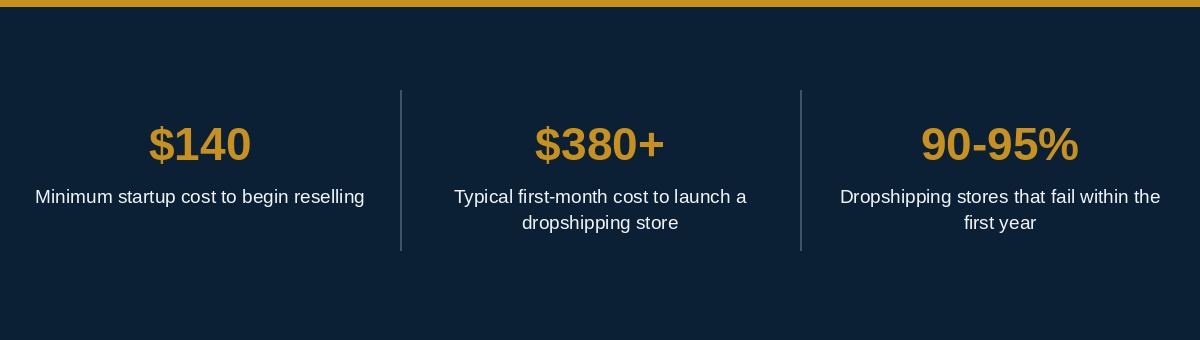
Reselling is the cheaper entry point by a wide margin. A realistic reselling budget runs $140 to $465: roughly $50 to $300 for your first batch of inventory, $30 to $60 for shipping and packing supplies, $15 to $25 for a basic postal scale, and an optional $45 to $80 if you want a steamer or simple photo backdrop.
Dropshipping costs far more before you make a single dollar. A typical first month runs $380 to $2,060 or more once you count a roughly $39-a-month Shopify plan, $12 to $18 a year for a domain, $0 to $20 a month in app subscriptions, and — the part that catches people off guard — $300 to $1,500 in ad spend just to find out whether a product will sell at all.
Some dropshipping guides are blunter about this: they estimate you need $1,500 to $5,000 in cumulative ad spend before you land on a genuinely profitable product, because most products you test simply won’t work. That number alone settles most of the dropshipping vs reselling budget question for anyone starting with a few hundred dollars.
There’s also a hidden cost difference worth naming directly: reselling’s costs are mostly one-time and recoverable (unsold inventory retains some resale value), while dropshipping’s ad spend is a sunk cost the moment it’s spent, win or lose.
Dropshipping vs Reselling: Profit Margins and Real Numbers
Reselling margins, after platform fees, tend to be strong: premium denim can run 75% to 85% margin, vintage band tees 85% to 90%, used electronics 50% to 70%, and sealed LEGO sets 70% to 80%. You know your cost basis on day one because you already paid it, so there’s no guessing involved in your margin math.
Dropshipping margins look fine on paper and thin out fast in practice. A $12 product sold for $29.99 is a 54% gross margin — until you subtract $40 to $167 in ad spend per sale, which often drags the real net margin down to 10% to 30%.
This is the part of the dropshipping vs reselling comparison that surprises beginners most: dropshipping’s headline margin and its actual take-home margin can be worlds apart, while reselling’s margin is close to what you calculated before you ever listed the item.
Neither model’s margins are fixed, of course. A reseller who overpays for inventory or misjudges demand can still lose money, and a dropshipper who finds a genuinely winning product with low ad costs can beat any reselling margin easily. These figures describe typical outcomes, not guarantees in either direction.
Dropshipping vs Reselling: Time Investment Each Week
Reselling runs about 13 to 26 hours a week once you’re active: 4 to 8 hours sourcing inventory, 4 to 8 hours photographing and listing, and 2 to 4 hours packing and shipping orders, plus a bit of time answering buyer questions.
Dropshipping runs slightly higher, 16 to 31 hours a week, but the work looks completely different: 3 to 5 hours managing ad campaigns, 4 to 8 hours producing ad creative, 3 to 6 hours on customer service, and several more hours optimizing pages and offers that aren’t converting.
Neither model is passive, whatever the ads promise. The dropshipping vs reselling time commitment is comparable in total hours, but reselling’s hours are physical and predictable — you know roughly what a packing session takes — while dropshipping’s hours are spent chasing numbers that can swing without warning from one day to the next.
Dropshipping vs Reselling: Risk and Failure Rates
Reselling’s downside is small and contained. If an item doesn’t sell, you’re typically out $5 to $20 per piece, and unsold inventory can usually be relisted, bundled, marked down, or donated for a tax write-off. Cash flow also turns around fast — most resellers see money back within one to three days of a sale.
Dropshipping’s downside is bigger and less forgiving. A failed product test can cost $500 or more in wasted ad spend before you even know it isn’t working, and industry estimates put dropshipping store failure at 90% to 95% within the first year. Return rates run 15% to 30%, roughly two to three times higher than typical reselling return rates of 5% to 10%.
None of this means dropshipping can’t work — plenty of sellers do make it genuinely profitable, some quite well. It means the realistic odds, not the highlight-reel odds shown in ad screenshots, belong in your dropshipping vs reselling decision before you commit real money.
Which Side Hustle Fits Your Budget?
If your total risk capital is under $500, reselling is the responsible starting point. The loss ceiling per mistake is small, cash comes back quickly, and you can reinvest profits into dropshipping later if you still want to try it with money you can genuinely afford to lose.
If you have $2,000 to $5,000 you’re comfortable losing while testing products, and you enjoy running ads and creative more than sourcing inventory, dropshipping becomes a fair comparison rather than a mismatch. Just budget for the ad-spend “tuition” as a real, expected cost rather than an optional extra you might avoid.
A hybrid path also works well for many beginners: start reselling to build cash flow and learn the basics of listing, pricing, and customer service, then use reselling profits — not rent money — to fund a small, disciplined dropshipping test later once you have a cushion.
Your personality matters here too. If you dislike sourcing and packing physical items, reselling will feel like a chore no matter how good the margins look. If you dislike staring at ad dashboards and tweaking budgets daily, dropshipping will wear you down just as fast.
Getting Started This Week
For reselling, pick one category you already understand — clothing, electronics, or a hobby niche — source 10 to 15 items from a thrift store or clearance rack, and list them on one platform before touching a second one.
For dropshipping, resist the urge to build a full store around 50 products. Pick one product, run a small test budget of $200 to $300, and treat the result as data rather than a verdict on the whole business model either way.
Either way, track every dollar in and out from day one, ideally in a simple spreadsheet rather than in your head. The dropshipping vs reselling debate online is full of best-case screenshots; your own spreadsheet is the only number that actually tells you if your side hustle is working.
Give yourself a real trial period before judging the result — 60 to 90 days for reselling, and at least two or three product tests for dropshipping — since a single bad week tells you very little about either model’s long-term potential for you specifically.
To sum up the dropshipping vs reselling decision one more time: reselling is the lower-cost, lower-risk way to start a side hustle in 2026, and dropshipping is a higher-cost, higher-upside bet that only makes sense once you have real money you can afford to lose while you learn.
The startup math looks very different depending on which model you pick: dropshipping typically needs close to $0 in upfront inventory since you only pay suppliers after a sale, but after platform fees, ad spend, and supplier pricing, realistic net margins often land in the 15–30% range and can be thinner in competitive niches.
Reselling requires real upfront capital — often $200–500 to start building inventory worth listing — but sourced-right items (thrift finds, clearance, liquidation lots) can realistically hit 50–100%+ margins since you’re buying below wholesale rather than at a dropship supplier’s marked-up rate. If your budget is genuinely near zero, dropshipping’s low barrier wins; if you have even a few hundred dollars to risk and time to source well, reselling’s margin ceiling is usually the better long-run economics.
Related Reading
Amazon FBA for Beginners: Is Reselling Still Worth It in 2026?
How to Buy From AliExpress Safely: A Beginner’s Guide to Personal Imports
FTC: Guidance on Online Advertising Disclosures
This article is for general informational purposes only and is not financial or business advice. Costs, fees, and platform rules change often — verify current numbers directly with each platform or supplier before investing your own money.

About the Author: TradeMentorHQ Team
The TradeMentorHQ team researches and writes practical, plain-language guides on Incoterms, customs clearance, trade finance, and shipping logistics for small business owners, first-time importers/exporters, and side-hustle sellers. Our articles are grounded in publicly available regulations and guidance from bodies like U.S. Customs and Border Protection (CBP), the International Chamber of Commerce (Incoterms 2020), and established industry practice, and we link to primary sources wherever a number or rule could change. We are not customs brokers, freight forwarders, or licensed trade attorneys, and nothing here is a substitute for advice from one on your specific shipment.