
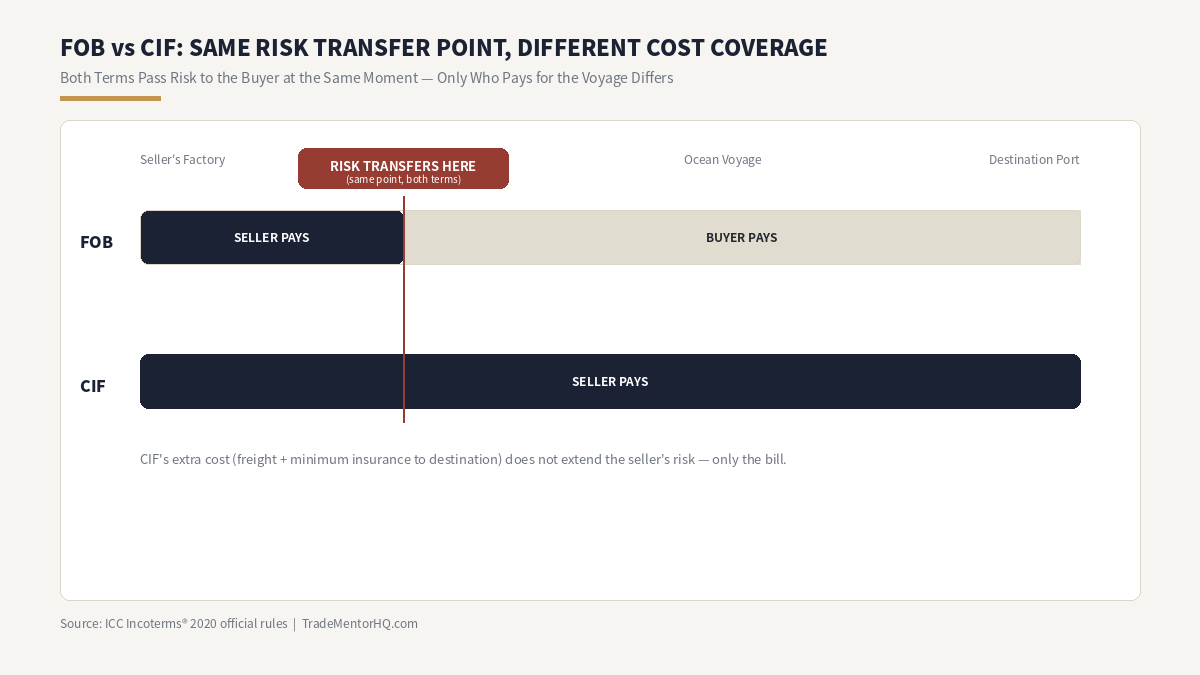
FOB vs CIF is one of the most misunderstood Incoterm comparisons in international trade, and getting it wrong can shift thousands of dollars of cost and risk onto the wrong party. This guide walks through FOB vs CIF with concrete examples, so you can see exactly where risk transfers and who pays for what under each term.
Of all eleven Incoterms 2020 rules, FOB and CIF are the two that get misunderstood most often — not because they’re complicated, but because of one specific detail that trips up buyers and sellers alike: under both terms, risk transfers at exactly the same point, even though CIF sounds like the seller is responsible for a lot more.
Short version: under both FOB and CIF, risk passes from seller to buyer the moment goods are on board the vessel at the port of origin — the difference is only about who pays for freight and insurance during the voyage, not who bears the risk of loss or damage during it. Confusing “who pays” with “who’s at risk” is the single most expensive misunderstanding in these two terms.
FOB vs CIF: What FOB Actually Means
Under FOB (Free on Board), the seller’s job ends the moment the goods are placed on board the vessel nominated by the buyer at the named port of shipment. From that point, the buyer arranges and pays for ocean freight, insurance (if they want it), and everything else through to their own door. Risk transfers to the buyer at that same moment — on board the vessel, at origin.
FOB vs CIF: What CIF Actually Means — and Where the Confusion Comes From
CIF (Cost, Insurance and Freight) sounds like a fundamentally different arrangement, because the seller is paying for freight and insurance all the way to the destination port. But here’s the part that catches people out: risk still transfers at the exact same point as FOB — on board the vessel at the origin port. The seller is contractually required to pay for the ocean freight and to buy insurance covering the voyage, but that insurance is arranged for the buyer’s benefit, because the buyer is the one carrying the risk during that voyage, not the seller.
In other words: under CIF, the seller pays the bills for the trip, but the buyer owns the risk of the trip. If cargo is damaged mid-voyage, it’s the buyer’s loss to claim against the insurance the seller arranged — not the seller’s problem to absorb separately. A lot of buyers assume that because the seller is “covering” the shipment financially under CIF, the seller is also on the hook if something goes wrong at sea. They aren’t, past the port of loading.
A Concrete Illustration
Say a seller quotes the same 500-unit order two ways: $10,000 FOB Shanghai, or $11,200 CIF Los Angeles. The $1,200 difference is the seller’s estimated cost of ocean freight and minimum cargo insurance to get the goods to Los Angeles — it is not a premium for the seller taking on more risk. If the vessel encounters heavy weather mid-Pacific and a container is damaged, the buyer files the claim against the CIF policy (which the seller was contractually required to buy on the buyer’s behalf), not against the seller directly.
The seller’s obligation under CIF was to arrange and pay for that insurance — not to personally guarantee the cargo arrives intact.
The Other Common Mistake: Using FOB or CIF for Container Shipments
As explained in our Incoterms 2020 overview, FOB and CIF are part of the “sea and inland waterway only” group, originally written for an era when cargo was loaded loose across a ship’s rail. Container cargo is typically handed to the carrier at a container yard well before it’s actually loaded onto the vessel — which makes the technical FOB/CIF risk transfer point (on board the ship) mismatched with what’s physically happening. The ICC’s own guidance recommends FCA for containerized freight instead of FOB, and CIP instead of CIF, precisely because those terms transfer risk at the carrier handover, which matches container logistics far more accurately.
FOB and CIF still get used out of habit for container shipments constantly, and it usually works out fine — but it’s worth knowing the terms weren’t really written for the way most cargo moves today.
How to Actually Use These Terms Correctly
If you’re quoting or accepting CIF, don’t treat the “insurance” part as a guarantee — check the coverage tier (CIF’s Incoterms 2020 minimum is Institute Cargo Clause C, the narrowest tier, as covered in our marine cargo insurance guide) and decide whether it’s actually enough for your cargo, because you’re the one who’ll be filing a claim against it, not the seller. And if your cargo moves in containers rather than as break-bulk, ask your counterparty whether FCA/CIP would actually describe the shipment more accurately than FOB/CIF — the risk-transfer mechanics genuinely differ.
The Bottom Line
FOB and CIF transfer risk at the identical point — on board the vessel at the origin port — despite CIF sounding like the seller is responsible for more of the journey. The seller’s extra obligation under CIF is to pay for freight and buy minimum insurance on the buyer’s behalf, not to carry the risk any further than FOB does. Know that distinction before you sign a contract that says “CIF” and assume it means “not my problem until it arrives.”
Source: ICC Incoterms® 2020 official rules; standard international trade practice on FOB/CIF risk allocation.
FOB vs CIF: Common Claim and Dispute Scenarios
Real disputes make the FOB vs CIF distinction clearer than definitions alone. Under FOB, if goods are damaged in transit after being loaded onboard, the buyer bears that loss and must claim against its own cargo insurance — this is one of the most common FOB vs CIF disputes, since buyers sometimes mistakenly assume the seller remains responsible until arrival.
Under CIF, the seller arranges insurance and freight, but risk still transfers once goods are onboard the vessel, meaning a FOB vs CIF mix-up over “who insures” versus “who bears risk” causes recurring confusion — the seller pays for insurance under CIF, but the buyer is the one who actually files a claim if goods are damaged in transit. A third scenario: a buyer assuming CIF means the seller handles customs clearance at destination, when in fact FOB vs CIF terms only cover the international leg, not destination customs, which remains the buyer’s responsibility under both terms.
- Damage after loading — under FOB vs CIF, risk has already transferred to the buyer in both cases.
- Confusing who insures with who bears risk — a classic FOB vs CIF mix-up.
- Assuming destination customs is covered — it isn’t, under either FOB vs CIF term.
FOB vs CIF: A Side-by-Side Comparison
Comparing FOB vs CIF side by side in table form makes the practical differences easier to retain than reading paragraphs of explanation.
| Factor | FOB | CIF |
|---|---|---|
| Who arranges freight | Buyer | Seller |
| Who arranges insurance | Buyer | Seller (minimum coverage) |
| Where risk transfers | Onboard vessel at port of shipment | Onboard vessel at port of shipment |
| Best suited for | Break-bulk, buyer controls freight | Break-bulk, seller controls freight/insurance |
Frequently Asked Questions: FOB vs CIF
Is FOB vs CIF the same as who pays for shipping? Not exactly — the FOB vs CIF distinction is about who arranges and pays for freight and insurance, but risk transfer point is actually identical under both terms once goods are onboard.
Should container shipments ever use FOB vs CIF terms? Generally no — most trade professionals recommend FCA or CIP instead of FOB vs CIF for containerized cargo, since those terms were designed for break-bulk cargo loaded directly over a ship’s rail.
Can a buyer negotiate CIF into FOB terms mid-contract? Yes, though renegotiating FOB vs CIF terms after a contract is signed usually requires adjusting the price too, since the party newly taking on freight or insurance responsibility incurs a real cost.
FOB vs CIF: Cost Implications Worth Modeling
Choosing between FOB vs CIF isn’t just a legal question — it changes the total landed cost calculation a buyer runs. Under FOB, the buyer must separately budget and arrange ocean freight and insurance, giving more control over carrier selection but also more administrative work. Under CIF, the seller bundles freight and insurance into the quoted price, which simplifies budgeting but can mean paying a markup over what the buyer could arrange directly with a carrier. Buyers who import frequently and have strong freight-forwarder relationships often prefer FOB vs CIF terms that favor FOB, since they can negotiate better freight rates than a seller’s bundled CIF quote.
Buyers new to a trade lane, without established freight relationships, often prefer CIF specifically so a knowledgeable seller in the origin market handles logistics they don’t yet understand well.
FOB vs CIF: Why the Confusion Persists
The FOB vs CIF confusion persists partly because risk transfer is identical under both terms — onboard the vessel at the port of shipment — while the actual arrangement of freight and insurance differs. Many traders assume that because CIF’s seller pays for freight and insurance, the seller must also bear risk longer, when in fact FOB vs CIF share the exact same risk transfer point under Incoterms 2020. This mismatch between “who pays” and “who bears risk” is the single most common source of FOB vs CIF disputes, and clearing it up early in any negotiation avoids expensive misunderstandings later, particularly around cargo insurance claims after transit damage.
FOB vs CIF: A Practical Decision Checklist
Before choosing between FOB vs CIF for a specific deal, it helps to run through a short checklist. First, does the buyer have an established freight-forwarder relationship with competitive rates on this lane — if yes, FOB often saves money. Second, is the buyer new to this trade lane or unfamiliar with the destination country’s import process — if yes, CIF’s bundled logistics support can be worth the markup. , it’s containerized), consider FCA or CIP instead of either FOB vs CIF term. Running through this FOB vs CIF checklist before signing avoids defaulting to whichever term a counterparty happens to prefer by habit.
FOB vs CIF: How Payment Terms Interact With Each
Payment terms are negotiated separately from FOB vs CIF, but the two interact in practice more than many traders expect. A buyer paying by letter of credit under CIF terms typically requires the seller to present an insurance certificate along with the bill of lading before payment releases, since the bank wants proof that the bundled insurance the FOB vs CIF term promised actually exists. Under FOB, a letter of credit usually only requires proof of loading, since insurance is the buyer’s own responsibility and not something the seller needs to prove.
This distinction matters for document preparation: sellers quoting CIF need to build in extra lead time to obtain and present an insurance certificate, while FOB shipments move through documentary review slightly faster because one fewer document is required in the FOB vs CIF documentation set.
FOB vs CIF: Renegotiating Mid-Contract
Occasionally a buyer or seller wants to switch FOB vs CIF terms after a contract is already signed — usually because freight rates changed, or because one party discovered better logistics options than originally assumed. Renegotiating FOB vs CIF mid-contract is possible, but it should always come with a corresponding price adjustment, since the party newly taking on freight and insurance responsibility is absorbing a real cost that wasn’t in the original quote.
Trade professionals generally recommend documenting any FOB vs CIF term change in a signed amendment rather than an informal email exchange, since disputes over which term actually governed a shipment are far easier to resolve with clear paper trail evidence.
Related Incoterms Worth Understanding Alongside This Comparison
Beyond this comparison, several other Incoterms are worth understanding for a complete picture of international shipping. FCA (Free Carrier) has become the recommended alternative for containerized cargo, since it lets risk transfer at the carrier’s facility rather than requiring goods to be loaded onboard a vessel directly. CIP (Carriage and Insurance Paid To) functions similarly to the seller-arranged logistics model, but for any mode of transport rather than sea and inland waterway only, and now requires broader insurance coverage under the 2020 revision.
DAP (Delivered at Place) and DDP (Delivered Duty Paid) both shift far more responsibility onto the seller, extending obligations all the way to the buyer’s chosen destination rather than stopping at the port of shipment. Understanding how these terms relate to each other — not just memorizing definitions in isolation — is what lets a trader confidently choose the right term for a given shipment rather than defaulting to whatever a counterparty happens to suggest.
A Note on Risk Allocation Philosophy
Every Incoterm reflects an underlying philosophy about which party is best positioned to manage a particular risk. Terms that transfer risk early tend to suit sellers with limited destination-market knowledge, while terms that transfer risk late tend to suit buyers who prefer a turnkey delivery experience. Neither approach is universally better — the right choice depends on which party actually has the logistics expertise, insurance relationships, and customs knowledge needed to manage that leg of the journey most cheaply and reliably.
Traders who understand this underlying philosophy, rather than treating trade terms as arbitrary legal boilerplate, tend to negotiate contracts that actually reflect where risk should sit given each party’s real capabilities.
Whichever term ends up governing a given shipment, it is worth documenting the decision consistently across every related document — the purchase order, the commercial invoice, and the bill of lading should all reference the identical term and named port, since a mismatch between those documents is a common cause of customs delays and can even complicate an insurance claim if damage occurs in transit.
A Final Word on Choosing the Right Term
There is no single universally correct choice between these two terms — the better fit depends on which party has stronger freight relationships, better insurance rates, and more familiarity with the destination market’s customs process. A buyer new to a trade lane may reasonably prefer letting an experienced seller handle logistics end to end, even at a modest price premium, simply to reduce the number of unfamiliar moving parts in a first shipment. A buyer with years of experience and an established freight-forwarder relationship, by contrast, often saves real money by taking on freight and insurance arrangement directly rather than paying a seller’s bundled markup.
Revisiting this decision periodically as a trading relationship matures, rather than defaulting permanently to whichever term was used on the very first order, tends to save the most money over the life of a long-running import or export relationship.
For the official rules text, see the Wikipedia overview of Incoterms, and for a related comparison on this site see our guide to customs clearance delays.
Getting the Risk Transfer Point Right
The FOB vs CIF comparison ultimately comes down to who arranges freight and insurance, not where risk transfers — that part is identical under both terms. Getting comfortable with FOB vs CIF specifically, rather than treating all Incoterms as interchangeable, is what prevents costly disputes over damaged or delayed cargo.
A detail that trips people up even after they’ve learned the basic risk-transfer point: under CIF, the seller is only required to buy the minimum insurance coverage under Institute Cargo Clauses (C), which covers a narrow list of major casualties (fire, vessel sinking, collision) and excludes a lot of the damage that actually happens in transit, like water damage or rough handling.
This is a lower bar than CIP’s post-2020 requirement of Institute Cargo Clauses (A), the broadest all-risk tier. So a buyer receiving goods under CIF terms who assumes they’re fully covered because “insurance is included” is often wrong — if you’re the buyer on a CIF deal and want real protection, you typically need to arrange supplemental insurance yourself rather than relying on the seller’s minimum-required policy.
Related Reading
- Incoterms 2020 Explained: A Practical Guide for Importers and Exporters
- Marine Cargo Insurance 101: What It Covers and What It Doesn’t
Written by the TradeMentorHQ editorial team. We research primary sources — ICC Incoterms® 2020 official rules and standard international trade practice — before every article, and we’re upfront about how the site is produced on our About page. Spotted something that needs a correction? Let us know.

About the Author: TradeMentorHQ Team
The TradeMentorHQ team researches and writes practical, plain-language guides on Incoterms, customs clearance, trade finance, and shipping logistics for small business owners, first-time importers/exporters, and side-hustle sellers. Our articles are grounded in publicly available regulations and guidance from bodies like U.S. Customs and Border Protection (CBP), the International Chamber of Commerce (Incoterms 2020), and established industry practice, and we link to primary sources wherever a number or rule could change. We are not customs brokers, freight forwarders, or licensed trade attorneys, and nothing here is a substitute for advice from one on your specific shipment.