
For the official rules, see the ICC Incoterms 2020 overview, and our related guide on cargo insurance basics.
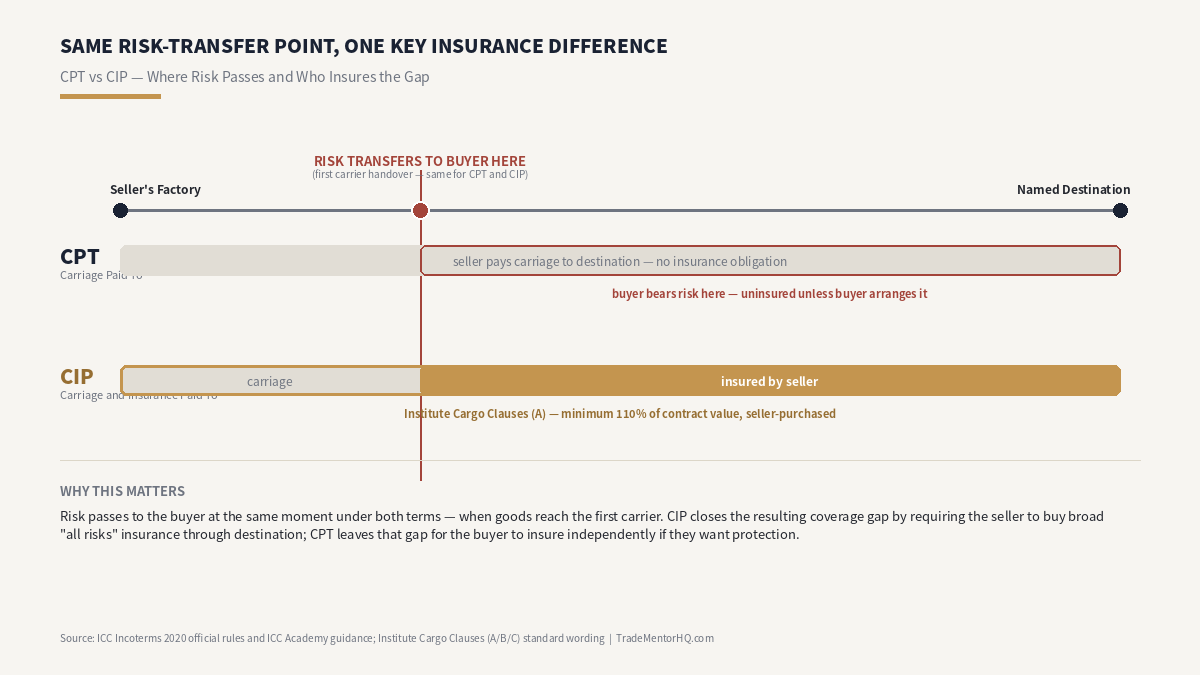
CPT vs CIP incoterms confusion trips up even experienced shippers, since both terms transfer risk at the same point in the journey but differ in one critical way: who pays for insurance.
CPT and CIP get lumped in with FOB and CIF so often that traders assume the same logic applies — pick the “C” term with insurance if you want coverage, skip it if you don’t. That shortcut breaks down here, because CPT and CIP are multimodal terms with an identical risk-transfer point, and the only real difference between them is a single, specific insurance obligation.
Where Risk Actually Transfers (Same for Both)
Under Incoterms 2020, CPT (Carriage Paid To) and CIP (Carriage and Insurance Paid To) both transfer risk from seller to buyer at the same point: when the goods are handed over to the first carrier engaged by the seller, not at the final destination named in the contract. This surprises traders used to thinking “paid to [destination]” means the seller bears risk all the way there — it doesn’t. The seller pays the carriage costs to the named destination, but the risk of loss or damage passes to the buyer far earlier, at that first handover.
This is the same split-point structure as CFR and CIF (cost/carriage obligation runs to destination, risk transfers earlier) — the difference is that CPT/CIP are usable for any mode of transport, including multimodal and containerized shipments, while CFR/CIP are restricted to sea and inland waterway transport.
The One Real Difference: Who Insures the Gap
Because risk transfers to the buyer well before the goods arrive, there’s a real exposure gap — the buyer owns the risk for a leg of the journey they’re not physically managing. CIP closes that gap by obligating the seller to purchase cargo insurance covering that transit, and Incoterms 2020 raised the bar significantly from the 2010 rules: CIP now requires Institute Cargo Clauses (A) coverage (or equivalent), the broadest “all risks” tier, at a minimum of 110% of the contract value — up from the minimal Clause C coverage CIP required under Incoterms 2010.
CPT carries no such requirement; the seller arranges carriage but not insurance, leaving the buyer to independently arrange coverage for the transit if they want protection during the leg where they already bear the risk.
Why the Coverage Level Matters
The Institute Cargo Clauses (A) requirement under CIP is meaningfully more protective than what most traders assume a shipping term implies. Clause C only covers a short list of major casualties (fire, vessel sinking, collision); Clause A covers essentially all risks of physical loss or damage except a narrow list of specific exclusions (inherent vice, war, and similar).
Combined with the 110% valuation — covering not just the goods’ invoice value but an additional 10% buffer for anticipated profit or incidental costs — CIP is designed to leave the buyer close to financially whole if the shipment is lost or damaged in transit, even though the buyer technically owns the risk from the first-carrier handover onward. CPT buyers who assume their contract offers similar protection, without independently arranging insurance, are exposed for the entire transit with no seller-provided safety net.
A Concrete Illustration
A buyer sources machinery parts under CPT terms and doesn’t arrange separate cargo insurance, assuming “paid to” coverage extends the whole way. The truck carrying the parts is damaged in an accident after leaving the seller’s factory — since risk transferred at that first handover, the buyer bears the loss, and with no insurance in place, the buyer absorbs the full cost.
Compare the same scenario under CIP: the seller was obligated to purchase Institute Cargo Clauses (A) coverage at 110% of contract value before shipment, so even though risk transferred at the identical point, the buyer (as the insured party, since CIP policies are typically assignable to the buyer) can file a claim and recover the loss. Same risk-transfer point, dramatically different financial outcome, entirely because of the insurance clause.
The Bottom Line
CPT and CIP aren’t a “basic version vs. insured version” of the same term in the way traders sometimes assume from CFR/CIF — they share an identical risk-transfer point, and the entire practical difference is whether the seller is contractually required to buy Institute Cargo Clauses (A) insurance at 110% of contract value. A buyer under CPT terms who wants that same protection has to arrange it themselves.
Source: ICC Incoterms 2020 official rules and ICC Academy guidance on CPT and CIP; Institute Cargo Clauses (A/B/C) industry standard wording.
The practical difference between CPT and CIP often gets lost in the textbook definitions: under CIP, the seller isn’t just required to buy insurance — since the 2020 Incoterms revision, they must purchase coverage at Institute Cargo Clauses (A) level, which is all-risk coverage at a minimum of 110% of the invoice value.
Under CPT, the seller has zero insurance obligation, so if goods are damaged in transit, the buyer is left arranging their own claim unless they proactively bought coverage themselves. This is why CIP tends to show up more in buyer-favorable contracts for higher-value or fragile goods, while CPT is more common for bulk or lower-risk cargo where the extra premium isn’t worth it.
Related Reading
- Incoterms 2020 Explained: A Practical Guide for Importers and Exporters
- FOB vs CIF: The Most Commonly Confused Incoterms, Explained with Examples
Written by the TradeMentorHQ editorial team. We research primary sources — the official ICC Incoterms 2020 rules and ICC Academy guidance — before every article, and we’re upfront about how the site is produced on our About page. Spotted something that needs a correction? Let us know.
The core CPT vs CIP incoterms distinction
CPT (Carriage Paid To) and CIP (Carriage and Insurance Paid To) are nearly identical Incoterms, and understanding CPT vs CIP incoterms correctly comes down to a single difference: CIP requires the seller to purchase cargo insurance covering the goods during transit, while CPT does not. Under both terms, the seller arranges and pays for carriage to the named destination, and risk transfers to the buyer once the goods are handed to the first carrier — but only CIP guarantees that insurance is already in place at that handoff point.
This CPT vs CIP incoterms distinction matters enormously for buyers who may not realize they are responsible for arranging their own cargo insurance under CPT. A buyer who assumes “carriage paid” also means “insured,” without checking whether the contract specifies CPT or CIP, can discover only after a loss that no insurance was ever in place covering the shipment during its most vulnerable leg — international ocean or air transit.
Why Incoterms 2020 upgraded CIP’s insurance requirement
The 2020 revision of the Incoterms rules specifically increased the minimum insurance coverage level required under CIP from Institute Cargo Clauses (C), a fairly limited named-perils policy, to Institute Cargo Clauses (A), a broader all-risk policy — a change that widened the practical difference in the CPT vs CIP incoterms comparison. This means a CIP shipment today comes with meaningfully better insurance protection than it did under the 2010 rules, while CPT still carries no insurance obligation on the seller at all, leaving that decision entirely to the buyer.
When to choose CPT vs CIP incoterms for a shipment
Buyers with their own existing cargo insurance program, or those who prefer to control their own coverage terms and insurer relationship, often prefer CPT, since it avoids paying for insurance embedded in the seller’s price that may not match their preferred coverage level. Buyers without an existing insurance arrangement, or those shipping high-value or fragile goods for the first time, generally benefit more from CIP, since the CPT vs CIP incoterms choice in that case guarantees a baseline of protection is already purchased and in place without the buyer needing to arrange it separately.
How CPT vs CIP incoterms relate to CFR and CIF
Shippers frequently confuse the CPT vs CIP incoterms pair with the similarly structured CFR (Cost and Freight) and CIF (Cost, Insurance, and Freight) terms, and the confusion is understandable since both pairs follow the same “with insurance” versus “without insurance” pattern. The key difference is that CFR and CIF apply only to sea and inland waterway transport, while CPT and CIP apply to any mode of transport, including multimodal shipments involving trucking, rail, and air alongside ocean freight.
Getting the CPT vs CIP incoterms choice right for a non-ocean or multimodal shipment matters because CFR and CIF are simply the wrong term to use in that context, regardless of insurance preferences.
Another point of confusion in the CPT vs CIP incoterms discussion is exactly where risk transfers. Under both terms, risk passes to the buyer once goods are delivered to the first carrier at origin, not when they arrive at the destination — a detail that surprises buyers who assume “carriage paid to” a destination means the seller bears risk the entire way there. Understanding this risk transfer point is just as important as understanding the insurance difference when negotiating which Incoterm to use in a sales contract.
Negotiating CPT vs CIP incoterms in a sales contract
Because the CPT vs CIP incoterms choice affects who pays for insurance and at what coverage level, it is worth negotiating explicitly rather than defaulting to whichever term a supplier’s standard contract template happens to use. Buyers should ask sellers proposing CPT terms whether they are willing to upgrade to CIP for a modest price adjustment, since the cost difference is often smaller than buyers expect relative to the protection gained, particularly for higher-value or fragile cargo making a long international journey.
Common mistakes with CPT vs CIP incoterms
The most common mistake is assuming that “carriage paid” automatically includes insurance, which is only true under CIP and never true under CPT. Another common mistake is assuming CIP’s insurance coverage is comprehensive enough that no additional cargo insurance is needed, when in practice the Incoterms-mandated minimum coverage under CIP may still fall short of a buyer’s actual risk exposure for high-value goods, making supplemental cargo insurance worth considering even when CIP terms are already in place.
CPT vs CIP incoterms and customs documentation
Beyond insurance, the CPT vs CIP incoterms choice can affect how customs authorities and banks treat the shipment’s paperwork, since a letter of credit or customs declaration sometimes references the specific Incoterm used to determine what documentation is required. A bank processing a letter of credit tied to a CIP shipment will typically expect to see the insurance certificate as one of the required documents, while a CPT shipment’s documentation set will not include this requirement unless the buyer separately arranged and documented their own coverage.
Getting the CPT vs CIP incoterms designation right on the commercial invoice and bill of lading avoids a documentation mismatch that can delay a letter of credit payment or customs clearance.
How freight forwarders handle CPT vs CIP incoterms shipments
Freight forwarders arranging a CPT vs CIP incoterms shipment need clear instructions on which term applies, since the operational steps differ: a CIP shipment requires the forwarder or seller to arrange and pay for a cargo insurance policy meeting the Incoterms 2020 minimum, while a CPT shipment does not involve the forwarder in insurance at all unless the buyer separately requests it as an added service. Miscommunicating the CPT vs CIP incoterms choice to a forwarder can result in a shipment moving without insurance that the buyer assumed was already arranged, which is one of the more common and costly breakdowns in international shipping communication.
Practical examples of CPT vs CIP incoterms in use
A manufacturer shipping machine parts by truck and rail across several countries to a buyer with its own comprehensive cargo insurance program might reasonably use CPT, since the buyer’s existing coverage already protects the shipment and paying for redundant seller-arranged insurance under CIP would be an unnecessary added cost.
A small importer purchasing electronics for the first time from an overseas supplier, with no existing cargo insurance relationship of their own, is usually better served by CIP, since the CPT vs CIP incoterms choice in that case ensures a baseline of protection exists without the importer needing to independently research and arrange a policy before the first shipment ever leaves the factory.
How pricing differs between CPT vs CIP incoterms quotes
When a supplier quotes both CPT and CIP prices for the same shipment, the CIP quote will typically run a modest amount higher, reflecting the cost of the required insurance policy. Buyers comparing CPT vs CIP incoterms quotes side by side should confirm that the price difference actually reflects a reasonable insurance premium rather than an inflated markup disguised as an insurance cost, since some sellers use the insurance requirement as an opportunity to pad margin rather than simply passing through the actual policy cost. Requesting a copy of the insurance certificate or policy terms as part of a CIP quote helps buyers verify the coverage matches what was promised.
Buyers who negotiate CPT vs CIP incoterms terms as part of a larger, ongoing supplier relationship sometimes find it more efficient to standardize on one term across all shipments rather than negotiating it deal by deal, simplifying paperwork and reducing the chance that an important shipment slips through without adequate insurance because everyone assumed a previous deal’s terms carried over automatically.
Reviewing Incoterms choices as trade relationships evolve
A buyer’s ideal choice between CPT vs CIP incoterms today may not remain the right choice indefinitely. A growing importer who initially relied on CIP because they had no cargo insurance program of their own may eventually build a broader, more cost-effective insurance relationship and switch to CPT to avoid paying for coverage embedded in a supplier’s price. Revisiting this choice periodically, rather than defaulting permanently to whatever term was used in the very first contract with a given supplier, keeps shipping costs and protection aligned with how the business has actually grown.
The bottom line on CPT vs CIP incoterms
The CPT vs CIP incoterms decision ultimately comes down to a simple question: does the buyer already have adequate cargo insurance in place, or does the shipment need the seller to arrange it as part of the deal? Getting this answer right, and making sure both parties to a contract share the same understanding of which term applies and what it actually obligates each side to do, prevents the single most common and costly mistake in this area — a shipment moving without insurance that one party assumed the other had already arranged.
Building a habit of confirming this explicitly on every new supplier or buyer relationship, rather than assuming familiarity with one deal carries over to the next, is a small amount of diligence that protects against a genuinely expensive gap.
Keeping a short written note in the contract file for each supplier — which Incoterm applies, who arranges insurance, and what coverage level was confirmed — turns this from a recurring point of confusion into a quick reference that new team members can check without having to re-negotiate or re-clarify the same details every time a new shipment goes out. This kind of simple documentation habit costs almost nothing to maintain but consistently prevents the exact kind of misunderstanding that leads to an uninsured loss.
For teams handling a growing number of international suppliers, building this into a simple shared spreadsheet or procurement checklist — rather than relying on individual memory or scattered email threads — makes the practice scale naturally as the business adds new trade partners over time.
Trade compliance teams that manage this well often build a short onboarding note into every new supplier or customer agreement specifically addressing which Incoterm governs the shipment and what that means for insurance responsibility. This single paragraph, agreed to in writing before the first shipment moves, removes almost all of the ambiguity that otherwise leads to disputes months later when a loss occurs and both sides discover they had different assumptions about who was covering the cargo.
Reviewing these agreements periodically, particularly after a company changes freight forwarders, insurers, or trade lanes, catches situations where an old assumption about CPT vs CIP incoterms responsibility no longer matches how the business currently operates, before a real shipment exposes the gap.

About the Author: TradeMentorHQ Team
The TradeMentorHQ team researches and writes practical, plain-language guides on Incoterms, customs clearance, trade finance, and shipping logistics for small business owners, first-time importers/exporters, and side-hustle sellers. Our articles are grounded in publicly available regulations and guidance from bodies like U.S. Customs and Border Protection (CBP), the International Chamber of Commerce (Incoterms 2020), and established industry practice, and we link to primary sources wherever a number or rule could change. We are not customs brokers, freight forwarders, or licensed trade attorneys, and nothing here is a substitute for advice from one on your specific shipment.