Short answer: Alibaba for beginners works best when you treat it like a vetting exercise first and a shopping trip second — verify the supplier, order a sample, and pay through Trade Assurance before you commit to a bulk order, and the scam risk drops dramatically.
Alibaba connects buyers to hundreds of thousands of manufacturers and trading companies in China and beyond, which is exactly why it’s both the cheapest way to source products for a side hustle and a platform where inexperienced buyers lose money to fake suppliers every year. The difference between the two outcomes almost always comes down to process, not luck.
This Alibaba for beginners guide walks through exactly how to buy wholesale on Alibaba as a first-timer: how to verify a supplier is real, what Trade Assurance actually protects, how samples and minimum order quantities work, which payment methods are safe, and the red flags that should make you walk away from a deal.
Verify the Supplier Before You Talk Price (Step One for Alibaba Beginners)
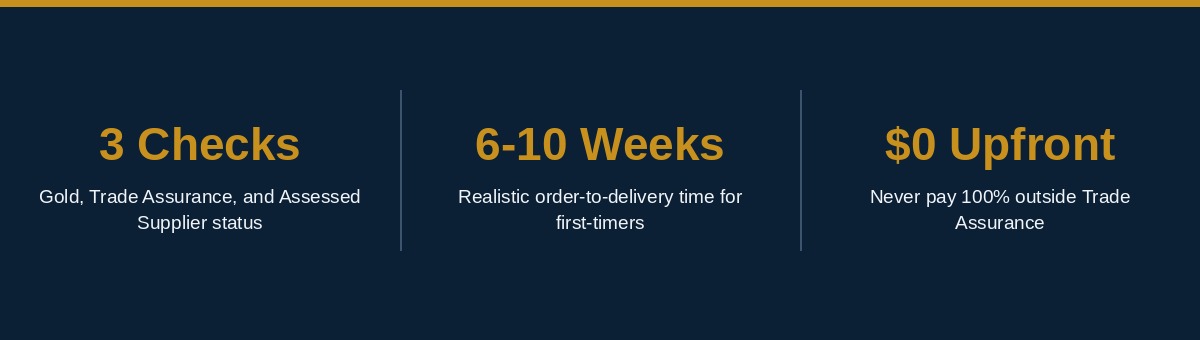
Before requesting a single quote, check for three signals on a supplier’s profile: Gold Supplier status (a paid, pre-qualified membership that filters out the lowest-effort accounts), Trade Assurance Supplier designation, and third-party Assessed Supplier verification. A supplier with all three isn’t guaranteed perfect, but the combination filters out the large majority of low-effort or fraudulent listings.
Also check how long the account has been active — Alibaba displays supplier tenure, and a business with one or two years of verified history and real transaction records is a meaningfully safer bet than a brand-new storefront, especially if you’re buying wholesale for the first time.
Use Trade Assurance on Every Order
Trade Assurance is Alibaba’s built-in payment protection: your money is held by Alibaba rather than sent directly to the supplier, and it’s only released once you confirm the order arrived as described. If there’s a dispute, you can request a refund within a window after delivery, and Alibaba mediates. Paying through Trade Assurance instead of a side deal is the single highest-leverage safety step for anyone new to Alibaba for beginners, because it turns “trust the stranger” into “trust the platform,” which is a much safer bet on a first order.
Always Order a Sample First
Never place a bulk order without a physical sample in hand. Samples cost more per unit than bulk pricing, but most suppliers apply the sample cost as a credit toward your first bulk order, so the real cost is usually small. A sample tells you what photos and specs can’t: real fabric weight, real stitching quality, real color accuracy, real packaging. If a supplier resists sending a sample or wants to skip straight to a large deposit, treat that as a serious red flag rather than a minor inconvenience.
Understand MOQs and How to Negotiate Them
Minimum order quantities on Alibaba typically start around 200 to 1,000 units depending on the product category, though some suppliers will negotiate a lower first order to win a new relationship.
Ask for pricing at two or three different volumes (for example 500, 1,000, and 5,000 units) so you can see how the per-unit cost changes, and always clarify whether a quote is FOB (the supplier covers cost to the port) or EXW (you cover everything from the factory door). Confusing the two is one of the most common beginner mistakes, since it can add hundreds or thousands of dollars in shipping and customs costs you didn’t budget for.
Pick a Safe Payment Method
Ranked from safest to riskiest: Alibaba Trade Assurance or verified escrow first, PayPal second (it adds its own buyer protection layer), a letter of credit third for larger orders, and wire transfer last, used only with a supplier you’ve already verified through a completed Trade Assurance order. Avoid Western Union and any request to pay a stranger’s personal account entirely — legitimate Alibaba suppliers don’t need you to bypass the platform’s payment system, and a request to do so is one of the clearest scam signals that exists.
Alibaba for Beginners: Red Flags That Mean Walk Away
Be cautious of a supplier who insists on 100% payment upfront outside Alibaba’s protected checkout, prices for branded goods that are far below what the brand itself charges wholesale, compliance certificates that look generic or can’t be verified, a request to suddenly change bank details mid-transaction, or an account that’s brand new with no transaction history. None of these alone is automatically a scam, but two or more together is reason enough to find a different supplier rather than hoping for the best.
Budget for Duties, Fees, and Inspection
Your landed cost is more than the unit price. Budget for customs duties (most shipments now owe some duty regardless of value), a merchandise processing fee, possible brokerage fees, and — for orders above a few hundred units — a third-party inspection service like QIMA to check the goods before they leave the factory. Skipping inspection to save a few hundred dollars is a common beginner mistake, since fixing a quality problem after goods have shipped is far more expensive than catching it beforehand.
Alibaba for Beginners: Frequently Asked Questions
Is Alibaba safe for beginners with a small budget?
Yes, as long as you stick to Trade Assurance suppliers and order samples first. Plenty of small sellers start with orders well under $1,000 by choosing suppliers with lower MOQs and building the relationship up over time.
How long does an Alibaba order actually take to arrive?
Production typically takes 15 to 30 days depending on the product and order size, and shipping adds another 1 to 2 weeks by air or 4 to 6 weeks by sea. First-time buyers should plan for 6 to 10 weeks total from order to delivery, not the 1-to-2-week timelines common on retail marketplaces.
Can I buy a small quantity on Alibaba, or is it wholesale only?
Many suppliers will accept smaller first orders, sometimes 50 to 100 units, specifically to build a track record with a new buyer, even if their listed MOQ is higher. It never hurts to message a supplier and ask directly.
What’s the difference between Alibaba and AliExpress for a beginner?
AliExpress is built for single-unit, retail-style purchases with no negotiation, while Alibaba is built for wholesale quantities with negotiable pricing, samples, and MOQs. If you just want one item to test, AliExpress is simpler; if you’re sourcing inventory to resell, Alibaba is the right platform.
Bottom Line
Alibaba for beginners doesn’t have to be risky, and most first orders go smoothly when you follow this process. Verify the supplier, pay through Trade Assurance, order a sample before committing to a bulk run, and budget honestly for duties and shipping on top of the unit price. Buyers who skip these steps to save a week of vetting are the ones who end up in Alibaba’s dispute resolution system — buyers who follow them typically have a boring, uneventful first order, which is exactly what you want when real money is on the line.
On the numbers — a detail every Alibaba for beginners guide should mention — the platform’s Trade Assurance program caps its protection at the order amount shown at checkout, so it’s only useful if you actually place and pay for the order through the platform rather than moving to off-platform wire transfers, which void the coverage entirely. A typical deposit structure for a new supplier relationship is around 30% down at order confirmation and the remaining 70% before shipment, though this is negotiable once you’ve built a track record with a supplier.
Sample orders are worth budgeting for separately — expect anywhere from $20 to $100+ per sample depending on the product, plus shipping, and treat that cost as quality-control insurance rather than a wasted expense if the sample reveals a problem before you commit to a full production run.
Related Reading
Dropshipping vs. Reselling: Which Side Hustle Fits Your Budget in 2026?
Amazon FBA for Beginners: Is Reselling Still Worth It in 2026?
eBay vs Poshmark vs Mercari: The Best Marketplaces for Reselling in 2026

About the Author: TradeMentorHQ Team
The TradeMentorHQ team researches and writes practical, plain-language guides on Incoterms, customs clearance, trade finance, and shipping logistics for small business owners, first-time importers/exporters, and side-hustle sellers. Our articles are grounded in publicly available regulations and guidance from bodies like U.S. Customs and Border Protection (CBP), the International Chamber of Commerce (Incoterms 2020), and established industry practice, and we link to primary sources wherever a number or rule could change. We are not customs brokers, freight forwarders, or licensed trade attorneys, and nothing here is a substitute for advice from one on your specific shipment.