
Short answer: retail arbitrage works when you buy deeply discounted items at thrift stores, clearance racks, and liquidation sales, then resell them where demand and prices are higher — and it stays profitable only if you track your real costs (fees, shipping, your own time) instead of just the price tag difference.
Retail arbitrage is the simplest side hustle to start because it needs no supplier relationships, no inventory minimums, and no importing knowledge — you’re buying items that already exist on a shelf near you and moving them somewhere they’re worth more. That simplicity is also why so many beginners lose money on it: without a system for checking resale value before you buy, “cheap” and “profitable” are not the same thing.
This guide walks through how retail arbitrage actually works, where experienced flippers source inventory, which apps do the profit math for you before you buy, a real numbers example from thrift rack to sold listing, the legal gray areas around branded goods, and what the 2026 tax rules mean for a reseller doing this on the side.
What Is Retail Arbitrage, Exactly?
Retail arbitrage means buying a product at a low retail price in one place and reselling it at a higher price somewhere else — usually on Amazon, eBay, or Poshmark — without ever manufacturing, importing, or wholesaling anything yourself. The “arbitrage” part is just the price gap between where you bought it and where you’re selling it.
It’s different from dropshipping, where you never touch the product, and different from wholesale buying, where you order dozens or hundreds of units from a manufacturer before you know if any of them will sell. In retail arbitrage, you’re usually buying one to a handful of a specific item, checking that it already has a track record of selling for more elsewhere, and only then handing over your money.
That upfront verification step is what separates a sustainable retail arbitrage side hustle from an expensive closet full of things nobody wants. Every experienced flipper’s first rule is the same: check the resale price before you buy, not after.
Where to Find Retail Arbitrage Deals
Thrift stores are the classic starting point because pricing is inconsistent by design — a $6,000 vintage instrument and a $4 mug can sit on the same shelf, priced by volunteers or staff who aren’t pricing against real-time online comps. That inconsistency is where the profit lives.
Beyond thrift stores, the same logic applies to clearance aisles at big-box retailers (especially seasonal clearance after a holiday), garage and estate sales, dollar stores carrying discontinued name-brand items, and liquidation pallets sold by companies that resell customer returns and overstock in bulk. Each source has a different risk-versus-effort trade-off.
Thrift stores reward patience and frequent visits, since inventory turns over daily and the best finds go fast. Clearance racks reward timing — showing up right after a seasonal markdown cycle. Liquidation pallets reward capital and risk tolerance, since you’re buying a mixed box sight-unseen and some items inside won’t sell at all.
The Apps That Do the Retail Arbitrage Profit Math for You
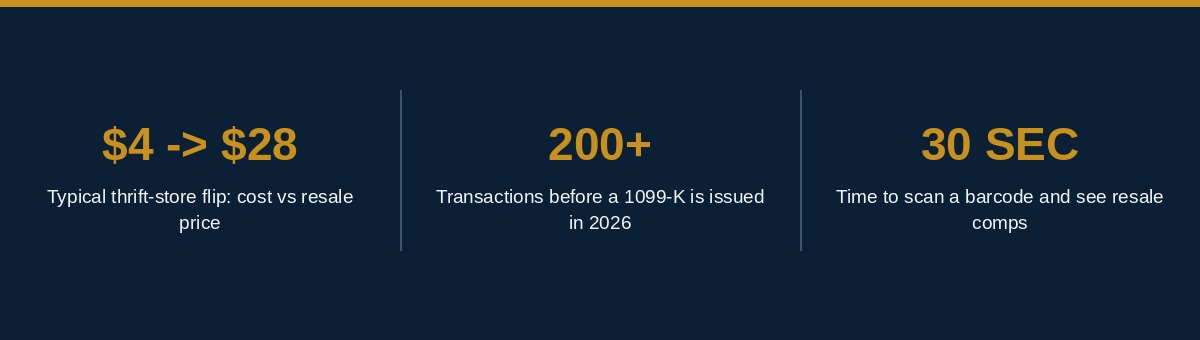
The single habit that separates profitable resellers from hobbyists who lose money is scanning before buying, not after. A handful of free or cheap apps make this a 30-second habit instead of a guessing game.
The Amazon Seller app is the free starting point — point your phone camera at a barcode in-store and it shows you the current Amazon sale price, how many other sellers are competing, and a rough sense of sales rank. ScoutIQ ($10–$44/month) adds offline lookups and is popular specifically with book and media resellers who need to scan fast in stores with weak cell signal. ProductChimp goes a step further and estimates your actual take-home profit after Amazon’s referral and fulfillment fees, not just the gap between purchase price and sale price — which matters because those fees routinely eat 30–40% of the sale price on smaller items.
None of these apps guarantee a sale — sales rank and current price only tell you an item has sold recently, not that yours will sell quickly at that price. Treat the app’s number as a ceiling estimate, not a promise.
A Real Retail Arbitrage Numbers Example
Here’s a simple, honest walkthrough rather than a best-case brag. Say you find a name-brand kitchen appliance at a thrift store for $8. A quick scan shows recent completed sales on eBay around $34 for the same model in similar condition.
Before buying, subtract the real costs: eBay’s final value fee (around 13% of the total sale, so roughly $4.42 on a $34 sale plus shipping), packaging materials (call it $2), and shipping if you’re covering it (say $9 for a mid-size item). That’s roughly $15.42 in costs against a $34 sale, leaving about $18.58 — minus your original $8 cost, for a real profit closer to $10.58, not the $26 gap the sticker prices suggested.
$10.58 is still a solid margin on an $8 item, but it’s less than half of what the raw price difference implied. This is the exact math beginners skip, and it’s why some resellers feel like they’re “always selling” but never seem to have much to show for it at tax time.
Where to Actually Sell What You Find
Where you list an item matters as much as what it is. Electronics, tools, and anything with a UPC barcode generally do best on Amazon or eBay, where buyers are actively searching by product name or model number. Clothing, shoes, and accessories tend to perform better on Poshmark and Mercari, where browsing and brand-specific search matter more than barcode lookups.
If you’re weighing which marketplace fits your specific items and shipping preferences, the comparison in eBay vs Poshmark vs Mercari breaks down fees and audience by category. Many experienced flippers list the same item type across two platforms simultaneously and let whichever sells first win, canceling the other listing.
The Legal Gray Zones: Branded Goods, Gating, and Counterfeits
Retail arbitrage is legal — reselling a product you legitimately own is protected under the first-sale doctrine in the United States. But two practical problems trip up beginners specifically on name-brand goods.
First, Amazon “gates” many brands and categories, meaning you need approval (often an invoice from an authorized distributor) before you’re allowed to list certain items, even ones you legitimately own. Buying a gated brand at a thrift store won’t get you approved to sell it, so check a brand’s gating status in Seller Central before you commit to buying multiples of it.
Second, counterfeits do circulate through secondhand channels, and unknowingly reselling a fake — even one you bought in good faith at a thrift store — can get an Amazon listing removed or a seller account flagged. When a name-brand item looks unusually pristine, lacks normal packaging or authentication features, or is priced far below what even a used one typically sells for, treat that as a reason to research the specific authentication markers for that brand before listing it.
Retail Arbitrage and Your Taxes: The 1099-K Reality for 2026
For the 2026 tax year, marketplaces are required to send you a Form 1099-K only if you cross both $20,000 in gross payments and 200 transactions on that platform — a threshold that was restored after a brief drop to $5,000 in 2024, giving part-time resellers real breathing room on paperwork.
That threshold is about reporting paperwork, not about whether the income is taxable. Every dollar of net profit from reselling is taxable income whether or not a platform sends you a form for it, and the IRS has separately clarified that selling personal items at a loss (the couch you sell for less than you paid) generally isn’t taxable income in the first place — but a retail arbitrage flip bought specifically to resell at a profit is a different category and should be tracked as such. Keep a simple log of what you paid, what you sold for, and your fees; it takes minutes per item and saves hours at tax time.
Common Retail Arbitrage Mistakes Beginners Make
The most common mistake is buying based on the price tag gap alone, without subtracting marketplace fees, shipping, and packaging — the exact trap in the numbers example above. The second is buying multiples of an item because it’s cheap, before confirming there’s actual sustained demand rather than one lucky recent sale.
The third is ignoring storage and holding time. An item that takes four months to sell ties up your cash and shelf space, quietly lowering your effective return even if the eventual sale price looks good on paper. Experienced flippers generally set a mental clock — if it hasn’t sold in a set window, they discount it rather than let it sit indefinitely.
How Much Should You Pay? A Quick Retail Arbitrage Rule of Thumb
A rough rule many resellers use: don’t pay more than 25–30% of the realistic resale price for an item, before you’ve even factored in fees and shipping. On the $34 eBay example above, that puts a sensible ceiling around $8.50–$10.20 — which happens to line up closely with the $8 actually paid.
This rule isn’t a guarantee of profit; it’s a fast filter for deciding whether an item is even worth pulling out your phone to double-check. If a thrift-store price tag is already above 30% of what you believe the resale value is, it’s rarely worth the time to research further — move on to the next shelf.
The rule gets more conservative the slower or more competitive a category is. Fast-turning categories like current electronics can tolerate paying closer to 35–40% of resale value, since the holding period is short. Slower categories — bulky furniture, seasonal decor out of season, niche collectibles with a thin buyer pool — deserve a stricter ceiling, closer to 20%, because the cost of an item sitting unsold for months is real even if it isn’t a line item on a receipt.
Turning Retail Arbitrage Into a Repeatable Side Hustle
A single profitable flip is luck. A repeatable retail arbitrage side hustle comes from routine: the same few thrift stores visited on a consistent schedule (many rotate new stock on specific days), a simple spreadsheet or notebook tracking cost, sale price, and fees per item, and a personal ceiling rule like the one above applied consistently instead of case-by-case.
Most people who stick with retail arbitrage for more than a few months eventually specialize — narrowing down to a category they understand well, whether that’s vintage electronics, name-brand kids’ clothing, or kitchen tools. Specializing means faster in-store decisions (you already know what sells and roughly for how much without scanning everything) and better negotiating instincts at estate sales and liquidation events.
It’s also worth deciding upfront how big you want this to get. Retail arbitrage scales reasonably well up to a part-time income, but at higher volumes many resellers eventually shift some inventory toward Amazon FBA so a warehouse — not their own garage — handles storage and shipping. That’s a different cost structure worth understanding before you scale past what fits in a spare room.
A pricing habit that separates profitable retail arbitrage from a garage full of unsold inventory: before buying anything to flip, check eBay’s sold listings (filter by “Sold” in the search sidebar, not active listings, which only show asking price) for that exact item in similar condition.
Active listings routinely run 30–50% higher than what things actually sell for. A $4 thrift-store item with a $60 active listing but only $18–22 in actual sold comps is a real $14–18 profit item after eBay’s roughly 13% final value fee and shipping — solid, but nowhere near the $56 the active listing implied.
Related Reading
eBay vs Poshmark vs Mercari: The Best Marketplaces for Reselling in 2026
Dropshipping vs. Reselling: Which Side Hustle Fits Your Budget in 2026?
Amazon FBA for Beginners: Is Reselling Still Worth It in 2026?

About the Author: TradeMentorHQ Team
The TradeMentorHQ team researches and writes practical, plain-language guides on Incoterms, customs clearance, trade finance, and shipping logistics for small business owners, first-time importers/exporters, and side-hustle sellers. Our articles are grounded in publicly available regulations and guidance from bodies like U.S. Customs and Border Protection (CBP), the International Chamber of Commerce (Incoterms 2020), and established industry practice, and we link to primary sources wherever a number or rule could change. We are not customs brokers, freight forwarders, or licensed trade attorneys, and nothing here is a substitute for advice from one on your specific shipment.