
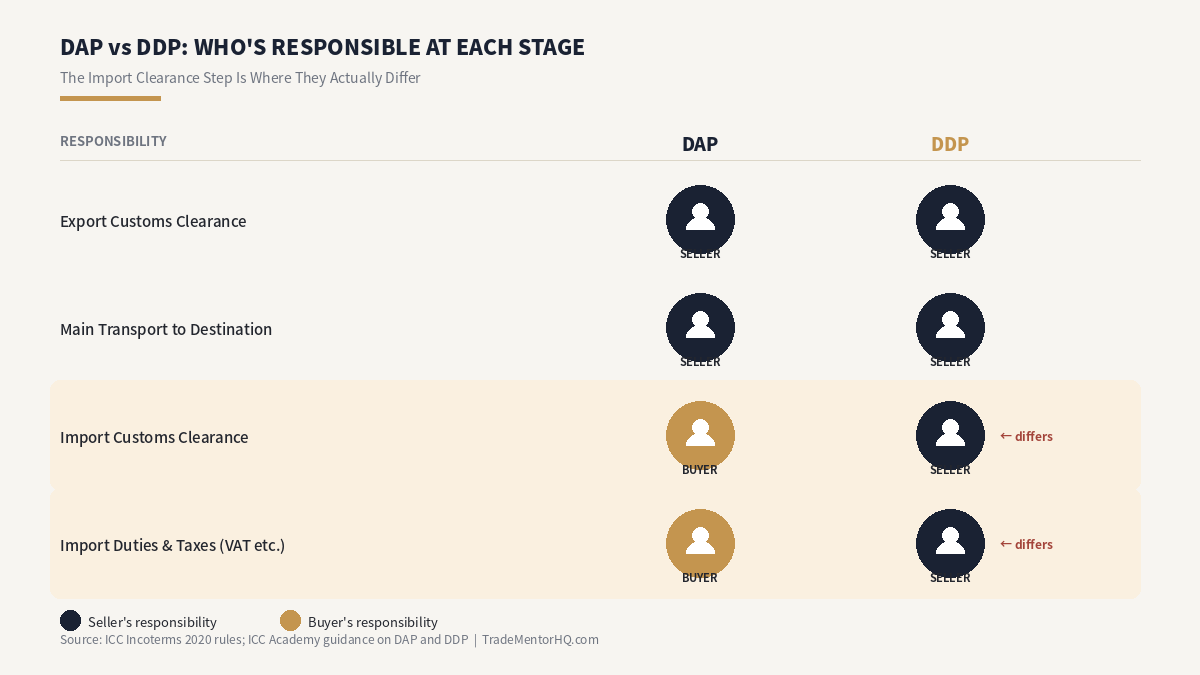
Getting DDP vs DAP right in a sales contract determines exactly who pays import duty and who bears customs risk at the border, and confusing the two can leave one party stuck with an unexpected bill they never budgeted for.
DDP and DAP get confused constantly because they look almost identical on paper — both are “delivered” terms where the seller takes the goods most or all of the way to the buyer’s door. The difference that actually matters is buried in what happens at the border. Under DAP, the buyer clears customs and pays all import duties and taxes in their own country; under DDP, the seller does — and that one difference shifts a meaningful amount of cost, paperwork, and legal risk from one party to the other, which is exactly why picking the wrong one causes real problems.
What Each Term Actually Requires
Under an Incoterms 2020 EXW or FOB shipment, where responsibility shifts to the buyer much earlier in the journey. Under DAP, the seller delivers the goods to the named location, ready for unloading, but the buyer takes over from there: the buyer selects a customs broker, clears the goods through import customs, and pays all duties, taxes, and import fees. Under DDP, the seller goes one step further and handles that entire import process themselves — clearing customs in the buyer’s country, paying the import duties and VAT, and completing all customs formalities before the goods are ever handed over.
In both cases the seller typically isn’t required to unload the goods at destination unless the contract says otherwise; that’s a separate point some buyers assume is automatically included and shouldn’t.
Where Risk Actually Transfers
The risk transfer point differs too, and it tracks the same logic. Under DAP, risk passes from seller to buyer at the moment the goods arrive at the named place and are made available for unloading — the buyer then owns the risk of anything that goes wrong during customs clearance, even though that process hasn’t started yet. Under DDP, risk doesn’t transfer until the goods have actually cleared import customs and are delivered to the buyer, meaning the seller is carrying the risk through the entire customs process, not just the transport leg. That’s a longer risk window for the seller, on top of the extra cost and paperwork.
The Hidden Problem with DDP: Who Can Legally Be the Importer of Record
This is the part that trips up more shipments than anything else: DDP requires the seller to act as, or arrange, the importer of record in the buyer’s country — and that’s not just a paperwork formality. A properly executed DDP shipment generally requires the seller to have a registered legal entity or a licensed customs broker actually operating in the destination country, since the importer of record carries direct legal responsibility for accurate customs declarations, correct tariff classification, and full duty payment — a responsibility that can’t simply be handed off through a commercial contract. Large multinational sellers with local subsidiaries can genuinely do this.
Most small and mid-sized exporters can’t, which is exactly why some DDP shipments quietly route through shell companies that register as the importer of record, operate with minimal customs bonds, and sometimes dissolve before authorities catch up with the shortfall — leaving the actual buyer holding unexpected duty liability, since customs authorities can pursue the duty on the goods themselves rather than being limited to the party who nominally filed the entry. None of this means DDP is inherently fraudulent; it means DDP done properly requires real destination-country infrastructure, and a buyer accepting DDP terms should ask, specifically, who is filing the import entry and how.
A Concrete Illustration
A US buyer imports a container of goods from a supplier in Vietnam under DAP terms to a warehouse in Los Angeles. The supplier delivers the container to the port, and from that point the US buyer’s own customs broker files the entry, pays the import duties and merchandise processing fee, and arranges final delivery — costs and risk the buyer had already budgeted for.
Compare that to the same shipment under DDP: the Vietnamese supplier is now on the hook for filing a US customs entry, which in practice usually means routing it through a US-based customs broker or trading company acting as importer of record on the supplier’s behalf. If that arrangement is legitimate and well-documented, DDP genuinely simplifies life for the buyer, who receives a landed, duty-paid shipment with nothing further to file. S. Customs and Border Protection regardless of what the sales contract said about who was supposed to pay it.
How to Actually Decide Between Them
DAP tends to make sense when the buyer already has an established, reliable customs broker relationship in their own country and would rather control the import process and cost directly — which is the norm for experienced importers. DDP tends to make sense for a buyer who has no import infrastructure at all and genuinely wants a landed, all-in price with nothing left to manage — common in e-commerce and first-time buyers — but only when the seller can demonstrate real, verifiable capacity to act as importer of record, not just a willingness to quote DDP pricing. The same logic applies to choosing between other confusable Incoterms pairs like FOB and CIF.
The Bottom Line
DAP and DDP both get goods to the buyer’s door, but they split the customs and duty responsibility at opposite ends: DAP leaves import clearance and duty payment with the buyer, DDP puts it on the seller. The cost difference is usually straightforward to negotiate into the price either way — the risk difference is the part worth scrutinizing, particularly on the DDP side, where “who is legally the importer of record” is a question every buyer should be able to answer before agreeing to the term.
Source: International Chamber of Commerce (ICC) Incoterms 2020 rules; ICC Academy guidance on DAP and DDP; industry analysis of importer-of-record risk under DDP terms.
What DDP vs DAP actually means
Under DDP (Delivered Duty Paid), the seller takes on maximum responsibility: export clearance, main transport, import clearance, and payment of import duty and taxes, delivering the goods ready for the buyer to simply unload. Under DAP (Delivered at Place), the seller handles export clearance and transport to the named destination, but the buyer takes over from there — handling import clearance and paying any duty themselves. This single difference in who pays import duty is the core of the DDP vs DAP comparison.
Because DDP vs DAP shift duty and import clearance responsibility so differently, sellers who default to one term out of habit without checking the buyer’s expectations often create friction at the worst possible moment — when the shipment is already sitting at the destination country’s border waiting for customs clearance and duty payment.
Why DDP vs DAP confuses so many shippers
DDP vs DAP look nearly identical in their names and both fall under the “Delivered” family of Incoterms, which is exactly why they get mixed up so often. The seller in both cases is responsible for delivering the goods to a named place in the buyer’s country — the entire distinction hinges on the smaller detail of who clears import customs and pays duty once the goods arrive.
This is a meaningful enough difference that DDP vs DAP mistakes in a sales contract can result in a shipment stuck at customs with neither party having budgeted for the duty payment, delaying delivery and sometimes triggering storage fees while the confusion gets sorted out.
When to use DDP over DAP
DDP makes sense within the DDP vs DAP decision when the seller wants to offer the buyer the simplest possible experience — a landed, duty-paid delivery with no customs surprises for the buyer at all. E-commerce sellers shipping direct-to-consumer internationally frequently choose DDP specifically because it removes the risk of a customer being hit with an unexpected duty bill on delivery, which can damage the buying experience badly.
The tradeoff in the DDP vs DAP comparison is that DDP requires the seller to have import clearance capability, or a customs broker relationship, in the buyer’s country — something not every seller has readily available, particularly for occasional or one-off shipments to unfamiliar markets.
When to use DAP over DDP
DAP fits the DDP vs DAP decision better when the buyer already has established import processes and prefers to handle customs clearance and duty payment themselves, or when the seller lacks the local import infrastructure that DDP requires. Many B2B transactions default to DAP for exactly this reason — the buyer, as the party actually operating in the destination country, is often better positioned to manage that country’s customs process.
Choosing DAP within the DDP vs DAP decision also shields the seller from unexpected duty rate changes or customs delays in the destination country, since those risks now sit with the buyer rather than being absorbed as part of a DDP delivery commitment.
Cost implications of DDP vs DAP
Sellers offering DDP typically build the estimated duty and customs brokerage cost into the quoted price, which means the DDP vs DAP price comparison is not truly apples-to-apples unless the buyer accounts for the duty they would otherwise pay separately under DAP. A DAP quote that looks cheaper on paper may end up costing the buyer more once their own import duty and clearance fees are added.
Because duty rates and customs brokerage costs vary by country and product, sellers offering DDP across multiple destination markets need accurate, current data for each market to price DDP vs DAP quotes correctly — underestimating duty on a DDP quote turns a profitable sale into a loss once the actual customs bill arrives.
Put numbers on it: a seller quotes a $10,000 shipment DDP to a buyer in a market with an 8% duty rate and a flat $150 customs brokerage fee. If the seller’s estimate is even slightly off — say they price for a 6% duty rate because that’s what an earlier shipment in a different product category incurred — the shipment arrives with an $800 duty bill instead of the $600 budgeted, wiping out most of the margin on what looked like a straightforward sale.
A DAP quote for the same shipment might look $950 cheaper on paper, but once the buyer’s own $800 duty and $150 brokerage fee are added back in, the two options land within $100 of each other — the real comparison a spreadsheet-only price check misses.
Common mistakes with DDP vs DAP in contracts
The most frequent mistake is using DDP vs DAP interchangeably in casual conversation with a counterparty, then formalizing whichever term was assumed without confirming it matches what was actually discussed. A sales contract should state the chosen incoterm explicitly and specify the named place of delivery, since ambiguity here creates exactly the kind of dispute DDP vs DAP confusion is known for.
Another common mistake is a seller agreeing to DDP terms without verifying they can actually clear customs in the buyer’s country — some jurisdictions restrict import clearance to local entities, making a straightforward DDP commitment from a foreign seller legally impossible without a local customs representative, a detail easy to miss until the shipment is already in transit.
Insurance and risk transfer under each term
Risk transfer timing is similar between DDP and DAP — in both, risk generally passes to the buyer once the goods are made available at the named destination, before unloading. The DDP vs DAP distinction is specifically about customs and duty responsibility, not about when risk of loss or damage transfers, which is a common point of confusion since people assume the two questions are the same.
Cargo insurance arrangements should reflect this clearly regardless of which side of DDP vs DAP is chosen, with both parties confirming who insures the goods for which leg of the journey, since Incoterms define cost and customs responsibility but do not themselves mandate insurance coverage.
Frequently asked questions about DDP vs DAP
Which term is more common in e-commerce? DDP is increasingly common for direct-to-consumer international e-commerce, since it avoids surprise duty bills for individual customers who are unfamiliar with import processes.
Does DDP mean the seller pays duty at a discounted rate? No — the seller pays the same duty rate the buyer would have paid under DAP; DDP just shifts who is responsible for calculating and remitting it.
Can a seller offer DDP without a local entity in the destination country? Sometimes, using a customs broker with import authority, but some countries restrict this, making local representation necessary for a seller to genuinely offer DDP terms.
How to negotiate DDP vs DAP with a new counterparty
When negotiating DDP vs DAP with a new buyer or seller, start by asking directly which party has existing import clearance capability and experience in the destination country — this practical question often resolves the choice faster than a theoretical discussion of the Incoterms rules themselves. A seller with no import infrastructure in a given market should generally propose DAP rather than committing to DDP terms it cannot reliably fulfill.
It also helps to get a duty and customs brokerage cost estimate before finalizing DDP vs DAP terms, since an inaccurate estimate on either side can turn a seemingly straightforward agreement into a costly surprise once the actual customs bill arrives. Many freight forwarders can provide this estimate as part of a standard shipping quote.
How DDP vs DAP fits into a broader Incoterms strategy
DDP and DAP sit at the far end of the Incoterms spectrum in terms of seller responsibility — DDP is the most seller-responsible term of all eleven Incoterms 2020 rules, while DAP is only slightly less so. Businesses building an overall Incoterms strategy across multiple markets should decide their default posture on DDP vs DAP based on how much control and customer-experience consistency they want versus how much operational complexity they can support in each destination market.
Larger exporters with established logistics infrastructure across many countries can often support DDP broadly, standardizing the buyer experience globally. Smaller exporters may need to default to DAP in markets where they lack local import capability, reserving DDP only for markets where they have already built the necessary customs relationships.
Sample contract language for DDP vs DAP
Contracts should state the chosen incoterm clearly, for example: “Delivery under these terms is DDP (Delivered Duty Paid), Incoterms 2020, [named place]” or the DAP equivalent, along with the specific named place of delivery. Vague language like “delivered, duty included” without referencing DDP vs DAP and the applicable Incoterms edition invites exactly the kind of dispute these standardized terms exist to prevent.
Whichever side of DDP vs DAP a business defaults to, revisiting that default periodically as the company expands into new markets, builds new customs relationships, or gains more experience with a particular destination country keeps the choice aligned with actual operational capability rather than an outdated assumption carried over from an earlier stage of the business.
Final checklist before signing
Before finalizing any contract, confirm the exact DDP vs DAP term chosen, the named place of delivery, who holds cargo insurance for each leg, and whether the seller has verified import clearance capability if DDP is chosen. Running through this short checklist takes only a few minutes but prevents the vast majority of disputes that arise from Incoterms confusion later in the shipment process.
For the official Incoterms 2020 rules, see the ICC’s Incoterms resources. For more delivery terms comparisons, see our TradeMentorHQ homepage.
Getting the Responsibility Split Right
Choosing correctly between DDP vs DAP comes down to who is better positioned to handle destination-country customs clearance and who should bear duty cost risk. Confirm the choice explicitly in every contract, verify the seller can actually deliver on a DDP commitment before agreeing to it, and make sure both parties understand that DDP vs DAP is fundamentally a customs and duty question, separate from risk transfer or insurance.
Related Reading
- Incoterms 2020 Explained: A Practical Guide for Importers and Exporters
- FOB vs CIF: The Most Commonly Confused Incoterms, Explained with Examples
Written by the TradeMentorHQ editorial team. We research primary sources — ICC Incoterms 2020 guidance and industry analysis of importer-of-record practices — before every article, and we’re upfront about how the site is produced on our About page. Spotted something that needs a correction? Let us know.

About the Author: TradeMentorHQ Team
The TradeMentorHQ team researches and writes practical, plain-language guides on Incoterms, customs clearance, trade finance, and shipping logistics for small business owners, first-time importers/exporters, and side-hustle sellers. Our articles are grounded in publicly available regulations and guidance from bodies like U.S. Customs and Border Protection (CBP), the International Chamber of Commerce (Incoterms 2020), and established industry practice, and we link to primary sources wherever a number or rule could change. We are not customs brokers, freight forwarders, or licensed trade attorneys, and nothing here is a substitute for advice from one on your specific shipment.