Choosing correctly between all risk vs named perils cargo insurance is one of the most consequential decisions a shipper makes, since the wrong choice can leave a genuinely damaging loss completely uncovered even though a premium was paid every month.
Cargo insurance quotes usually come with a clause letter attached — A, B, or C — and it’s tempting to treat that as fine print rather than the actual decision. It isn’t fine print. Institute Cargo Clause A (“All Risks”) covers any physical loss or damage unless the insurer can point to a specific exclusion, while Clauses B and C only pay out for a fixed list of named perils — meaning the same shipment can be covered or completely uninsured for the exact same incident depending on which clause was purchased.
How “All Risks” Coverage Actually Works
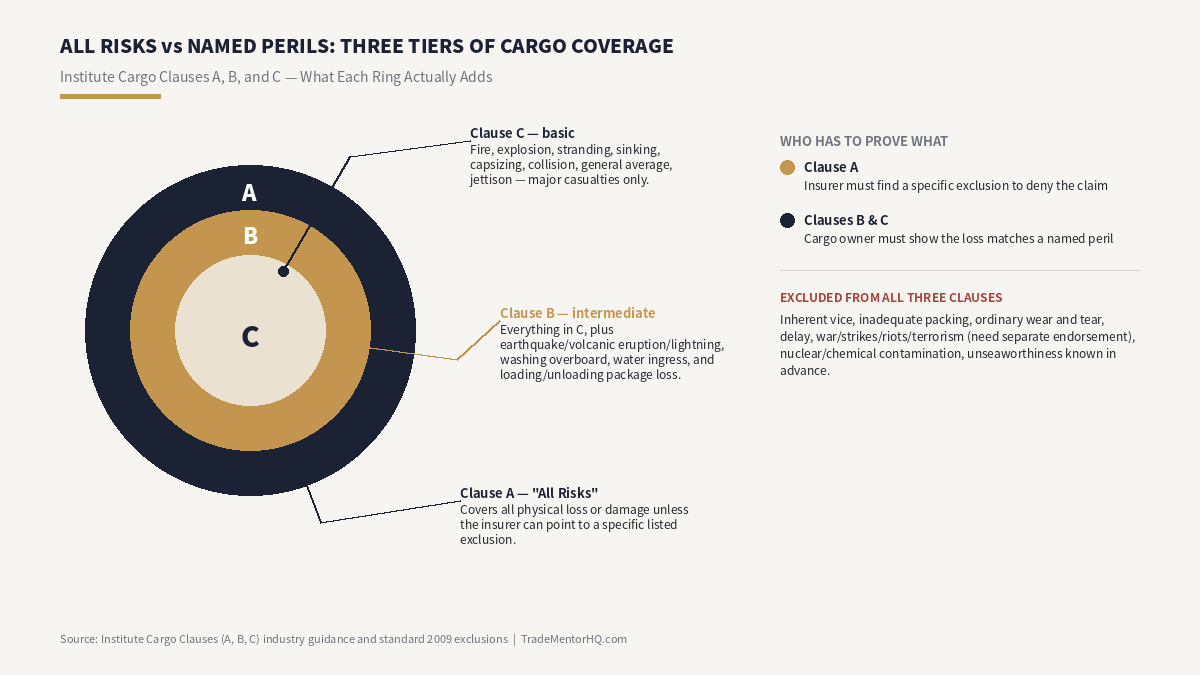
Institute Cargo Clause A is built around a burden-of-proof that favors the cargo owner: coverage applies to all physical loss or damage to the insured goods, and if the insurer wants to deny a claim, the insurer has to identify which specific policy exclusion applies — the cargo owner doesn’t have to prove which named peril caused the damage in the first place.
That structure matters most when a shipment arrives damaged in a way that’s hard to pin to one obvious cause, which is common with high-value, fragile, or easily pilferable goods (electronics, garments, machinery with delicate components) where rough handling, moisture, or partial theft can occur without leaving an obvious “named peril” fingerprint like fire or stranding.
How “Named Perils” Coverage Actually Works (Clauses B and C)
Clauses B and C flip that structure: coverage only applies to a specific enumerated list of events, and the burden is on the cargo owner to show the loss was caused by one of them. Clause C, the most restricted tier, covers only major casualty-type events — fire or explosion, the vessel stranding, grounding, sinking, or capsizing, overturning or derailment of land transport, collision with an external object, general average sacrifice, and deliberate jettison.
Clause B covers everything in Clause C plus four additional categories: earthquake, volcanic eruption, and lightning; cargo washed overboard by waves; water entering the vessel’s hold, container, or storage area; and total loss of a package dropped during loading or unloading. Both explicitly exclude the kind of everyday damage — rough handling short of a listed casualty, unexplained shortage, ordinary wetting without a qualifying water-ingress event — that Clause A would cover and Clauses B/C simply won’t pay for, regardless of how genuine the loss is.
What None of the Three Clauses Cover
It’s worth being clear that “All Risks” doesn’t mean all risks in the colloquial sense — Clause A carries the same universal exclusions as B and C. All three exclude intentional destruction and ordinary wear and tear, inadequate packing and inherent vice (the goods’ own natural tendency to deteriorate), loss caused by delay even if the delay itself followed a covered peril, insolvency of the vessel operator, nuclear/chemical/biological contamination, unseaworthiness the shipper knew about in advance, and cyberattacks.
War, strikes, riots, and terrorism are excluded from all three clauses by default and require separate war-risk and strikes endorsements layered on top — a detail that surprises shippers who assume “All Risks” already includes them.
A Concrete Illustration
A shipment of consumer electronics travels by container from Shenzhen to Rotterdam. On arrival, several units show water damage, but there’s no record of the vessel taking on seawater, no storm, no listed casualty event — the most likely explanation is condensation inside the container from temperature swings during the voyage, which doesn’t cleanly match any named peril. Under Clause C, this claim would likely be denied outright, since condensation damage isn’t stranding, fire, or any of the other listed events.
Under Clause B, it would probably still be denied, since “water ingress” under that clause typically refers to seawater or external water entering the hold or container, not internal condensation. Under Clause A, the cargo owner doesn’t need to prove which peril caused it at all — the insurer would need to show a specific exclusion applies (like inherent vice, if the goods were improperly prepared for humidity), and absent that, the claim is payable.
How to Actually Choose
The practical decision comes down to value density and fragility versus premium cost. High-value, fragile, or theft-prone cargo — electronics, pharmaceuticals, precision machinery — usually justifies Clause A’s higher premium, because the gap in what it covers versus B or C is exactly the kind of ambiguous, hard-to-prove damage that’s common with those goods.
Bulk commodities, raw materials, and cargo that’s cheap to replace relative to freight cost are often insured under Clause C, since the events it does cover (major casualties) are the realistic loss scenarios for that kind of cargo, and paying All Risks premiums for coverage against theft or handling damage that wouldn’t matter much financially is often not worth it. This connects directly to which marine cargo insurance policy to buy in the first place — it isn’t a single yes/no choice but a match between the cargo’s actual risk profile and the clause that covers it.
The Bottom Line
The clause letter on a cargo insurance policy determines who has to prove what after something goes wrong — under Clause A, the insurer has to find an exclusion; under Clauses B and C, the cargo owner has to prove a specific named peril occurred. For anything valuable, fragile, or prone to loss in ways that don’t fit neatly into “fire, sinking, or collision,” that difference in burden of proof is usually worth more than the premium gap between the tiers.
Source: Institute Cargo Clauses (A, B, C) as commonly summarized by marine insurance industry guidance; standard exclusions under Institute Cargo Clauses 2009.
What all risk vs named perils cargo insurance actually covers
All risk cargo insurance covers loss or damage from any cause except a short list of specific exclusions (usually war, inherent vice, and willful misconduct), while named perils cargo insurance only covers loss or damage caused by perils explicitly listed in the policy — fire, sinking, collision, and similar named events. Understanding all risk vs named perils cargo insurance starts with this inverted structure: one covers everything except exclusions, the other covers only what is specifically named.
This structural difference means that in an all risk vs named perils cargo insurance comparison, the burden of proof shifts depending on which policy you hold. Under all risk coverage, the insured generally just needs to show a loss occurred and that no exclusion applies. Under named perils coverage, the insured must affirmatively prove the loss was caused by one of the specifically listed perils — a materially higher bar when the cause of loss is unclear or disputed.
Institute Cargo Clauses A, B, and C explained
The Institute Cargo Clauses are the standard framework most insurers use to structure all risk vs named perils cargo insurance policies. Clause A is the broadest, functioning as true all-risk coverage. Clause B and Clause C are progressively narrower named-perils forms, with C covering only the most catastrophic named events like fire, explosion, and vessel sinking.
Shippers comparing all risk vs named perils cargo insurance quotes should always ask which Institute Cargo Clause underlies the quote, since “named perils” coverage sold under Clause C can be dramatically narrower than Clause B, even though both are technically named-perils policies.
When all risk coverage is worth the extra premium
All risk vs named perils cargo insurance pricing generally favors all risk being somewhat more expensive, but for high-value, fragile, or theft-prone cargo, the extra premium is usually worth it. Electronics, pharmaceuticals, and luxury goods are frequently damaged or lost in ways that would not be covered under a narrower named-perils policy — water damage from condensation, handling damage during transshipment, or partial pilferage rarely fit neatly into a named-perils list.
Shippers moving commoditized, low-value, or highly durable goods sometimes reasonably choose the named-perils side of the all risk vs named perils cargo insurance decision, since the premium savings can be significant and the goods themselves are less vulnerable to the kinds of ambiguous, hard-to-prove losses that all-risk coverage is best suited to protect against.
Common claims disputes in all risk vs named perils cargo insurance
The most frequent dispute under named perils cargo insurance is proving that a loss falls within a listed peril. If cargo arrives with unexplained moisture damage and the policy only names fire and collision, the insurer can and often will deny the claim, arguing the shipper failed to prove the loss falls under a covered cause. This is the single biggest practical risk in choosing the named perils side of all risk vs named perils cargo insurance.
All-risk policies are not entirely dispute-free either. Insurers still investigate whether an exclusion applies — inherent vice (the cargo’s own natural tendency to deteriorate) is a particularly common exclusion insurers invoke to deny claims even under all-risk coverage, so understanding all risk vs named perils cargo insurance exclusions matters just as much as understanding what is nominally covered.
How premiums and deductibles compare
Premium differences in all risk vs named perils cargo insurance typically run 10-30% higher for all-risk coverage on comparable cargo, though the exact spread depends heavily on the underwriter, trade lane, and cargo type. Deductibles also tend to be structured differently — named perils policies sometimes carry lower deductibles specifically because the insurer’s exposure is already narrowed by the limited list of covered causes.
When comparing all risk vs named perils cargo insurance quotes side by side, always normalize for deductible and sub-limits before concluding one option is meaningfully cheaper — a lower headline premium on a named-perils policy can be misleading if it comes with a much higher deductible or lower per-incident payout cap.
How to decide which coverage fits your shipments
Start the all risk vs named perils cargo insurance decision by cataloging your typical cargo types and loss history, if you have one. High claims frequency from causes that would fall outside a narrow named-perils list — handling damage, partial theft, condensation — is a strong signal that all-risk coverage will pay for itself over time.
For newer trade lanes or unfamiliar cargo types where loss patterns are unknown, defaulting to the broader side of all risk vs named perils cargo insurance is the more conservative choice until enough shipping history accumulates to justify the narrower, cheaper alternative with confidence.
Frequently asked questions about all risk vs named perils cargo insurance
Is all risk cargo insurance the same as no exclusions at all? No. All risk vs named perils cargo insurance still involves exclusions under the all-risk side — typically war, inherent vice, and willful misconduct — it just covers everything else rather than only a specific named list.
Can I switch between all risk and named perils mid-contract? Usually yes at renewal, though mid-term changes may require underwriter approval and a premium adjustment reflecting the new risk profile.
Which is more common for containerized ocean freight? All-risk coverage under Institute Cargo Clause A is the more common default for higher-value containerized shipments, while named perils coverage is more often seen on lower-value or bulk commodity cargo.
Does all risk cargo insurance cover theft? Generally yes, since theft is not typically among the standard exclusions, whereas a named-perils policy would only cover theft if it is explicitly listed as a covered peril.
Working with a marine cargo insurance broker
Because the practical difference between all risk vs named perils cargo insurance often comes down to policy wording rather than the label alone, working with a marine cargo insurance broker who reviews the actual clause language — not just the all-risk or named-perils marketing description — is one of the most reliable ways to avoid an unpleasant coverage surprise at claim time.
A good broker will also benchmark all risk vs named perils cargo insurance quotes from multiple underwriters, since coverage breadth and pricing can vary meaningfully even among policies nominally sold under the same Institute Cargo Clause.
Documenting cargo condition to support any claim
Regardless of which side of all risk vs named perils cargo insurance you choose, thorough documentation at the point of loading — photographs, packing lists, and a signed condition report — dramatically improves the odds of a smooth claim. Under named perils coverage especially, clear documentation of the cargo’s pre-shipment condition helps establish that damage occurred during transit rather than before loading, which strengthens the case that a listed peril was the actual cause.
Even under all-risk coverage, insurers scrutinize claims more closely when documentation is thin, since a well-documented loss makes it much easier to rule out exclusions like inherent vice or improper packing. Treating documentation discipline as part of the all risk vs named perils cargo insurance decision — not a separate afterthought — meaningfully improves claim outcomes either way.
How trade credit and cargo insurance interact
All risk vs named perils cargo insurance protects against physical loss or damage to the goods themselves, which is a distinct risk from buyer non-payment, covered instead by trade credit insurance. Exporters sometimes conflate the two, assuming a comprehensive all-risk cargo policy also protects against a buyer who simply refuses to pay for undamaged goods — it does not.
A complete risk management program typically layers both: cargo insurance under whichever side of the all risk vs named perils cargo insurance decision fits the shipment, plus separate credit insurance or letter-of-credit protection against buyer default, since these two risks are independent and require separate coverage to fully protect an export transaction.
Regional and underwriter variation to expect
Terminology and structure for all risk vs named perils cargo insurance can vary by market — some underwriters use different clause naming conventions outside the Institute Cargo Clauses framework entirely, particularly in certain Asian and Middle Eastern insurance markets. Always ask an underwriter to map their policy language to the familiar Institute Cargo Clause equivalent so you can compare apples to apples across quotes from different regions.
Because of this variation, the safest practice when evaluating all risk vs named perils cargo insurance across multiple underwriters is to request the full policy wording, not just a one-line summary, and have someone familiar with marine cargo insurance review the exclusions section specifically before binding coverage.
Ultimately, the all risk vs named perils cargo insurance decision is not one to make once and forget — revisit it whenever your product mix, trade lanes, or loss history changes meaningfully, since the coverage that made sense for last year’s shipments may no longer be the best fit for what you’re shipping today.
For background on Institute Cargo Clauses, see the ICC’s trade finance resources. For more cargo insurance comparisons, see our TradeMentorHQ homepage.
Matching Your Coverage to Your Actual Risk
There is no universally correct answer in the all risk vs named perils cargo insurance decision — it depends on cargo value, fragility, loss history, and how much premium savings actually matter relative to the coverage gap being accepted. For most first-time exporters shipping unfamiliar goods on unfamiliar lanes, all-risk coverage remains the safer starting point.
Whichever side of all risk vs named perils cargo insurance you choose, read the policy wording carefully, confirm the underlying Institute Cargo Clause, and understand the specific exclusions that apply — the policy’s actual text, not its marketing label, determines what is truly covered when a claim is filed.
On pricing, All Risk coverage typically runs around 0.3–0.5% of the cargo’s insured value, while Named Perils coverage is cheaper at roughly 0.15–0.3% — but that discount reflects real gaps in coverage, not just lower risk. Named Perils policies generally exclude things like rough handling, theft, or water damage from condensation unless those perils are specifically listed, whereas All Risk covers any physical loss or damage except for a short list of standard exclusions (war, inherent vice, willful misconduct).
For high-value or fragile cargo, the premium difference is usually small in absolute dollar terms compared to the cost of a single uncovered claim, which is why most freight forwarders default to recommending All Risk unless a shipper specifically asks to cut costs.
Related Reading
- Marine Cargo Insurance 101: What It Covers and What It Doesn’t
- Trade Credit Insurance Explained: Protecting Your Business from Buyer Default
Written by the TradeMentorHQ editorial team. We research primary sources — Institute Cargo Clauses guidance and marine insurance industry documentation — before every article, and we’re upfront about how the site is produced on our About page. Spotted something that needs a correction? Let us know.

About the Author: TradeMentorHQ Team
The TradeMentorHQ team researches and writes practical, plain-language guides on Incoterms, customs clearance, trade finance, and shipping logistics for small business owners, first-time importers/exporters, and side-hustle sellers. Our articles are grounded in publicly available regulations and guidance from bodies like U.S. Customs and Border Protection (CBP), the International Chamber of Commerce (Incoterms 2020), and established industry practice, and we link to primary sources wherever a number or rule could change. We are not customs brokers, freight forwarders, or licensed trade attorneys, and nothing here is a substitute for advice from one on your specific shipment.