
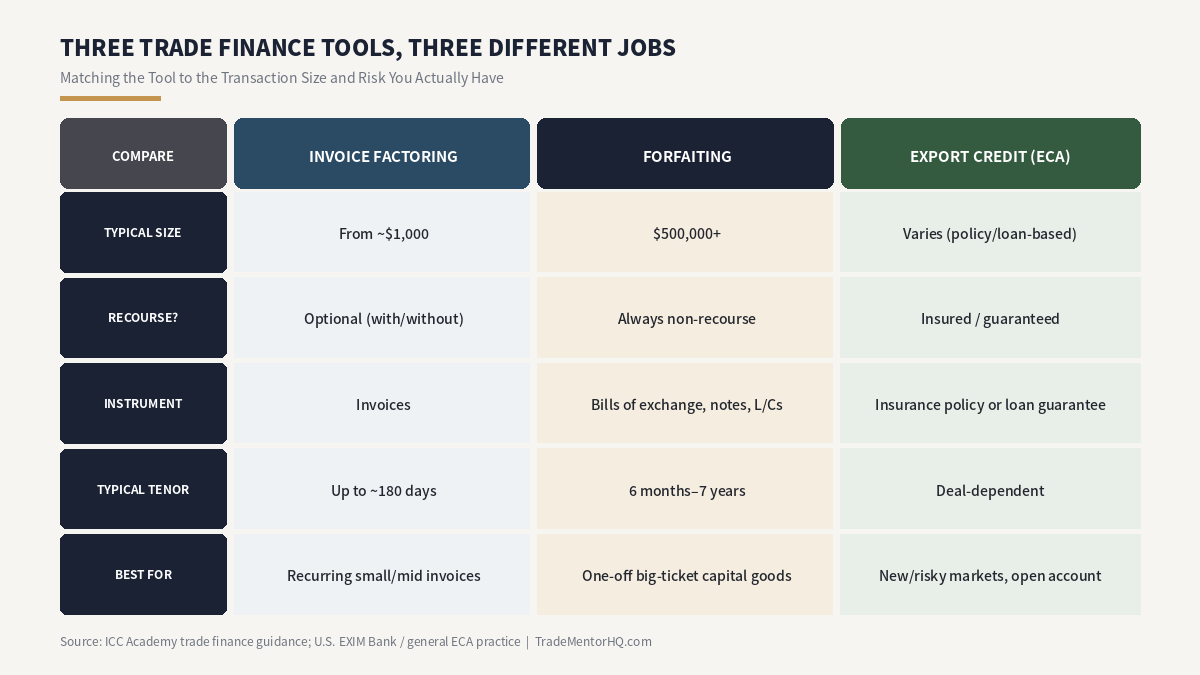
Trade finance explained in one line: it is the toolkit of financing instruments — invoice factoring, forfaiting, and export credit chief among them — that lets exporters get paid sooner and importers buy on better terms than a simple invoice would allow. This guide keeps trade finance explained in plain language, comparing invoice factoring, forfaiting, and export credit side by side so you can pick the right tool for a specific deal.
Exporters run into three financing tools that all promise the same basic thing — get paid sooner instead of waiting 30, 60, or 90 days for a buyer to settle an invoice — and the names get used almost interchangeably in casual conversation. They shouldn’t be. Invoice factoring, forfaiting, and export credit (through an export credit agency, or ECA) solve the same cash-flow problem at three completely different transaction sizes, risk levels, and time horizons, and picking the wrong one usually means paying too much for the wrong kind of protection.
Trade Finance Explained: What Invoice Factoring Actually Is
Factoring is the sale (or assignment) of your accounts receivable — the invoices your buyers already owe you — to a specialized finance company (a “factor”) in exchange for an immediate cash advance, typically 80-90% of the invoice’s face value. The factor collects from your buyer when the invoice matures and pays you the remaining balance, minus its fee. Factoring is built for recurring, relatively small invoices: a manufacturer or distributor with a steady stream of $5,000-$50,000 invoices going out every month is the textbook factoring client, and deals can start from as little as $1,000.
It can be structured with recourse (you’re on the hook if the buyer never pays) or without recourse (the factor eats that risk) — recourse factoring is cheaper, but only because you’re still holding the bag if the buyer defaults.
Trade Finance Explained: What Forfaiting Actually Is
Forfaiting looks similar on the surface — you’re still selling a future payment obligation for cash today — but it’s built for an entirely different scale of transaction. A forfaiter buys a negotiable financial instrument (a bill of exchange, promissory note, or a letter of credit’s deferred payment obligation) at a discount, and the deal is always non-recourse: once it’s done, you have zero exposure to the buyer’s credit risk, the buyer’s country’s political risk, or currency transfer risk.
That complete risk transfer is why forfaiting is reserved for large, one-off sales — think capital equipment, machinery, or infrastructure contracts — typically starting around $500,000 and running anywhere from six months to seven years, not the 180-day ceiling you see in factoring.
Trade Finance Explained: What Export Credit (via an ECA) Actually Is
, EXIM Bank; other countries run their own, and there are roughly 85 ECAs worldwide) that provides two distinct tools: export credit insurance, which protects you against buyer non-payment and political risk so you can safely offer open-account or extended terms instead of demanding cash in advance, and financing or loan guarantees, which help your buyer secure the funds to pay you, or help you access working capital to fulfill a large order.
ECAs exist largely to fill a gap private banks won’t cover — a buyer or country too risky for a commercial lender — and to keep exporters competitive against rivals whose own governments are subsidizing their export financing.
A Concrete Illustration
A furniture exporter shipping $20,000 worth of goods to a repeat retail buyer every month, on 60-day terms, is a factoring case — they sell the invoice, get roughly $17,000-$18,000 within a day or two, and keep production cash flowing without waiting two months per cycle. A machinery manufacturer selling a single $2 million production line to a buyer in an emerging market, payable over three years via a letter of credit, is a forfaiting case — the forfaiter buys that deferred payment instrument now, at a discount, and the manufacturer walks away with no further exposure to that buyer’s country risk for the next three years.
A mid-size exporter that wants to offer a new, politically unstable market open-account terms instead of requiring cash in advance — because a competitor backed by their own country’s ECA is already offering those terms — is an export-credit-insurance case: the ECA insures the receivable so the exporter can compete without absorbing the full risk of non-payment themselves.
How to Actually Choose Between Them
Match the tool to the transaction, not the other way around. If you’re managing a recurring stream of small-to-mid invoices from repeat buyers and the core problem is cash-flow timing, factoring is usually the fastest and cheapest fit. If you’re closing a single large capital-goods sale with extended payment terms and want the buyer’s risk off your books entirely, forfaiting is built for exactly that.
If your real problem isn’t a specific invoice but a broader need to safely offer credit terms to new or riskier markets — or you need financing support to fulfill a large order at all — that’s when an ECA’s insurance or guarantee programs are worth exploring, usually through your national export credit agency or a bank that works with one. our LC vs T/T comparison, the underlying payment method you’ve already agreed to with your buyer often determines which of these three tools is even available to you.
The Bottom Line
Invoice factoring, forfaiting, and export credit all convert a future payment into cash sooner, but they aren’t interchangeable — they’re built for different invoice sizes, different risk appetites, and different time horizons. Factoring handles the everyday cash-flow grind on small, recurring invoices; forfaiting takes the entire risk of a single large, long-term sale off your hands; and export credit through an ECA exists to make riskier markets and larger deals possible in the first place. Knowing which problem you actually have is most of the battle.
Source: ICC Academy trade finance guidance on factoring vs. forfaiting; U.S. EXIM Bank and general export credit agency (ECA) practice.
Trade Finance Explained Through Real Claim Scenarios
Trade finance explained through examples is often clearer than through definitions alone. An exporter shipping electronics to a buyer in another country sells its unpaid invoices to a factor for immediate cash — this is invoice factoring, one of the fastest tools once trade finance explained moves from theory to practice. A capital goods exporter selling a five-year receivable to a forfaiter to remove all collection risk is forfaiting in action. A small manufacturer backed by an export credit agency guarantee to win a loan it couldn’t get alone is export credit at work.
Trade finance explained this way — through the deal, not the definition — is usually how working capital teams actually learn which tool fits which situation.
- Need cash within days on short-term invoices — trade finance explained here means invoice factoring.
- Need to remove all risk on a multi-year receivable — trade finance explained here means forfaiting.
- Need a lender to take on more risk than it normally would — trade finance explained here means export credit / ECA support.
How to Choose the Right Trade Finance Tool
Once trade finance explained moves past terminology, the real question becomes which instrument fits a given deal. Invoice factoring suits short receivables (30-120 days) where speed matters more than cost. Forfaiting suits larger, longer-dated receivables where eliminating buyer and country risk matters more than price. Export credit suits deals where a lender needs extra comfort to extend financing at all, often for capital equipment or infrastructure. Trade finance explained side by side this way makes the trade-offs easier to see than reading about each tool in isolation.
| Tool | Trade finance explained: best fit |
|---|---|
| Invoice factoring | Short-term receivables, fast cash need |
| Forfaiting | Long-dated receivables, full risk transfer |
| Export credit (ECA) | Capital goods, added lender comfort needed |
Frequently Asked Questions: Trade Finance Explained
Is invoice factoring the same as a bank loan? No — with trade finance explained through factoring, the factor buys the receivable itself rather than lending against it, so it doesn’t always show up as debt on the balance sheet.
Does forfaiting require insurance? Not always, but trade finance explained through forfaiting typically involves a bank guarantee (an aval) backing the receivable, which is what lets the forfaiter take on full risk.
Who qualifies for export credit support? Eligibility varies by agency, but trade finance explained through export credit generally favors exporters of capital equipment, infrastructure, and other high-value goods.
Documentation Needed for Each Trade Finance Tool
Trade finance explained from a paperwork angle looks different for each instrument. Invoice factoring usually requires the underlying invoice, proof of shipment or delivery, and a signed factoring agreement outlining recourse terms. Forfaiting typically requires a negotiable instrument — a bill of exchange or promissory note — plus the bank aval or guarantee that backs it, since trade finance explained through forfaiting depends entirely on that guarantee being enforceable across borders. Export credit applications usually require the most documentation of the three: a full credit application, buyer and country risk information, and often an environmental or compliance review before the agency will commit.
Getting trade finance explained at the documentation level right the first time avoids weeks of back-and-forth with the counterparty or agency later.
Costs and Fees Compared
Cost is often the deciding factor once trade finance explained moves from theory to a real quote. Invoice factoring fees typically run from under one percent to a few percent of invoice value per month, scaling with buyer credit quality and how long the invoice stays outstanding. Forfaiting pricing is usually quoted as a discount rate against the face value of the receivable, reflecting the tenor and the country risk of the underlying guarantee.
Export credit financing is often the cheapest of the three per dollar financed, since the agency backing lets a bank offer a lower rate — but slower approval timelines mean trade finance explained through export credit is rarely the fastest option even when it is the cheapest.
Common Mistakes When Using Trade Finance Tools
A frequent mistake is choosing invoice factoring for a receivable that is really too long-dated, then getting stuck renegotiating fees every month rather than switching to forfaiting up front. Another is assuming forfaiting removes all risk when the underlying guarantee itself is weak — trade finance explained honestly means checking the guaranteeing bank’s own creditworthiness, not just assuming the aval is bulletproof. A third mistake is waiting until a deal is nearly signed to start an export credit application, when the review process for larger transactions can take months.
Keeping trade finance explained principles in mind early in deal structuring, rather than retrofitting financing after terms are set, avoids all three of these problems.
Trade Finance Explained for First-Time Exporters
A first-time exporter reading trade finance explained for the first time often assumes all three tools require years of banking relationships to access — in practice, invoice factoring is usually the most accessible starting point, since factors evaluate the buyer’s credit rather than the exporter’s balance sheet history. Trade finance explained from a first-timer’s perspective usually starts with a single factoring relationship on the largest or most reliable buyer, then expands to forfaiting or export credit as deal sizes and receivable tenors grow.
Chambers of commerce and export promotion agencies in many countries also offer introductions to factors and forfaiters specifically for exporters without an existing track record, which is worth asking about before assuming trade finance explained tools are out of reach.
Trade Finance Explained: Currency and Country Risk
Every one of these tools interacts with currency and country risk differently, which matters once trade finance explained moves into cross-border deals specifically. Invoice factoring on a foreign-currency invoice usually leaves the exporter exposed to exchange-rate movement unless a hedge is arranged separately. Forfaiting typically locks in a fixed discount rate at signing, which can effectively hedge both currency and interest-rate risk in a single instrument — one reason trade finance explained through forfaiting appeals to exporters selling into volatile markets.
Export credit financing often comes with the agency’s own currency and political-risk coverage bundled in, which is part of why trade finance explained through export credit tends to carry lower all-in risk for the exporter than the other two tools, even though approval takes longer.
The cost structures differ meaningfully across these tools: invoice factoring discount rates typically run 1–5% of the invoice value depending on the buyer’s creditworthiness and payment terms, and factors usually advance 80–90% of the invoice upfront with the remainder (minus fees) paid once the buyer settles.
Forfaiting is generally reserved for larger, medium-to-long-term receivables (often tied to capital goods or project exports) and is priced more like a discount on a bond — based on the guaranteeing bank’s credit and the note’s tenor — but it comes with true non-recourse, all-risk coverage, meaning the forfaiter absorbs buyer default risk entirely, unlike most factoring arrangements which can be recourse or limited-recourse. Matching the tool to the receivable size and risk appetite matters more here than chasing the lowest headline rate.
Related Reading Beyond This Trade Finance Explained Guide
This trade finance explained guide focuses on invoice factoring, forfaiting, and export credit specifically, but it sits alongside other financing tools worth understanding — supply chain finance, letters of credit, and bank guarantees among them. Reading trade finance explained alongside those adjacent topics gives a fuller picture of how exporters and importers fund cross-border trade beyond these three instruments alone.
Trade Finance Explained: Working With a Bank or Broker
Most exporters encounter these tools through a relationship bank, a dedicated trade finance broker, or directly through a factor or forfaiter’s own sales team, and trade finance explained through that lens is really a question of which intermediary to trust with a specific deal. A relationship bank often bundles trade finance options alongside existing credit lines, which can simplify paperwork but may not offer the best pricing on any single instrument. An independent broker specializing in trade finance explained across multiple providers can shop a deal to several factors or forfaiters at once, often improving pricing at the cost of an extra intermediary fee.
Going directly to a factor, forfaiter, or export credit agency cuts out the broker fee entirely, but requires the exporter to already understand enough about trade finance explained principles to negotiate terms without an intermediary’s guidance. For a first deal, many exporters find that a broker who can explain trade finance options clearly and compare several providers side by side is worth the fee, while repeat exporters with established relationships often move directly to their preferred factor or forfaiter once they know exactly what they need.
Trade Finance Explained: A Quick Decision Checklist
Before finalizing a financing choice, it helps to run through a short checklist built from everything trade finance explained above covers. First, confirm the receivable’s tenor — under four months usually points toward invoice factoring, while longer tenors point toward forfaiting. Second, weigh how much the buyer’s own credit risk worries you — if it worries you a lot, forfaiting’s full risk transfer becomes more attractive even at a higher discount rate. Third, check whether the deal involves capital equipment or infrastructure a lender might hesitate to finance alone; if so, an export credit agency conversation is worth having early rather than late.
Running trade finance explained through this checklist before requesting quotes tends to save time by ruling out at least one of the three options before a single phone call is made.
One last point worth repeating: trade finance explained well is ultimately about matching a financing tool to a deal’s actual timeline, risk profile, and size — not about picking whichever instrument sounds most sophisticated. Exporters who revisit this trade finance explained comparison periodically, as their receivables grow larger or their buyer base shifts to new countries, typically end up using a different mix of these three tools over time rather than sticking with whatever they started with.
For background on how these instruments are defined internationally, see the Wikipedia overview of trade finance, and for a related comparison on this site see our guide to customs clearance delays.
Matching the Financing Tool to the Deal
Trade finance explained simply: invoice factoring, forfaiting, and export credit each solve a different funding problem, and picking the wrong one usually just means paying more or waiting longer than necessary. Once trade finance explained becomes a matter of matching the tool to the deal’s timeline and risk profile, the choice tends to get much easier.
Related Reading
- Letter of Credit (LC) vs T/T: Which Payment Method Should You Choose?
- 7 Documents Every First-Time Exporter Needs Before the First Shipment
Written by the TradeMentorHQ editorial team. We research primary sources — ICC trade finance guidance and official export credit agency practice — before every article, and we’re upfront about how the site is produced on our About page. Spotted something that needs a correction? Let us know.

About the Author: TradeMentorHQ Team
The TradeMentorHQ team researches and writes practical, plain-language guides on Incoterms, customs clearance, trade finance, and shipping logistics for small business owners, first-time importers/exporters, and side-hustle sellers. Our articles are grounded in publicly available regulations and guidance from bodies like U.S. Customs and Border Protection (CBP), the International Chamber of Commerce (Incoterms 2020), and established industry practice, and we link to primary sources wherever a number or rule could change. We are not customs brokers, freight forwarders, or licensed trade attorneys, and nothing here is a substitute for advice from one on your specific shipment.